



The CLARITY Act remains stuck in the Senate after the White House reportedly failed to respond to a bipartisan ethics proposal, pushing its 2026 passage odds back down to 27%.
Summary
- The White House has not responded to the Tillis-Gallego ethics counterproposal.
- Polymarket traders give the CLARITY Act a 27% chance of becoming law this year.
- Senate leaders have yet to file cloture on the bill as the chamber’s recess approaches.
- Bernstein warns a delay could cause another “knee-jerk” crypto sell-off.
White House has not answered ethics proposal
Crypto journalist Eleanor Terrett reported Monday that the White House had yet to respond to the ethics counterproposal submitted by Republican Sen. Thom Tillis and Democratic Sen. Ruben Gallego.

The proposal would reportedly give state attorneys general a role in enforcing restrictions on crypto activity involving federal officials. Under the compromise, state officials could sue the Department of Justice if it failed to enforce the ethics rules.
Democrats opposed an earlier version accepted by the White House because it left enforcement solely to the DOJ. The Tillis-Gallego proposal is intended to address those concerns and secure enough Democratic votes for the bill to advance.
Although the headline issue centers on Trump, the reported development concerns the White House’s response to the compromise rather than the president signing the legislation itself. The bill must still pass the Senate and clear any differences with the House before reaching Trump’s desk.
CLARITY Act faces shrinking Senate timetable
Senate Majority Leader John Thune has not filed a cloture motion for the CLARITY Act, leaving lawmakers with limited time to begin the procedural process before the chamber’s expected recess.
The Senate’s published Monday schedule instead included a cloture vote on the motion to proceed to H.R. 6500, a legislative vehicle for a continuing resolution. It listed no scheduled action on H.R. 3633, the Digital Asset Market Clarity Act. The Senate previously recorded a floor speech by Sen. Cynthia Lummis in support of the bill but no cloture filing.
Even if Thune files cloture, Senate rules require time for the motion to mature before an initial procedural vote can occur. The bill would also need 60 votes to overcome a likely filibuster, requiring support from several Democrats.
The ethics dispute is not the only obstacle. Prosecutors and law enforcement organizations have raised concerns about provisions protecting some non-custodial blockchain developers from Bank Secrecy Act registration requirements.
Treasury Secretary Scott Bessent has rejected that interpretation, arguing that non-custodial developers have never been subject to those obligations and that the bill would codify existing Treasury policy.
Passage odds fall back to 27%
Polymarket traders now assign a 27% probability that the CLARITY Act will be signed into law before the end of 2026. The market had climbed above 80% in February before Senate delays and disagreements over ethics and decentralized finance weakened expectations.
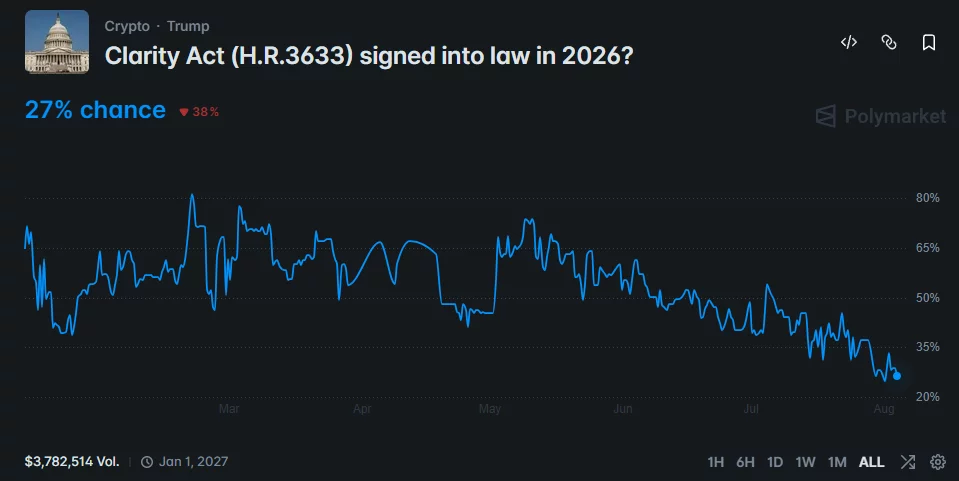
The falling odds reflect the bill’s narrowing legislative path rather than a formal defeat. Negotiations could continue during or after the recess, although a delay would leave less time before the U.S. midterm elections complicate the congressional calendar.
The legislation would establish a federal market-structure framework and clarify how the Securities and Exchange Commission and Commodity Futures Trading Commission divide oversight of digital assets.
Bernstein warns of another crypto sell-off
Bernstein analysts warned that a Senate failure to advance the bill could trigger an immediate decline in Bitcoin and the broader crypto market. They described the potential response as an industry “knee-jerk” sell-off capable of driving digital asset valuations through another leg lower.
“From a tactical standpoint, we expect the crypto market to bottom and start showing momentum towards late Q3 and early Q4 prior to the mid-terms,” the analysts wrote in a Monday client report.
Bernstein expects a legislative delay could also pressure the SEC and CFTC to issue more guidance through Project Crypto. That effort could cover token classifications, decentralized finance and a potential exemption for qualifying token issuances.
Regulatory guidance could provide temporary relief for U.S. crypto companies, but it would not carry the same permanence as a law passed by Congress. The White House’s response to the ethics compromise, and any cloture filing from Senate leaders therefore remain the next developments to watch.



Be the first to comment