



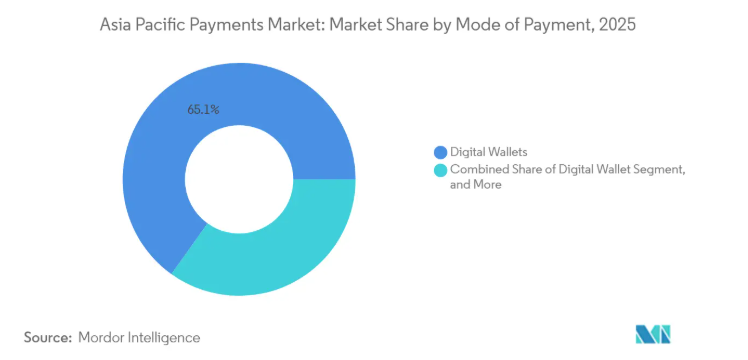
A new analysis by Mordor Intelligence published by Asian Banking & Finance on May 25 showed that digital wallets captured 65.12% of the Asia-Pacific (APAC) payments market in 2025. This was driven by QR codes, contactless payment technology, and wallets embedded in smartphones.
According to Mordor Intelligence, the transaction volume for digital wallets in APAC is projected to reach $21.15 trillion by 2031. On the other hand, traditional card networks are adjusting to this digital shift by using tokenization for secure transactions with digital wallets. The report said that Visa’s (NASDAQ: V) Token Service alone generated around $2 billion in incremental volume in APAC in 2024.
Buy Now, Pay Later (BNPL) also gathered uptake as it is being built directly into digital checkout systems, allowing users to access credit seamlessly. Another important factor driving digital wallets’ popularity in APAC is the widespread adoption of contactless point-of-sale systems in transport networks and fast-food restaurants, while real-time account-to-account payments are growing rapidly in countries like Singapore and Australia.
The report also showed that although cash usage continues to decline, it is still being used in rural areas.

In terms of end-user industry, retail accounted for 38.10% of payment volumes in 2025 in the Asia Pacific market, while healthcare is projected to expand at a 13.42% CAGR by 2031—emerging as the fastest-growing end-user—supported by telemedicine platforms and government subsidies embedded directly in digital wallets.
In Singapore, the unified QR code system used across 27 public hospitals has reduced waiting times and streamlined insurance processing, with private clinics now beginning to adopt the system.
“The healthcare payment opportunity extends into wearables that monitor chronic-disease patients and trigger micropayments for compliance milestones, thereby aligning incentives among payer, provider, and patient. Yet this data intensity raises privacy obligations, encouraging specialized processors that can store health information compartmentalized from payment credentials,” the report read.
Geographically, China retained 43.05% of 2025 transaction volume, driven by super-apps integrated with e-commerce, ride-hailing, food delivery, and personal finance. In India, a forecast CAGR of 14.05% is expected to drive the APAC payments market ahead of its global peers, thanks to the South Asian government’s zero-cost Unified Payments Interface (UPI) framework.
Additionally, South Korea, Taiwan, and Singapore maintain high transaction values per capita by layering cross-border instant payment features on top of their domestic rails. Japan and Australia focus on interoperability of domestic card schemes, account-to-account transfers, and offline central bank digital currency (CBDC) pilot tests.
In Southeast Asia, Indonesia, Vietnam, and the Philippines chart steep adoption curves; however, infrastructure in these countries remains hindered by power and poor internet connectivity. Lastly, Malaysia and Thailand leverage their geographic positions and serve as payment hubs, connecting other ASEAN settlement systems to “India, China, and eventually the Middle East, thereby monetizing FX spreads and treasury services.”
How digital wallets and payments are being adopted in APAC
A 2025 report by Global Payments found that over the past decade, digital payments accounted for more than 80% of all e-commerce transactions in APAC. Since 2014, digital payments have surged from 34% of e-commerce payments to 66% in 2024. Authored by Worldpay, the report included digital assets, digital wallets, and BNPL platforms under the digital payments category.
In India, UPI accounted for nearly 60% of all point-of-sale (POS) transactions, up from 2% in 2014, and is projected to reach 76% by 2030. Thailand’s PromptPay has a 41% market share, while Brazil’s Pix processed $35 billion in account-to-account payments last year, a massive increase from $1.2 billion in 2014.
More recently, in its 11th annual report, Global Payments revealed that APAC has led the world in digital wallet use. The regions accounted for 77% of online spending ($2.7 trillion) and 63% of in-person spending ($6.3 trillion) in 2025.
“By 2030, $4.1 trillion of U.S. spending is projected to take place through a digital wallet, which would represent a 64% increase from 2025,” Global Payments said.
Also, APAC leads the world in digital wallet payments, accounting for 77% of online spending and 62% of in-store spending in 2025, with direct card use accounting for just 15% of online spending and 20% of in-store spending.
Watch: How OnChain Labs Simplifies Digital Wallet Onboarding


Be the first to comment