



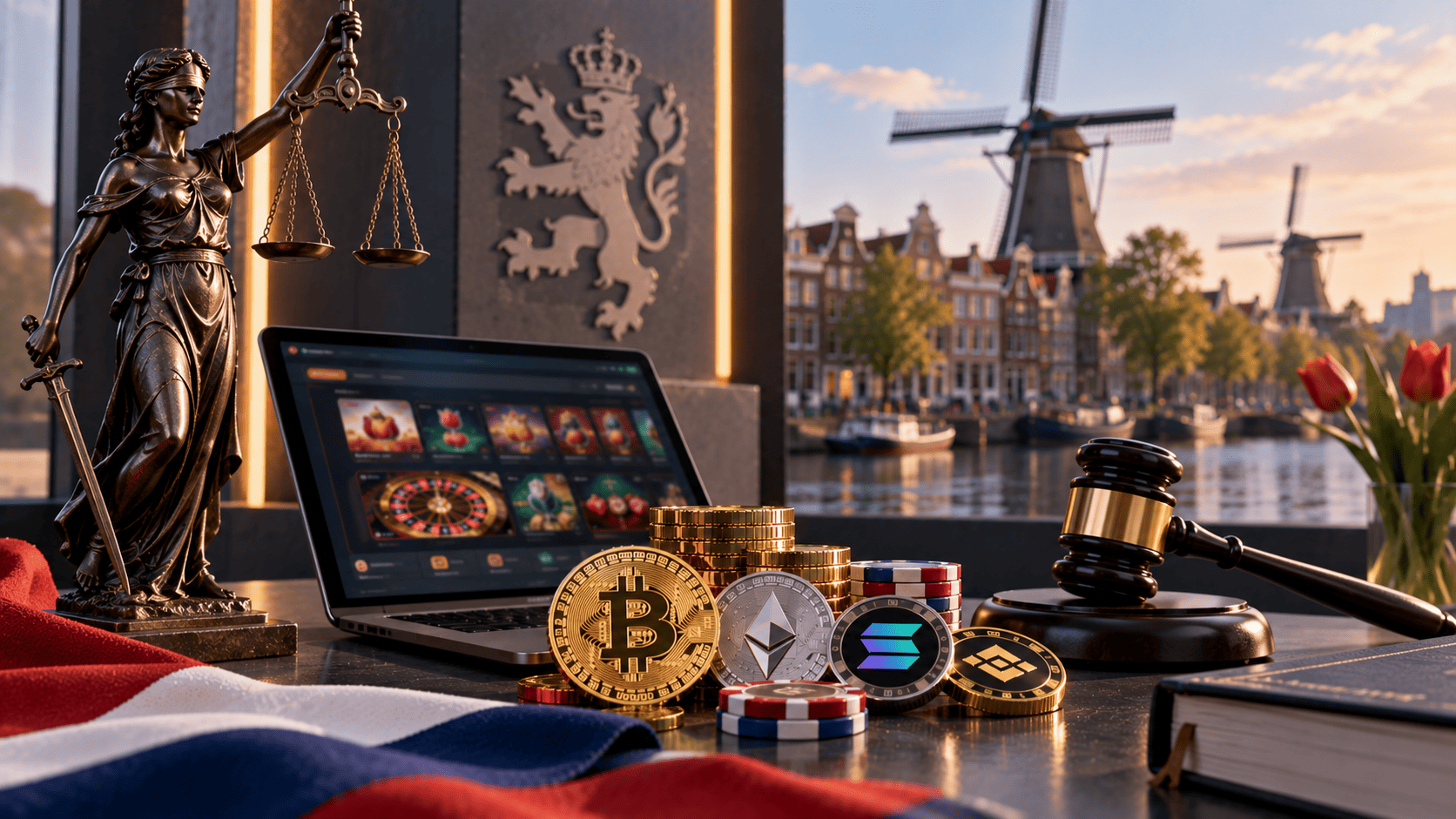
The Netherlands runs one of the more demanding licensing regimes in Europe, and it contains a payment rule that decides the crypto question before any other consideration arises.
Understanding what a KSA licence actually obliges an operator to do explains both what Dutch players get and what they leave behind.
Nothing here is legal advice, and anyone with a specific question should consult a professional in the Netherlands.

Six Obligations That Come With a KSA Licence
The Remote Gambling Act opened the licensed market on 1 October 2021, with online casino games and sports betting granted under a single remote gambling licence. Roughly 27 to 28 operators held one as of June 2026.
-
Connection to CRUKS. The central exclusion register blocks a registered person from every licensed Dutch platform for a minimum of six months, and every operator must check it before allowing play. It passed 100,000 registrations in late 2025.
-
Live regulator access to a control database. The KSA does not audit periodically and hopes it holds; licensees connect a control database that the regulator can see directly.
-
A statutory addiction-prevention and duty of care programme. Not a policy document, a running obligation with defined interventions.
-
Intervention thresholds at €300 and €700. These currently apply at operator or account level, not across the whole market. A cross-operator deposit limit with a financial-capacity assessment has been proposed but is not yet implemented, which is a meaningful distinction from the German model.
-
A near-total ban on untargeted advertising. Television, radio, print and public spaces are all closed to remote gambling advertising, and sports sponsorship by online operators is prohibited outright. A broader advertising ban was proposed in June 2026.
-
Only regulated payment methods. Licensed Dutch operators cannot accept cryptocurrency. This is the rule that settles the topic: a Dutch player using crypto is on an unlicensed site by definition, whatever else is true about that site.
A minimum age of 21 for the highest-risk products has also been proposed. It requires legislation and is not currently in force.
What the KSA Can Actually Do
Worth setting out, because the enforcement teeth here are sharper than in several neighbouring markets.
The regulator can impose administrative fines of up to €870,000 or 10% of annual turnover, issue binding instructions and cease-and-desist orders, suspend or revoke licences, and refer serious cases for criminal prosecution.
It also reaches promotion. Marketing unlawful gambling, including through affiliates, is itself prohibited under the framework, which is why Dutch-facing promotion of unlicensed sites looks very different from promotion in lighter jurisdictions.
That enforcement posture is aimed at operators and intermediaries. Dutch players are not the target of it, which is the same pattern seen across most European markets with a licensed regime.
The Trade a Dutch Player Makes
Two columns, stated honestly.
The licensed market provides certified games, protected player funds, a real complaints route, CRUKS, and a regulator with the powers above. Those are substantial protections and no offshore platform replicates them.
What it does not provide is crypto in any form, or the catalogue breadth and promotional generosity that an operator paying close to 40% of gross revenue in tax and levies cannot afford to offer.
Both halves are real. Anyone weighing the two should weigh them together instead of picking the half that suits the decision already made, and licensing quality is the variable that travels across every other comparison.
Offshore Platforms Dutch Players Reach For
Ordered by how much of the absent protection each one manages to substitute.
1. Dexsport
Dexsport is non-custodial, which speaks to the largest structural exposure of leaving a regulated market: settled play returns to a wallet you control, so there is no operator holding your balance and no protected-funds question to answer.
CertiK and Pessimistic have reviewed its contracts, and resolved bets are recorded on a public settlement desk.
None of that replaces CRUKS, and the point deserves stating without softening: the Dutch exclusion register does not extend offshore, so anyone who has relied on it is stepping outside its reach. The licence is Anjouan, lighter than Curacao or Malta.
2. Cloudbet
Operating since 2013 with its company named on a Curacao licence. A named legal entity with a long record is the nearest available substitute for a regulator holding real powers.
3. Stake
Carries market-specific licences in several jurisdictions alongside its offshore position, so what applies to you depends on which entity serves your access. Balances are custodial.
4. BC.Game
Under reformed Curaçao licensing with named beneficial owners on record, offering the catalogue breadth the Dutch tax burden has squeezed out of the licensed market.
5. Vave
A conventional catalogue funded across several chains, publishing noticeably less about its own licensing position than the four above.
Custody models differ across European-facing platforms, and it is one of the few things a player can verify independently.
Checking a Licence Before You Deposit
The Dutch version of this check is unusually easy, which is worth using.
Look for the KSA licence mark on the site, then confirm the legal entity name against the official KSA register instead of trusting the brand. Brands change, entities are what the licence attaches to, and the register is public.
If a site is not on that register, it is not licensed in the Netherlands. That does not automatically make it a bad operator, and it does mean the protections described above do not apply to it.
Confirm what is legal where you live, keep stakes within a set budget, and play only if you are of legal age, since KYC or AML checks may apply.
Responsible gambling is the specific thing at stake in this comparison, and CRUKS is a genuinely strong tool: anyone who has used it, or considered using it, should think carefully before playing somewhere it cannot reach.
Disclaimer: The information here is provided for general purposes only and is not legal, tax, investment, or financial advice. Dutch gambling law and tax treatment change, so confirm current provisions and consult a qualified professional about your own position. Betting carries risk, and rules vary by country, so check the law where you live. Please gamble responsibly, within your means, and only if you are of legal age.



Be the first to comment