




Former Ripple engineer Matt Hamilton has raised concerns over a proposed XRP Ledger (XRPL) change that would significantly expand the amount of data users can attach directly to transactions, warning that the move could put pressure on the network’s decentralization.
The proposal would increase the XRPL Memo field from its current 1 KB limit to roughly 1.3 MB, allowing users to store considerably larger files on the ledger. Supporters have argued that users should have the option to put content on-chain, provided they are willing to pay the associated fees.

Meanwhile, former Ripple developer relations director Hamilton strongly criticized the proposal, calling it “a really bad idea.”
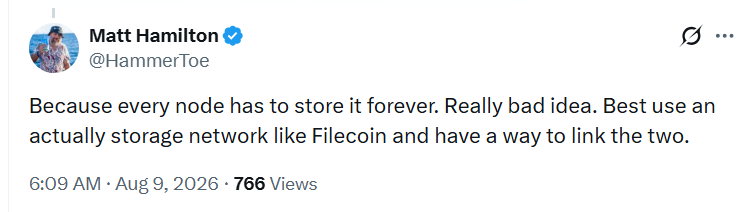
“Because every node has to store it forever. Really bad idea. Best use an actually storage network like Filecoin and have a way to link the two,” he noted.
His concern centers on how XRPL is designed to operate. Unlike a dedicated file-storage network, the XRP Ledger functions primarily as a distributed payment system, meaning network participants maintain copies of the ledger’s transaction history.

 
Consequently, allowing substantially larger files to be embedded in transactions could therefore cause the ledger’s data requirements to grow much faster than they do under its current design.
Hamilton warned that such growth could eventually increase the hardware and storage requirements for validators and other node operators. Higher operating costs could make it harder for smaller or independent participants to maintain nodes, potentially reducing network diversity.
Under the proposal, the expansion could support content such as images, PDFs, music, short videos, source code, and compressed archives. While that would broaden what users can place directly on XRPL, it also raises questions about whether a payment-focused blockchain should be responsible for permanently carrying large amounts of media data.
Notably, the concern is less about whether XRPL can technically process larger transactions and more about the long-term consequences of making substantial on-chain storage part of the network’s normal use.
If large files become common, the ledger’s cumulative size could increase significantly over time. That could translate into greater storage demands for validators and potentially raise the barrier to running independent infrastructure.
Hamilton pointed to decentralized storage networks such as Filecoin as a more suitable option for handling large files.
In his view, XRPL could continue to handle payments and other ledger activity while specialized decentralized storage systems manage heavier data. This would allow users to connect blockchain transactions with external files without turning the payment ledger itself into a large-scale data repository.
That said, Hamilton believes keeping the ledger relatively lightweight is important to maintaining broad participation. The proposed Memo expansion could offer new functionality, but he argues that the additional storage burden warrants careful consideration before adopting such a change.



Be the first to comment