



Artificial intelligence (AI) has moved well beyond being a novelty in Southeast Asia.
For millions across the region, it’s no longer just a chatbot that answers questions. It’s becoming a study partner before exams, a marketing assistant for small businesses, a travel planner, a brainstorming companion, and even a second opinion before publishing politically sensitive content online.
That shift was on full display during Google’s (NASDAQ: GOOGL) recent Southeast Asia media event, where executives shared regional adoption trends. But it was the stories from everyday users that painted the clearest picture of how AI is becoming woven into daily life.
Rather than talking about what AI could do, students, creators, and entrepreneurs showed what they’re already doing with it.

The diversity of Southeast Asia means AI adoption doesn’t follow a single pattern.
According to Google’s regional findings, students in Vietnam are using Gemini to prepare for exams, Indonesian entrepreneurs are creating marketing materials and visuals for their businesses, Thai fitness influencers are planning healthy meal ideas, while developers in Singapore are building AI prototypes. The company says active Gemini users in Southeast Asia have more than doubled over the past year, with nearly three out of four interactions happening on mobile devices.
Samuele Saini, Director of Google Ads Solutions & Insights for Southeast Asia, said the variety of use cases surprised even Google.
“Gemini is more than a chatbot. We built it as a powerful personal assistant that gets things done.”
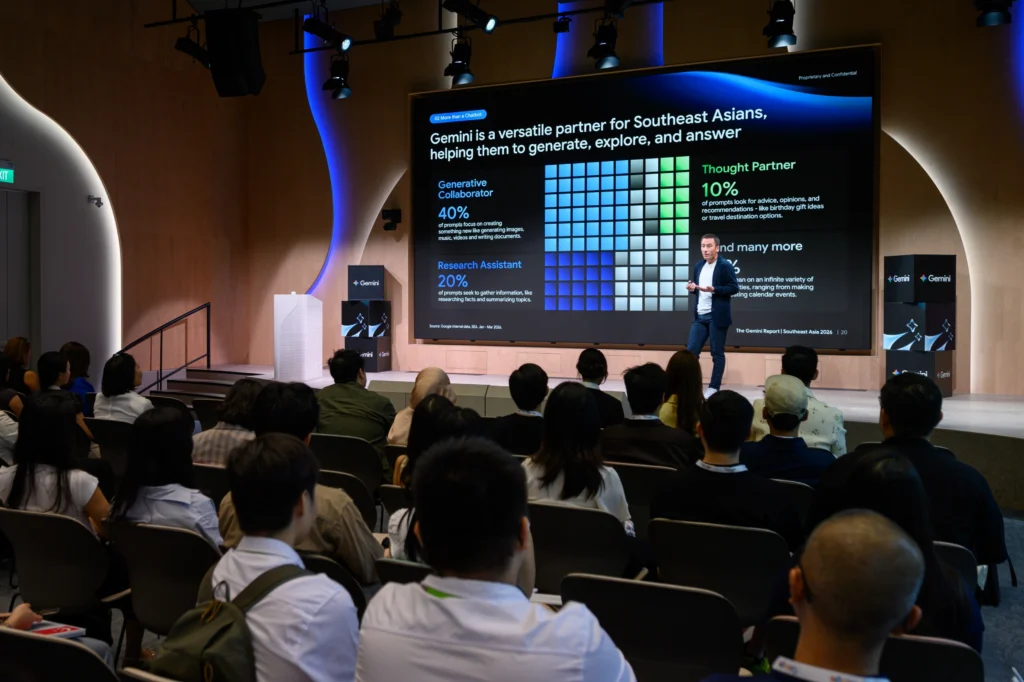
Instead of using AI for one specific purpose, users constantly switch roles: researcher, writer, tutor, designer, or planner, depending on what they need at the moment.
Google groups those interactions into three broad categories. Around 40% of prompts involve creating something new, such as text, images, music, or videos. Another 20% focus on research and summarizing information, while 10% involve deeper conversations where users seek advice, brainstorm ideas, or troubleshoot problems.
The statistics, however, only tell part of the story. To illustrate how AI is being used beyond the numbers, Google invited three Gemini users from across Southeast Asia to share their experiences.
For Vietnamese student and Google Student Ambassador, Gem, AI isn’t replacing learning; it helps her spend more time understanding her lessons.
“Gemini is helping me spend less time for my time management and spend more time actually learning.”
She explained that she relies on Gemini’s Deep Research feature for university assignments, using it to synthesize information from multiple sources before focusing on her own analysis. During exam season, she creates quizzes and flashcards to identify gaps in her knowledge instead of simply asking for answers.
“I really believe that everyone should have opportunities to learn regardless of where they come from,” she said. “Gemini actually makes learning more equal across Southeast Asia.”
Thai lifestyle creator Nonny uses AI in a completely different way.
Like many content creators, she spends hours planning shoots, scouting locations, and writing captions. Now, she asks Gemini to suggest aesthetic cafés, map out efficient travel routes, and even generate infographics she can send to her production crew.
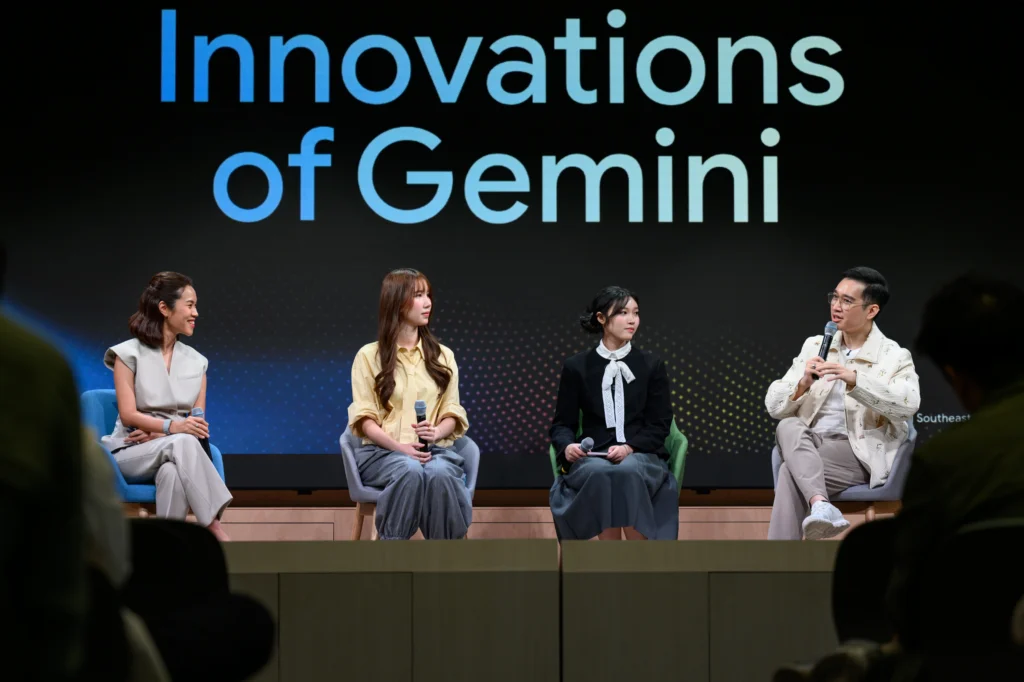
When writing captions, she said Gemini understands local internet culture surprisingly well.
“I asked Gemini for café hopping captions because we always worry about writing captions that don’t look cringe,” she laughed.
It even suggested trendy Thai slang without being specifically prompted.
As a young entrepreneur, Nonny also uses Gemini to rehearse business pitches by asking it to role-play as a marketing director asking difficult questions before real presentations.
For Indonesian entrepreneur and content creator Raymond Chin, AI plays a much higher-stakes role.
His online content often covers subjects where factual accuracy matters, such as finance, politics, and economics: “The most often prompt that I ask Gemini is… I send my YouTube link and ask the question, ‘Is it safe? Will I go to jail or not?’”
He joked that Gemini has “single-handedly helped me stay out of jail,” explaining that it helps verify facts, citations, and local context before publishing potentially sensitive content.
Their stories were personal, but they also reflected broader trends emerging across the region.
One of the lighter moments during the event came in the form of a game called “Secrets of Gemini,” where attendees guessed which Southeast Asian country matched various AI habits. The answers revealed just how differently each market is embracing AI.
Indonesia generates around nine million AI-created images every day, the highest volume in the region, with many users relying on voice commands and images instead of typing.
Singapore, meanwhile, records the region’s highest daily engagement. Users tend to spend weekdays analyzing data and debugging code before switching to personal finance and travel planning over the weekend.
Thailand stands out for lifestyle-related prompts, from healthy recipes to home décor ideas, and even older users are embracing AI by using voice commands and photos while shopping.
The Philippines emerged as the only market in Southeast Asia where female users outnumber male users on Gemini. According to Google, Filipinos commonly use AI for academic work, creative writing, and customer support tasks, reflecting the country’s strong education sector and business process outsourcing industry.
Malaysia, meanwhile, has the highest percentage of users generating AI images, while Malay-language interactions have doubled over the past year.
Another notable trend is language itself.
Rather than communicating primarily in English, 7 out of 10 prompts across Southeast Asia are now written in local languages.
“Language should never be a barrier for new technology,” said Ning from Google’s consumer marketing team.
Beyond productivity and creativity, the discussion also turned to one of AI’s biggest challenges: trust.
During the media Q&A, executives were asked about misinformation, education, sustainability, and the growing trend of people using multiple AI platforms instead of remaining loyal to one.
Sapna Chadha, Google’s Vice President for Southeast Asia and South Asia Frontier, emphasized that innovation must go hand in hand with trust.
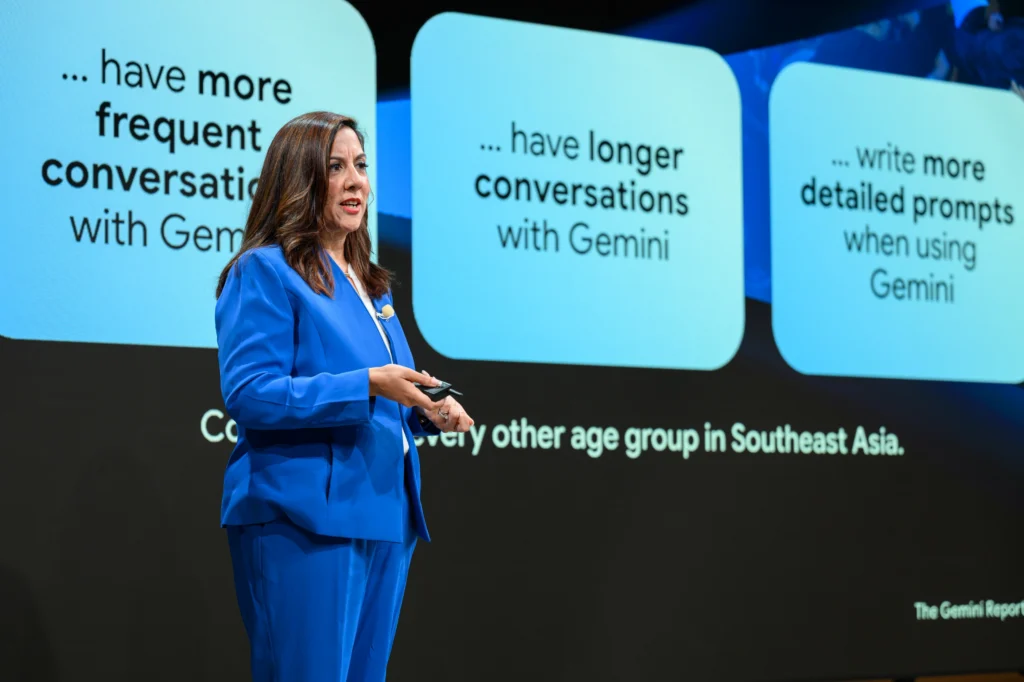
“We believe that innovation and safety… can work hand in hand.”
She pointed to technologies like SynthID, Google’s watermarking system for AI-generated content, alongside years of investment in detecting spam, abuse, and malicious content.
The company was also asked whether students might become overly dependent on AI.
Rather than encouraging shortcuts, Saini argued that Gemini is designed to guide learning, saying, “Instead of giving straight out the solution, Gemini engages in a two-way conversation… it’s about creating a learning path.”
Questions about AI’s environmental impact also surfaced, particularly as new data centers continue to be built across Southeast Asia. Chadha said Google considers sustainability when selecting locations and infrastructure, while Saini added that newer AI models are becoming increasingly energy efficient.
Perhaps one of the most interesting exchanges came when Google acknowledged that users are increasingly working across multiple AI platforms.
Instead of viewing that as a threat, Saini welcomed the competition.
“I think this is a very competitive space,” he said. “It actually helps the entire industry… become more helpful for users.”
While AI headlines often focus on larger models and faster performance, conversations at Google Singapore suggested that something more meaningful may already be happening.
The most compelling stories weren’t about algorithms or benchmarks.
They were about a university student preparing for graduation, a creator trying to write a better Instagram caption, an entrepreneur practicing investor pitches, and another carefully fact-checking videos before hitting publish.
In other words, AI’s biggest milestone in Southeast Asia may not be the number of people using it. It’s that, for many, using it is starting to feel completely ordinary.
In order for artificial intelligence (AI) to work right within the law and thrive in the face of growing challenges, it needs to integrate an enterprise blockchain system that ensures data input quality and ownership—allowing it to keep data safe while also guaranteeing the immutability of data. Check out CoinGeek’s coverage on this emerging tech to learn more why Enterprise blockchain will be the backbone of AI.
Watch | Inside Philippine Blockchain Week 2026: Driving the Future of Blockchain, AI & Web3



Be the first to comment