


Restaking lets staked assets secure more than one system. In Ethereum, a validator already takes on normal proof-of-stake responsibilities. Restaking adds another layer by letting that stake support additional services, often called Actively Validated Services, or AVSs.
The reward is extra yield or incentives. The trade-off is extra risk. If the operator fails the rules of a service it opted into, part of the delegated stake can be slashed. AVSs can slash operators that have delegated stake inside their operator sets, and slashing rules can be defined by the AVS.

That is the core risk. Restaking does not only reuse capital. It reuses security promises. The same stake can become accountable to several systems at once.
How Ethereum Slashing Works First
Ethereum already has slashing before restaking enters the picture. A validator can be slashed for serious consensus failures, such as proposing conflicting blocks or making slashable attestations. Slashed validators lose some ETH and are forced out of the validator set over a withdrawal period.
This base-layer slashing is narrow. It targets behavior that harms Ethereum consensus. Good validator operations reduce the chance of accidental slashing through proper key management, no duplicate validator instances, stable infrastructure, and careful failover design.
Restaking expands the risk surface. The operator still needs to run Ethereum correctly, but now may also need to run AVS software, meet uptime rules, sign correct messages, verify extra data, operate middleware, or satisfy service-specific commitments.
What Changes With Restaking
In restaking, operators take on extra duties. A restaker delegates stake to an operator, and that operator may opt into one or more AVSs. Each AVS can define conditions that must be followed. If an operator breaks those conditions, a slash can reduce the stake allocated to that service.
For example, EigenLayer’s 2025 upgrade made this more concrete. Slashing went live on mainnet as part of the protocol’s move toward economic enforcement for verifiable services. That changed restaking from a mostly reward-and-points story into a real accountability system.
The key difference is that restakers may not operate the infrastructure themselves. They choose an operator. If that operator makes a mistake, accepts too much risk, misconfigures software, or joins weak AVSs, delegated restakers can share the loss.
How One Mistake Can Cascade
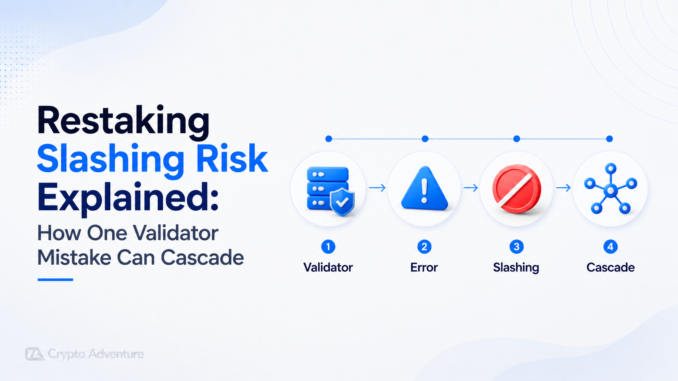
A single validator or operator mistake can cascade when the same operational setup supports multiple duties. The mistake may start small: a duplicate key, a wrong binary, a bad upgrade, downtime, incorrect signing, a faulty AVS client, or a misread service rule.
In plain Ethereum staking, the damage may stay inside Ethereum’s slashing rules. In restaking, the same operator may also be responsible for AVS commitments. If the failure affects several AVSs, the operator can face multiple penalties, reduced delegated stake, loss of reputation, exit delays, and lower future delegation.
The risk is not always malicious behavior. Bugs can matter. EigenLayer’s early whitepaper discussed the danger of unintentional slashing vulnerabilities in newer AVSs, where a programming bug or design flaw could trigger losses for honest users before the service is battle-tested.
Operator Sets And Unique Stake
EigenLayer’s slashing design introduced concepts such as operator sets and unique stake. Operator sets let AVSs organize which operators secure which tasks. Unique stake helps isolate slashable commitments so the same portion of stake is not blindly reused everywhere.
The ELIP-002 slashing design gives AVSs a way to slash stake when commitments are broken, while unique stake and operator sets make allocation more precise. This matters because restaking without isolation can create unclear risk stacking. A restaker needs to know which operator, which AVS, which allocation, and which slashing rules apply.
This is where restaking becomes more like risk underwriting than simple staking. The user is not only asking whether an operator has uptime. The user is asking which external services that operator secures and how much stake is exposed to each.
Main Slashing Triggers
The first trigger is incorrect computation. If an AVS expects operators to produce or verify data and the operator signs a wrong result, the AVS may slash.
The second trigger is liveness failure. If an operator promises availability and fails to perform during required windows, the AVS may impose penalties.
The third trigger is equivocation. If an operator signs conflicting messages or supports two incompatible states, that can be treated as serious misconduct.
The fourth trigger is software or configuration failure. An operator running outdated code, duplicate systems, weak failover, or poorly secured keys can create slashable behavior without intending harm.
The fifth trigger is AVS design risk. A service with unclear rules, weak dispute logic, or buggy contracts can create slashing outcomes that honest operators did not expect.
Why Restakers Must Care About Operators
Restakers are exposed to operator quality. A high-yield operator may look attractive, but that yield may come from joining riskier AVSs or taking on more commitments than the infrastructure can safely handle.
The better review starts with operational discipline. Restakers should look for operators with clear infrastructure practices, conservative AVS onboarding, public risk disclosures, monitoring, incident response, upgrade procedures, and transparent delegation terms.
Operator diversification can help, but it is not a full solution. If many operators use the same client, cloud provider, AVS software, or automation setup, a shared failure can still affect them together. Correlation matters more than the number of operator names in a portfolio.
How To Assess Restaking Risk
Restakers should first separate base Ethereum staking risk from AVS risk. Ethereum staking risk is tied to validator duties. AVS risk is tied to extra services. Combining them creates a larger risk map.
Next, users should check which AVSs an operator supports. A mature AVS with clear slashing rules is different from an experimental service with new code and uncertain enforcement.
Then, users should check allocation. Not every restaked asset has the same exposure. Operator sets and unique stake can change which portions are slashable for which services.
Finally, users should compare rewards against risk. Extra yield is not free. It is compensation for taking on more technical, contractual, smart contract, and operational exposure.
What Good Risk Management Looks Like
Good restaking risk management starts with conservative delegation. Users should avoid chasing the highest reward without understanding the operator’s AVS mix.
It also requires ongoing monitoring. Restaking is not a set-and-forget product. AVSs can upgrade, slashing rules can change, operators can opt into new services, and risk can increase after the initial deposit.
Risk-aware users should prefer operators that explain slashing exposure clearly, avoid excessive AVS stacking, publish incidents, and maintain disciplined key management. They should also understand withdrawal timing because exiting after a risk appears may not be instant.
Conclusion
Restaking slashing risk is the cost of reusing Ethereum security across extra services. The model can make new protocols safer and give stakers extra rewards, but it also expands the failure surface.
One validator mistake can cascade when an operator secures several AVSs, runs shared infrastructure, signs incorrect messages, misses service duties, or joins poorly designed systems. Restakers should treat operator choice as risk selection. The strongest protection is not chasing the highest yield. It is understanding who operates the stake, which AVSs are attached, what can be slashed, how exposure is allocated, and whether the reward is worth the added risk.


Be the first to comment