



The Hyperliquid Policy Committee (HPC) has submitted its first regulatory filing outside the United States, responding to the European Commission’s review of the Markets in Crypto-Assets Regulation (MiCA). The committee is asking EU policymakers to adapt existing financial rules to on-chain perpetual contracts rather than create a separate regulatory framework.
HPC Urges MiCA to Follow Economic Substance Rules
The HPC said crypto products should be classified according to their economic substance and functionality rather than their technological form. It proposed that on-chain perpetual contracts be addressed through the existing MiFID II framework and ESMA guidance, without requiring new legislation. The approach would place the regulatory focus on how the product functions rather than whether it operates through blockchain infrastructure.
The European Commission launched its targeted MiCA consultation on May 20 to assess whether the framework remains fit for purpose following its implementation and changes in digital-asset markets. The Commission said responses would contribute to its review of MiCA and could inform future legislative proposals. The consultation deadline was extended to September 30, 2026.
Also Read: CZ-Hyperliquid Finally Welcomes HYPE After 664-Day Debut

Public Order Books Set Perpetuals Apart From CFDs
A central part of the HPC submission concerns how regulators distinguish perpetual contracts from traditional contracts for difference. The committee argues that Hyperliquid-style perpetuals trade through transparent central limit order books, rather than the bilateral structure associated with conventional CFDs. It therefore opposes automatically applying retail restrictions designed specifically for CFD products.
The distinction could affect how on-chain derivatives are offered to European users if the Commission changes or clarifies MiCA-related rules. The HPC argues that applying identical requirements to structurally different products could create unnecessary restrictions on on-chain markets. Its position is a policy proposal rather than an indication that EU regulators have accepted the classification.
Blockchain Data Could Reduce Duplicate Reporting Duties
The HPC also asked regulators to recognize that public blockchains already provide continuously accessible transaction records. It argues that regulated institutions should not have to submit duplicate reports for information that is already verifiable on-chain. The proposal could reduce compliance costs if European regulators eventually incorporate blockchain-native reporting into supervisory processes.
The issue is relevant as European regulators continue developing rules for crypto-asset service providers. MiCA established a harmonized framework for crypto-assets, issuers and service providers, but the Commission is now examining whether adjustments are required as market structures evolve. The HPC’s submission therefore places on-chain transparency directly within the broader debate over how supervision should work in blockchain-based markets.
Hyperliquid Price Shows Volatility Amid Regulatory Push
The policy submission comes as Hyperliquid trades below its September highs. CoinGecko data shows Hyperliquid closed at $93.98 on September 23 before falling to $86.04 on September 29, while September 30 data showed market capitalization around $19.14 billion and daily trading volume of about $668 million. This price movement provides market context but does not establish that regulatory developments caused the decline.
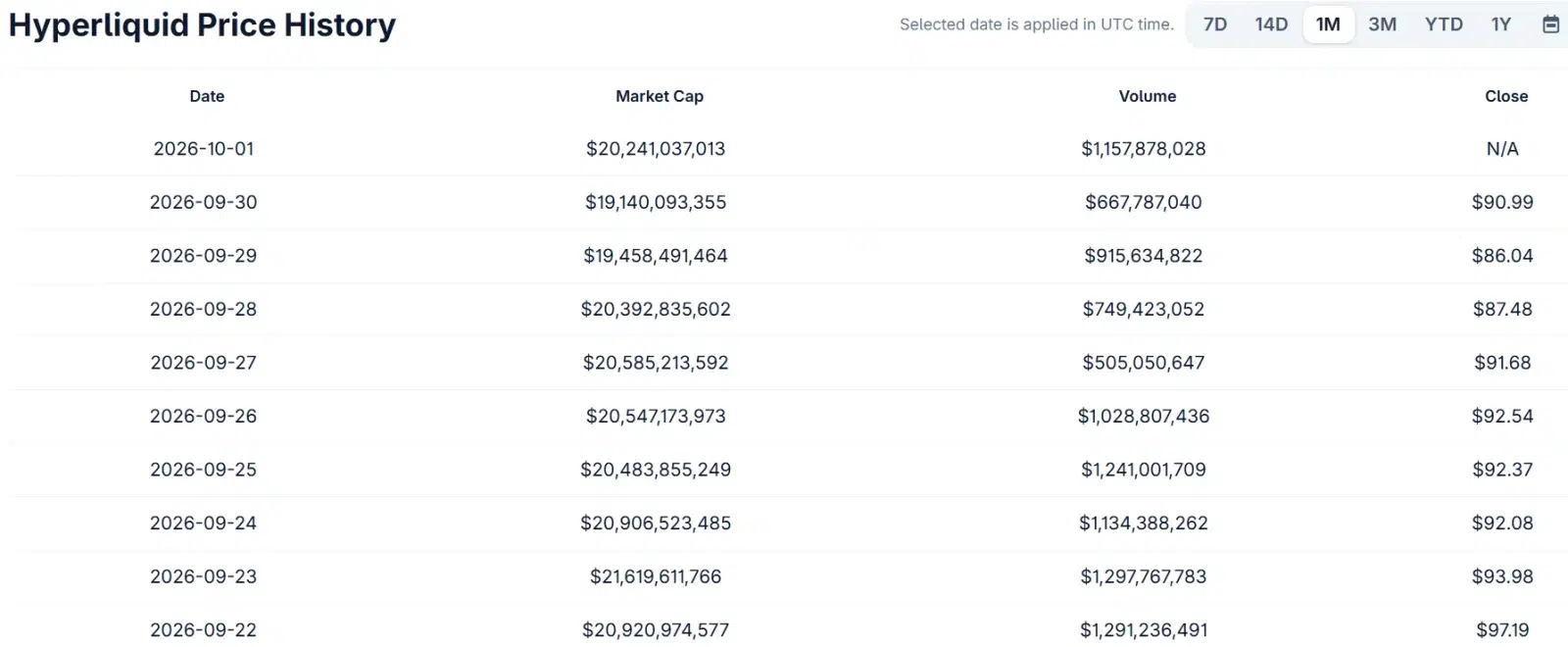
Hyperliquid’s regulatory push also follows increased attention on on-chain perpetual markets in the United States. The HPC has previously engaged with U.S. policymakers over pathways for bringing on-chain derivatives into the domestic regulatory framework, while regulatory debates around perpetual classification continue. The European submission now gives the committee an additional jurisdiction in which to argue for rules designed around the structure of on-chain markets.
Also Read: HYPE Price Holds Key Support as Hyperliquid Burns Nearly $1 Million


Be the first to comment