



Hyperliquid’s October team allocation has begun moving after its required seven-day staking-to-spot wait.
The reported OTC deal may have kept 3.75 million HYPE away from public order books, yet the transfer trail leaves the market with new questions about who now controls the tokens and what happens next.
The seven-day staking-to-spot wait has ended
Hyperliquid’s staking rules require more than a request to unstake. Its official documentation says that moving HYPE from a staking balance to a spot balance takes seven days, after which the tokens become available to move.
According to a September 30 message in Hyperliquid’s official Discord attributed to co-founder iliensinc, “Hyperliquid Labs has entered an OTC deal to sell 3.75M tokens to an institution for the October team unlock.” The message added that the batch would not be sold on the open market.
The waiting period has now ended. Wu Blockchain identified a 3.75 million-HYPE staking transfer in the Hyperliquid Labs account it tracks, placing the full block into spot balance. At the market price around the time of the transfer, the tokens were worth roughly $330 million.
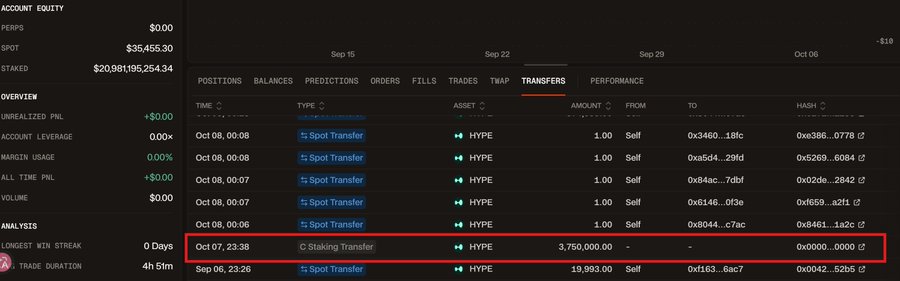
Five addresses show a route, not five named buyers
Onchain Lens also published five recipient addresses that each received 375,000 HYPE. Together, those transfers account for 1.875 million HYPE, or half of the allocation discussed in the Discord message.
The five equal transfers need to be read carefully because the team’s statement referred to one institutional counterparty. A fund, custodian or trading desk may use several wallets for custody, internal bookkeeping or staking. At the same time, a public ledger cannot confirm that the five addresses are controlled by the same institution.
For that reason, “recipient addresses” is more accurate than “five OTC buyers.” The chain can show where the tokens went; it cannot attach a legal owner, deal agreement or investment strategy to an address.
A private sale changes the first destination of supply
An OTC transaction allows the team to transfer a large token block to an agreed counterparty without placing a matching sell order on a public exchange. That can avoid the immediate pressure that might follow if $330 million of HYPE were offered directly into visible order books.
The deal does not settle what happens after the transfer. No public disclosure identifies the buyer, shows the price paid or says whether the HYPE is subject to a holding period. The reported market value is therefore not a confirmed transaction value, and the team’s commitment not to sell publicly does not establish what a future holder may do with the tokens.
The broader contributor schedule keeps the transfer relevant
Hyperliquid also has a separate demand mechanism, although it cannot be treated as an automatic offset to new supply. USDC reserve income has begun flowing toward the Assistance Fund, which is designed to purchase HYPE under the protocol’s buyback model. That income may support token demand over time, but it does not reveal the OTC buyer’s plans or guarantee that the October allocation will remain off exchanges.
The unanswered terms matter because the batch sits within a wider core-contributor allocation. A public SEC filing for a HYPE-focused treasury company describes roughly 238 million HYPE as vesting to core contributors over a multi-year period. The filing also warns that large holder sales can affect market price when demand does not keep pace with new liquid supply.
That general risk statement does not show that the institution in this deal intends to sell. It explains why the October transfer deserves more attention than a routine wallet movement. A scheduled allocation, a completed staking-to-spot transfer and a market sale are three separate events. The current record confirms the transfer; it does not show the OTC price or establish what the recipient may do with the HYPE later.
Future transfers will answer more than the headline did
The other 1.875 million HYPE was not included in the five equal transfers identified in Onchain Lens’ October 7 post. Further transfers, restaking activity or movement toward exchange-linked addresses would provide the next evidence of how the allocation is being handled.
Those signals will not prove the buyer’s identity on their own. They can, however, show whether the October allocation is being parked, restaked or moved toward broader market access.
For now, the evidence supports a narrow conclusion. Hyperliquid’s 3.75 million-HYPE team allocation completed its required transfer from staking to spot balance, while half of it moved into five identifiable recipient addresses. The buyer, purchase price and resale restrictions remain private—the terms most relevant to the batch’s longer-term effect on the market.
This article is for informational purposes only and does not constitute investment or trading advice. On-chain records can verify transfers and balances, but cannot independently identify wallet owners or reveal the terms of private agreements.

Kosta has reported on cryptocurrency markets and blockchain infrastructure since 2020, bringing over six years of hands-on experience in the crypto industry built through daily tracking of markets, trends, and emerging blockchain developments. Specializing in Bitcoin on-chain analysis, institutional ETF flows, and digital asset price action, his work at Coindoo has been cited by other news agencies and consistently covers market developments with a focus on data-driven reporting across Bitcoin, Ethereum, Solana, and XRP.
Over the years, Kosta has contributed to multiple crypto media outlets in different regions, authoring over 6,000 articles across the sector. His reporting spans cryptocurrency markets and the broader fintech industry, tracking not only price action but also the technological and regulatory forces shaping the ecosystem.
To support his analysis, Kosta actively leverages on-chain data and metrics from leading platforms such as Santiment, Glassnode, and CryptoQuant, enabling deeper, evidence-based market insights. He believes in the power of transparency and the data that underpins the blockchain ecosystem.
His academic background in Marketing Management from Denmark further complements his analytical approach, adding a strong understanding of communication strategy and content positioning to his work.



Be the first to comment