



AI Summary
- The supplied source reports that the IMF has placed XRP Ledger and Stellar within a wider examination of tokenized financial markets.
- French sovereign borrowing pressure illustrates why policymakers are examining alternative market infrastructure, but it does not prove an imminent monetary collapse.
- Tokenization could improve market access and settlement while introducing new operational, liquidity and regulatory risks.
- Bitcoin’s monetary thesis remains distinct from the institutional tokenization cases associated with XRP Ledger and Stellar.
The familiar crypto narrative is that sovereign debt stress automatically validates digital assets. The more concrete development in the supplied source is narrower: the IMF reportedly placed XRP Ledger and Stellar within its examination of tokenized finance while pressure was building around French government borrowing.
That combination matters without proving that a monetary collapse or crypto led recovery is imminent. Rising sovereign funding costs can create demand for more efficient capital markets, but tokenization does not remove credit risk, fiscal constraints or the possibility of disorderly repricing.
Our analysis is that two separate theses are converging. Bitcoin is being presented as an alternative monetary asset, while XRP Ledger and Stellar are being evaluated as potential infrastructure for issuing, moving and settling tokenized claims. Those roles can coexist, but they should not be treated as interchangeable.

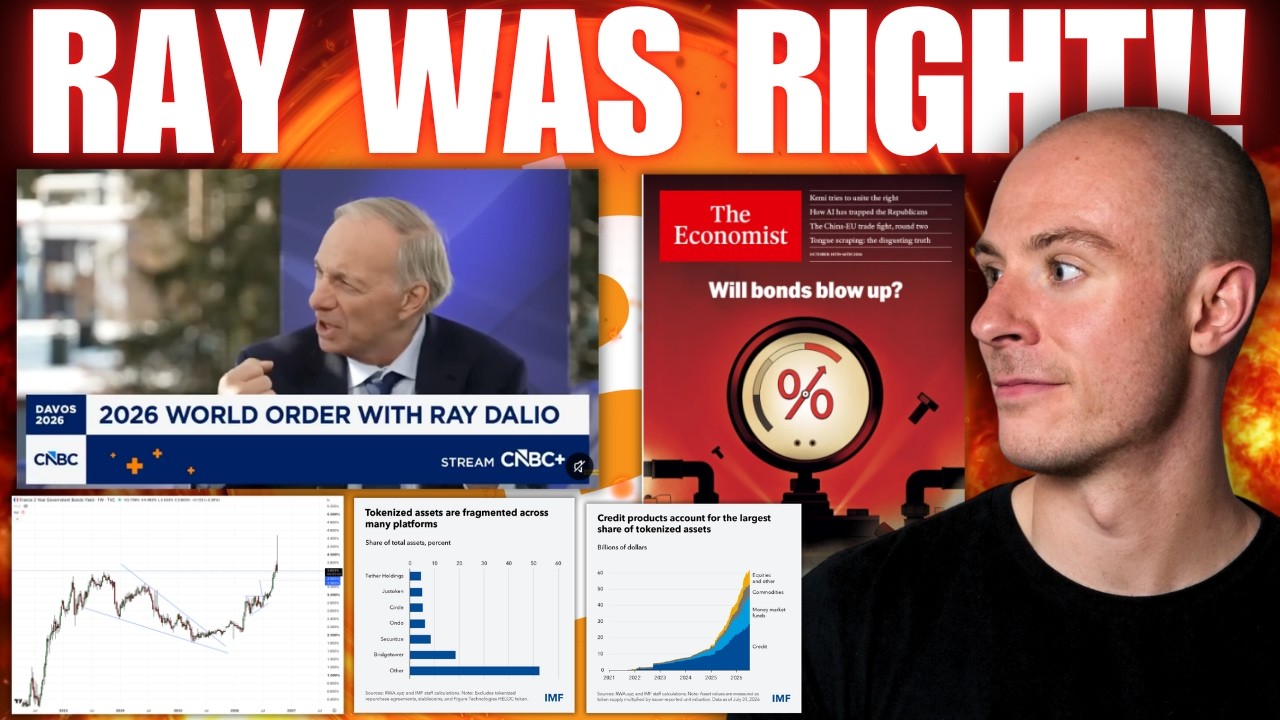
RAY WAS RIGHT! France Bond Market Collapse! Trigger Bailouts? IMF $300 Trillion Can Be Tokenized….
France’s bond stress changes the tokenization backdrop
The supplied source reports that France intends to borrow a record 340 billion as pandemic era obligations mature. It also claims that French borrowing rates have reached levels last observed during the 2008 financial crisis. No French government document or bond market dataset was supplied alongside the transcript, so those figures should be understood as source claims rather than independently verified statistics.
The more unusual claim is that 215 billion of corporate bonds were trading at lower spreads than government bonds, described as 18 times the January level and equivalent to 38% of the investment grade market. If accurate, that would indicate that a substantial section of the market was assigning greater relative risk to the sovereign than to certain companies.
- Sovereign refinancing: Higher yields make rolling existing obligations more expensive and can narrow a government’s fiscal room.
- Bank exposure: Stress in French government bonds could affect institutions holding those securities, although the source provides no bank level exposure data.
- Policy response: Bailouts or central bank support are possible scenarios raised by the commentary, not confirmed plans.
Calling France bankrupt would go beyond the evidence. A sovereign financing squeeze can be serious without amounting to insolvency, and the source itself acknowledges that central banks retain monetary tools. The defensible conclusion is that debt markets are testing confidence in fiscal management and the price of sovereign risk.
Capital flows are part of the monetary contest
The broader argument concerns the connection between trade, capital flows and demand for government debt. Countries running deficits depend on investors and official institutions remaining willing to hold their liabilities. The source links this question to changing central bank behavior, the performance of gold and concern about continued issuance of US dollar denominated debt.
“Maybe there’s not the same inclination to buy US debt”
This is a scenario rather than a demonstrated capital strike. The transcript supplies no holder level flows or official reserve data. Even so, the underlying mechanism is relevant: weaker marginal demand can raise borrowing costs, while higher yields can feed back into budgets, banks and asset valuations.
- Trade balance: Cross border commerce creates corresponding financial claims and funding relationships.
- Reserve behavior: Changes in demand for the US dollar, sovereign debt or gold can alter relative financing conditions.
- Confidence: Market power depends partly on the ability to borrow consistently and at manageable cost.
We therefore see France as an illustration of a wider funding debate, not proof that the existing monetary system is ending. The distinction matters because a gradual redistribution of capital can produce volatility without delivering the abrupt reset anticipated by the most aggressive crypto thesis.
What the IMF’s tokenization signal actually supports
The supplied material states that the IMF released chapter 3 of its October 2026 Global Financial Stability Report and highlighted XRP and XLM ledgers. It describes the work as an examination of scaling tokenization, potential efficiencies and new vulnerabilities. Because no primary IMF document URL was provided, we cannot independently establish the precise treatment of either network or whether their inclusion represented endorsement, technical illustration or risk analysis.
“Tokenized assets have grown rapidly, reaching roughly 65 billion yet remain tiny compared to the traditional uh capital markets at 300 trillion in assets.”
Even taken at face value, that comparison shows how early tokenized assets remain. A roughly 65 billion market would represent only a small fraction of the cited 300 trillion traditional asset base. The opportunity is therefore substantial, but so is the gap between experimentation and system wide adoption.
- Potential efficiency: Tokenized instruments may support continuous transfer and more programmable settlement processes.
- Market access: The source says more than half of tokenized trading occurs outside traditional market hours.
- New vulnerabilities: Always available infrastructure can transmit operational or liquidity problems beyond conventional trading sessions.
- Stablecoin dependencies: References to Tether and Circle indicate that stablecoins are part of the institutional policy discussion.
The IMF tokenization outlook should consequently be read as evidence of institutional attention, not as a promise that any protocol will capture a meaningful share of global financial activity.
XRP Ledger and Stellar face an institutional test
XRP Ledger and Stellar occupy a different position from a conventional sovereign bond market. They are settlement networks whose relevance depends on adoption, integration, compliance and the quality of assets issued on their rails. An IMF reference may increase visibility, but it does not establish transaction volume, revenue or lasting demand for XRP or XLM.
Recent AllinCrypto coverage has examined the same institutional question from several directions. A European stablecoin initiative on XRP Ledger provides one application level example, while our analysis of Stellar’s institutional tokenization test focuses on whether announced infrastructure develops into sustained use.
Those distinctions are important because tokenization can occur on several competing public and permissioned systems. A ledger may provide technical capacity without becoming the dominant venue. The strongest evidence will come from identifiable issuance, settlement activity and durable connections to regulated market infrastructure, not from inclusion in a policy report alone.
Bitcoin’s monetary thesis remains separate
The source links contemporary bond stress to Bitcoin’s creation during the 2008 financial crisis. That historical framing supports a monetary hedge thesis: an asset with rules outside discretionary sovereign issuance may become more attractive when trust in debt or fiat currencies weakens.
It does not follow that every sovereign funding problem must raise Bitcoin’s price. Near term stress can strengthen the dollar, lift yields, reduce market liquidity and pressure volatile assets. Our earlier examination of a Bitcoin monetary reset thesis similarly treated the case as conditional rather than inevitable.
“crypto has had a bit of a headwind due to this kind of uncertainty.”
The source also presents a technical scenario in which Bitcoin holds an inverse head and shoulders pattern and continues toward 116K if the dollar rolls over. That is an attributed market forecast, not an AllinCrypto price target. No supporting chart, timeframe methodology or invalidation level beyond holding the pattern was supplied.
Liquidity stress could cut both ways for crypto
The central tension is timing. Fiscal or banking stress can initially create forced selling and demand for liquid currency. A later policy response could reverse those conditions if authorities provide substantial liquidity, but the scale, transmission and market impact of any response remain uncertain.
“there is going to be volatility I think as a result of that.”
The commentary anticipates that headwinds could become tailwinds through bailouts resembling responses to earlier crises. That is plausible as a scenario, but neither a bailout nor a new international monetary agreement is confirmed by the supplied evidence. France’s borrowing costs alone cannot establish the arrival of a new Bretton Woods style settlement.
For crypto markets, we would monitor three separate channels: sovereign yields, the direction of the US dollar and verified institutional deployment of tokenized assets. Combining them into one inevitable outcome obscures the possibility that they move at different speeds or in opposing directions.
What this means
-
Debt stress is context, not proof. Higher French borrowing costs can strengthen the case for examining financial infrastructure, but they do not demonstrate sovereign collapse or guarantee demand for crypto assets.
-
Institutional recognition must become usage. References to XRP Ledger and Stellar matter most if they are followed by regulated issuance, reliable settlement activity and integration with established capital markets.
-
Bitcoin and tokenization answer different questions. Bitcoin addresses monetary scarcity and independent ownership, while tokenization projects seek to modernize the representation and movement of financial claims.
Bigger picture
The reported IMF focus fits a broader institutional shift already visible in supplied AllinCrypto context. Our coverage of how financial market rails are evolving examined the choice between adapting existing systems and adopting blockchain based infrastructure.
That transition is also advancing through specific market plumbing. The reported progress by DTCC and regulators on tokenized securities infrastructure shows why global financial stability authorities are examining both efficiency and vulnerability. These developments support a measured adoption thesis, not the assumption that legacy markets will be replaced at once.
In our view, the most credible takeaway is that sovereign funding pressure and tokenization research are developing in parallel. The connection is strategically important, but causation remains unproven. Investors should separate verified institutional implementation from macroeconomic forecasts and speculative price conclusions.
Sources
This article is for informational purposes only and does not constitute financial advice.



Be the first to comment