




WRITTEN BY
Crypto investor and blockchain researcher

Bitcoin remains one of the most discussed investment assets, but deciding whether it fits your portfolio requires more than following market hype. So, is Bitcoin a good investment right now? The answer depends on your goals, risk tolerance, time horizon, and ability to handle sharp price swings. Bitcoin offers a limited supply, growing institutional interest, and long-term adoption potential. However, it also carries high volatility, regulatory uncertainty, and security risks. In this article, you will learn the main benefits, key dangers, and practical factors to consider before buying Bitcoin, so keep reading before making any decision.
Is Bitcoin a Good Investment?
Bitcoin can be a good investment for some people, but it is not suitable for everyone. Its main appeal comes from its fixed supply, global availability, and growing role as a digital asset. Unlike traditional currencies, Bitcoin has a maximum supply of 21 million coins, which supports the idea that it may preserve value over the long term. At the same time, its price can rise or fall sharply within a short period, so investors must accept a much higher level of risk than with savings accounts, bonds, or many diversified funds.
When asking if Bitcoin is a good investment, you should first consider your financial goals and time horizon. Bitcoin may fit a long-term strategy for someone who can tolerate volatility and does not need quick access to the money. However, it should not replace an emergency fund or become your entire portfolio. A careful investor usually treats Bitcoin as one part of a broader plan, invests only an affordable amount, and avoids buying because of fear of missing out. The potential can be attractive, but the risks remain significant.
Why Do People Consider Investing in Bitcoin?
People consider Bitcoin because it offers a different type of investment from stocks, bonds, or traditional savings products. Bitcoin operates on a global network, does not depend on one bank or government, and allows users to transfer value directly. Many investors also focus on its limited supply. Only 21 million BTC can ever exist, so supporters believe rising demand could support the price over time.
Another reason is Bitcoin’s long-term growth potential. Although past performance does not guarantee future returns, Bitcoin has developed from a small digital experiment into a widely recognized asset. Large companies, investment funds, and financial institutions now follow the market more closely, which has improved access and public awareness.
Beginners often ask, should I invest in Bitcoin because they see both the opportunity and the risk. Some investors use it as a small speculative position, while others view it as digital gold or protection against currency depreciation. However, people should not invest only because the price is rising. A sensible decision should reflect personal goals, available savings, risk tolerance, and a realistic investment period.
Bitcoin as a Store of Value
Many investors describe Bitcoin as a store of value because its supply is limited and no central authority can create more coins at will. Bitcoin has a maximum supply of 21 million BTC, which makes it different from traditional currencies that governments can expand over time. Supporters believe this scarcity may help Bitcoin preserve purchasing power in the long run.
However, Bitcoin does not always behave like a stable safe-haven asset. Its price can fall sharply during periods of fear or market stress. For that reason, beginners should treat the store-of-value idea as a long-term investment thesis rather than a guarantee of short-term stability.
Bitcoin as a Diversification Asset
Bitcoin may support portfolio diversification because its market drivers differ from those of many traditional assets. Its price can react to adoption, regulation, investor sentiment, network activity, and changes in global liquidity. As a result, a small Bitcoin allocation may give a portfolio exposure to a separate asset class.
However, diversification does not mean protection from every loss. Bitcoin can fall at the same time as stocks, especially when investors reduce risk across global markets. Therefore, beginners should avoid relying on Bitcoin alone and combine it with other investments that match their goals, time horizon, and risk tolerance.
Benefits of Investing in Bitcoin
Bitcoin offers several advantages that attract both individual and professional investors. Its supply follows fixed rules, anyone can access the network, and transactions do not require approval from a traditional bank. Investors can also buy a small fraction of one coin, so they do not need enough money to purchase a full Bitcoin.
The main benefits of Bitcoin investment come from its scarcity, global reach, and potential for long-term adoption. Bitcoin trades around the clock and can be transferred across borders without relying on normal banking hours. Moreover, its public blockchain allows users to verify transactions and the total supply.
Bitcoin may also provide strong growth potential if demand continues to increase. However, these advantages do not remove the risk of major price declines. A sensible investor should balance Bitcoin’s potential with a realistic view of volatility, personal finances, and investment goals. It works best as part of a diversified strategy rather than as a guaranteed route to profit.
Limited Supply and Long-Term Adoption
The Bitcoin supply cannot exceed 21 million coins, while the rate of new issuance falls roughly every four years through an event called the halving. This predictable scarcity forms an important part of Bitcoin’s long-term investment case.
If more people, companies, and financial platforms use Bitcoin while supply remains limited, demand may support higher prices over time. Adoption has expanded through exchanges, payment services, wallets, and regulated investment products.
However, wider use does not guarantee permanent growth. Technology, regulation, market sentiment, and competition can still affect demand. Therefore, investors should view limited supply as a strong feature, not as proof that Bitcoin must rise in value.
Institutional Interest and Bitcoin ETFs
Institutional interest has made Bitcoin easier to access through familiar financial markets. A Bitcoin ETF allows investors to gain exposure through a brokerage account without buying coins directly or managing private keys. This structure can attract funds, advisers, companies, and investors who prefer regulated investment products.
Greater institutional participation may improve liquidity and strengthen Bitcoin’s position as a recognized asset. It can also increase public confidence and connect the crypto market with traditional finance.
Still, ETF demand can move in both directions. Large inflows may support the market, while heavy withdrawals can add selling pressure. Bitcoin ETFs improve access, but they do not make Bitcoin stable or risk-free.
Risks of Investing in Bitcoin
Bitcoin can deliver strong returns, but it also carries risks that beginners should understand before buying. The biggest issue is volatility. Bitcoin can gain or lose a large part of its value within days, and sudden market drops may cause emotional decisions. Investors who buy during excitement may panic and sell after the price falls.
The risks of investing in Bitcoin also include regulation, fraud, exchange failures, and mistakes with private keys. Unlike money held in a protected bank account, Bitcoin may be difficult or impossible to recover if access details are lost or funds are sent to the wrong address.
Bitcoin also produces no guaranteed income, dividend, or interest by itself. Its value depends mainly on market demand, adoption, and investor confidence. For this reason, beginners should avoid borrowing money to invest or using funds needed for bills and emergencies.
A careful approach includes investing a limited amount, choosing a trusted platform, protecting the account, and accepting that losses can happen. Bitcoin may offer long-term potential, but no investor should treat it as a safe or certain profit.
Price Volatility and Market Uncertainty
Bitcoin is known for sharp price movements. Its value may rise quickly during strong demand, but it can also fall heavily when investors become cautious. News, interest rates, regulation, large transactions, and wider market sentiment can all influence the price.
People often ask, is Bitcoin safe to invest in, but safety depends on how much risk they can accept. Bitcoin does not provide stable returns, and past growth cannot guarantee future results. Even long-term investors may face deep temporary losses before the market recovers.
Beginners should prepare for volatility before buying. They should invest only money they can leave untouched, avoid reacting to every price change, and never assume that a previous high will return quickly.
Regulation and Security Considerations
Bitcoin itself operates on a decentralized network, but investors still face legal and security risks. Governments can change tax rules, trading requirements, or access to crypto services. These changes may affect demand, market liquidity, and the way people buy or sell Bitcoin.
When asking is Bitcoin a safe investment, users should also consider how they store it. Hackers may target exchanges, wallets, and weak passwords. In addition, a lost private key can permanently block access to funds.
Investors can reduce these risks by using reputable platforms, enabling two-factor authentication, checking wallet addresses carefully, and learning how secure storage works. However, no method removes every risk, so personal responsibility remains essential.
Is Now a Good Time to Invest in Bitcoin?
Whether now is a good time to invest in Bitcoin depends on your strategy, not only today’s price. As of July 13, 2026, Bitcoin trades near $63,000 after a major decline from its October 2025 peak, so buyers can enter at a much lower level than during the previous market high. However, a lower price does not mean the decline has ended, and further losses remain possible.
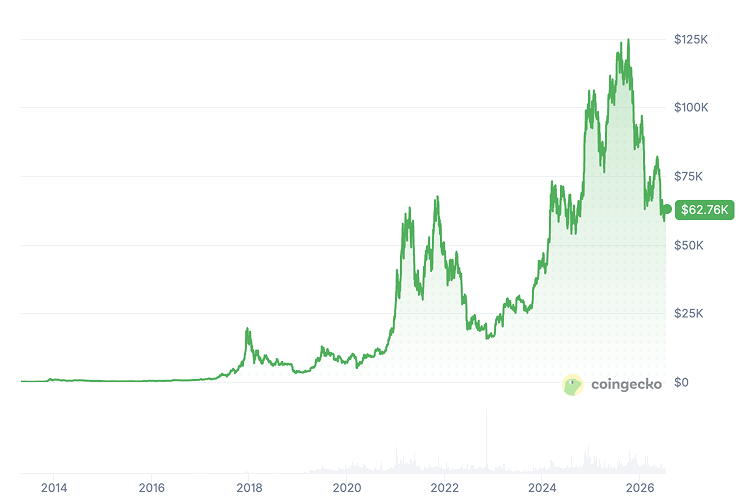
CoinGecko, July 13, 2026
Some analysts who follow Bitcoin’s four-year cycle believe the market could form its final bottom around October 2026. This view reflects earlier midterm-year lows in 2014, 2018, and 2022. Galaxy Research has also argued that Bitcoin may not have reached its cycle bottom yet. Still, an October bottom remains a forecast, not a fixed date, because ETFs, institutional demand, interest rates, regulation, and global liquidity can change the pattern.
For beginners, the safest answer to “is it a good time to invest in Bitcoin” is to avoid making one large bet on a single BTC price prediction. A gradual buying plan can reduce timing risk while keeping some cash available if Bitcoin falls further.
Investing Long Term vs Trying to Time the Market
Long-term investing focuses on Bitcoin’s adoption, limited supply, and possible value over several years. Market timing tries to buy near the exact bottom and sell near the top, but even experienced investors rarely identify these moments consistently.
An investor asking when should I invest in Bitcoin may consider waiting for a possible October 2026 cycle low. However, Bitcoin could bottom earlier, fall later, or recover before cautious buyers enter. Fidelity Digital Assets also notes that Bitcoin’s growing size and institutional market may cause future cycles to behave differently.
Dollar-cost averaging offers a practical middle ground. Investors can divide their planned amount into smaller weekly or monthly purchases. This method cannot prevent losses, but it reduces dependence on one entry price and makes sudden market moves easier to manage.
How Much Should You Invest in Bitcoin?
The right amount depends on your income, savings, debts, investment goals, and ability to accept losses. There is no universal percentage that suits every investor. A beginner should first build an emergency fund, cover essential expenses, and repay expensive debt before buying Bitcoin.
When asking how much you should invest in Bitcoin, focus on the amount you could lose without damaging your financial situation. Some cautious investors limit Bitcoin to a small part of their portfolio, such as 1% to 5%. People with more experience and a higher risk tolerance may choose a larger allocation, but this also increases potential losses.
You do not need to buy a full Bitcoin. Each coin can be divided into 100 million smaller units called satoshis, so you can start with a modest amount.
Avoid borrowing money, using leverage, or investing funds needed soon. A gradual buying plan may also reduce the risk of entering the market at an unfavorable price.
Should You Buy Bitcoin Now or Wait?
Deciding whether to buy Bitcoin now or wait depends on your time horizon and ability to accept further declines. As of July 13, 2026, Bitcoin trades near $63,000, far below its October 2025 peak. This gives buyers a lower entry price, but it does not confirm that the market has reached its final bottom. Some cycle-based forecasts suggest that Bitcoin could fall again and form a deeper low around October 2026. However, this remains a possible scenario rather than a reliable deadline.
People asking if I should buy Bitcoin now do not need to choose between investing everything today and waiting for the perfect price. A balanced approach is to split the planned amount into smaller purchases. You can buy part now, keep some cash available, and invest more if the price falls.
Waiting may provide a better entry, but Bitcoin could also recover before you act. Gradual buying reduces dependence on one date and limits emotional decisions. Beginners should avoid chasing short rallies, borrowing money, or investing funds needed for essential expenses. Choose a strategy you can follow calmly, even if Bitcoin drops further.
FAQ
Is Bitcoin Still Worth Investing In?
Bitcoin may still be worth investing in for people who accept high risk and plan to hold it for several years. Its limited supply and growing adoption support the long-term case, but strong price drops remain possible. A small allocation may be more suitable than making Bitcoin your main investment.
Is It Worth Investing in Bitcoin Right Now?
It may be worth investing in Bitcoin right now if you have a long-term plan and can handle further price declines. No one can confirm the exact market bottom, so gradual purchases may reduce timing risk. Invest only money you will not need for bills, emergencies, or short-term goals, and avoid buying because of market hype.
Is Bitcoin a Safe Investment?
Bitcoin is not a safe investment in the same way as a savings account or government bond. Its price can fall sharply, and investors also face exchange, wallet, fraud, and regulatory risks. Strong security practices, trusted platforms, and a limited portfolio allocation can reduce risk, but they cannot remove it completely.
Should I Buy Bitcoin Today?
You may buy Bitcoin today, but avoid investing your full amount at once. A better approach for many beginners is to divide the planned investment into smaller purchases over time. This can reduce the impact of short-term volatility, limit emotional decisions, and remove pressure to find the perfect entry price.

Follow us on Medium, X, Telegram, YouTube, and Publish0x to stay updated about the latest news on StealthEX and the rest of the crypto world.
Don’t forget to do your own research before buying any crypto. The views and opinions expressed in this article are solely those of the author.



Be the first to comment