



- Mizuho, MUFG and SMBC completed a yen stablecoin trial from July 17 to 23, 2026.
- The test covered cross-border payments between Mitsubishi Corporation’s Japanese and overseas operations.
- The banks confirmed the feasibility of the joint issuance model, but commercial launch has not been confirmed.
Japan’s three largest banks have completed a joint trial of a yen-based stablecoin, confirming the feasibility of a model designed to support cross-border payments between businesses. Mizuho Bank, MUFG Bank and Sumitomo Mitsui Banking Corporation (SMBC) conducted the proof of concept from July 17 to July 23, with the results announced on October 16, 2026.
Mitsubishi UFJ Trust and Banking Corporation and technology firm TISI also participated in the project. The trial focused on payments between Mitsubishi Corporation’s Japanese operations and its overseas locations, testing whether a stablecoin jointly issued by multiple banks could work within existing operational and regulatory requirements.
The project received support from Japan’s Financial Services Agency (FSA) through its FinTech Proof-of-Concept Hub in November 2025. Its goal was to examine whether the three banks could jointly issue a yen-denominated stablecoin and use it to improve the process of settling international payments.
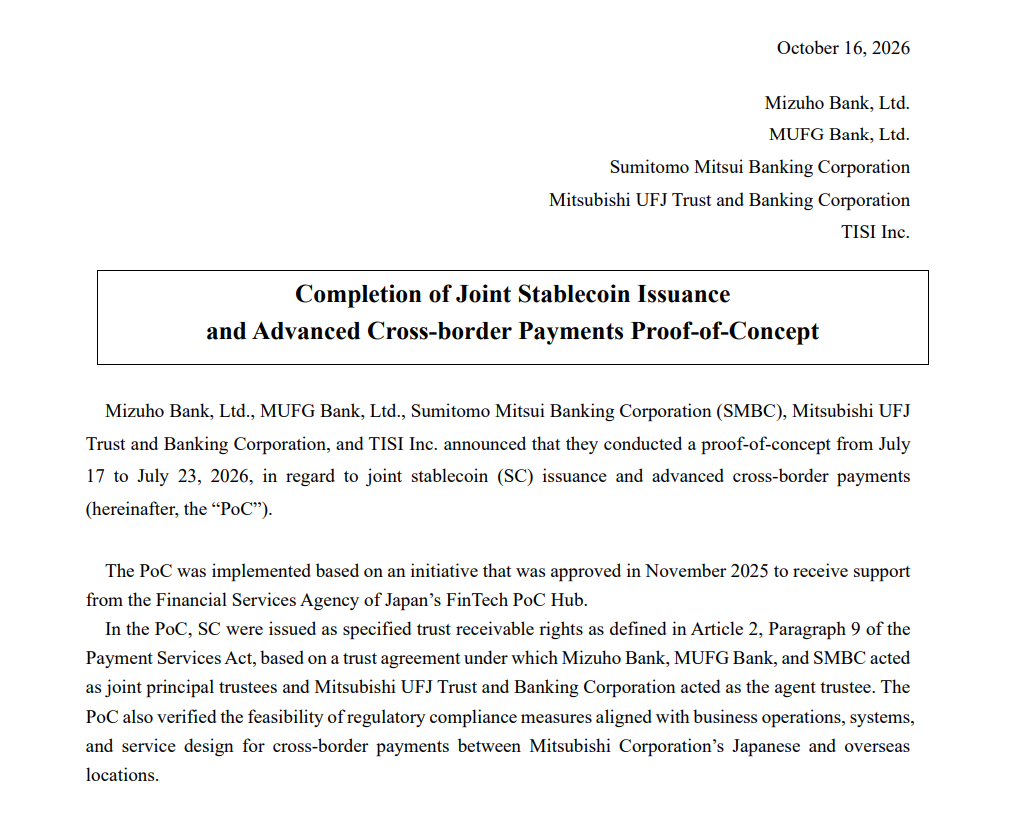
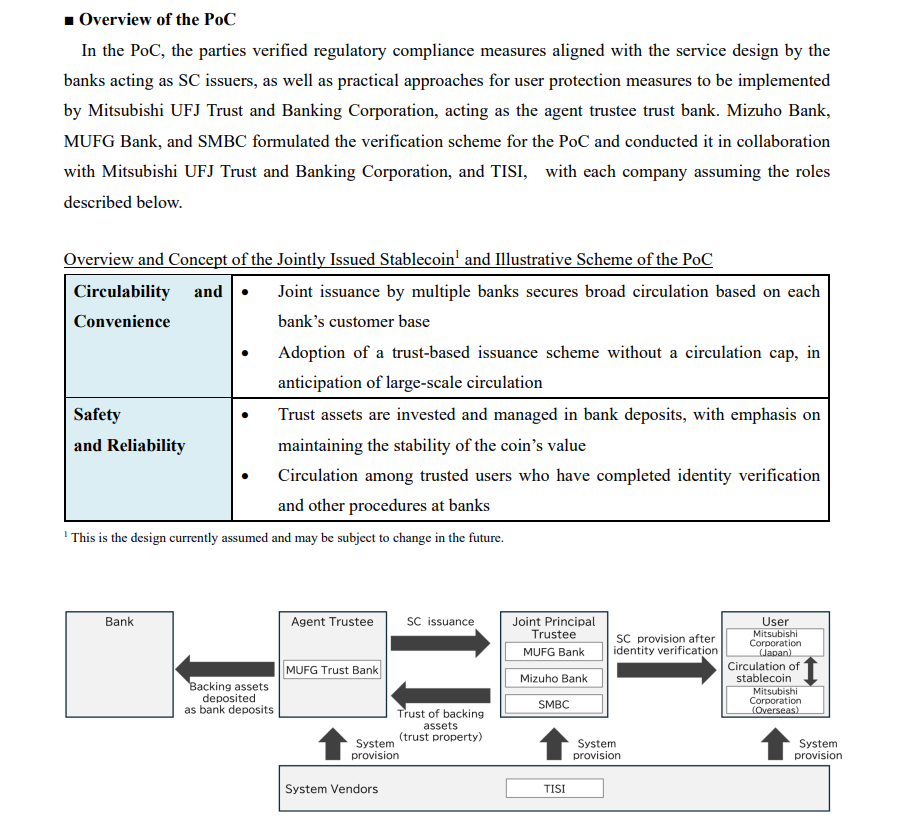
Under the tested structure, Mizuho, MUFG and SMBC acted as joint principals responsible for commissioning the stablecoin issuance, while Mitsubishi UFJ Trust and Banking served as trustee. The token was issued under a trust agreement as a form of specified trust beneficiary rights defined by Japan’s Payment Services Act.

Trial Verifies Issuance, Transfers and Redemption
During the trial, the participants examined the full process of issuing, transferring and redeeming the stablecoin. They also assessed system performance, operational requirements and compliance measures needed for cross-border transactions, including anti-money laundering and counter-terrorist financing controls.
Mitsubishi UFJ Trust and Banking reviewed the trust-related operations, management of trust assets and measures intended to protect users. TISI integrated the wallet infrastructure with the stablecoin issuance system and related business processes, while SMBC provided the blockchain platform built with TISI.
The proposed model is designed to support circulation across the customer networks of all three banks without a fixed issuance cap. The current design also envisages managing the trust assets through bank deposits. The companies stressed that these remain design assumptions and could change as development continues.
The banks said the trial confirmed the feasibility of the joint issuance model and produced practical findings for future implementation. However, the stablecoin is not yet confirmed as commercially available. In June, the banks said they were aiming to begin actual transactions during fiscal 2026, which ends in March 2027.
The participants will continue assessing outstanding issues, including user protection, cybersecurity, regulatory compliance and system stability, before moving toward practical use.



Be the first to comment