


What to know:
- The KOSPI crash sent the benchmark down 8.3% and triggered circuit breakers on Monday.
- Samsung and SK Hynix led losses as chip stocks erased major market value from the index.
- Won rebounded after officials met, while bond yields rose to the highest since 2023.

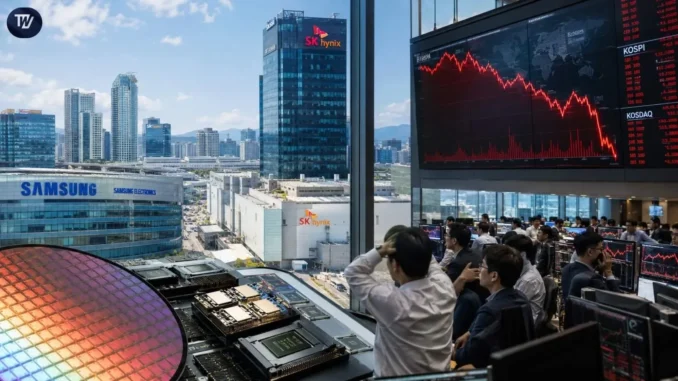
South Korea’s benchmark index suffered a sharp Monday selloff after strong U.S. jobs data lifted rate hike expectations. The KOSPI crash triggered circuit breakers, hit major chip stocks, and ended a powerful rally tied to artificial intelligence and semiconductor demand.
According to a Reuters report, the KOSPI fell 8.3% to close at 7,484.41. It was the highest daily drop for the index since March 4.
Also Read: South Korea’s KOSPI Surges 8% After Samsung Labor Deal Boosts Market Confidence

Samsung and SK Hynix Lead KOSPI Market Slide
The benchmark is now 15% below its June 2 peak of 8,801.49. The fall showed how quickly pressure spread through a market that had led global gains.
Samsung Electronics and SK Hynix were under pressure due to the KOSPI crash. Samsung fell 10.2% while SK Hynix declined 7.7%.
The drop occurred despite Nvidia CEO Jensen Huang’s praise of SK Hynix. As he announced new deals, he described the company as Nvidia’s “biggest partner.”
This year’s rally in the benchmark had been led by Samsung and SK Hynix. They saw their market value increase by over 150% and 200% with record profits.
The two chipmakers now make up more than half of the benchmark. That had left the market more vulnerable to the selling of semiconductor stocks.
In addition, the crash of the KOSPI also resulted in forced trading restrictions. Trading was halted for 20 minutes, the first such stoppage in three months, due to circuit breakers.
A sidecar curb was followed up on separately as sales continued. It was the third circuit breaker activation of the year and ninth in the market’s history.
Currency markets went in the opposite direction. The won gained more than 1% to 1,533.7 per dollar after hitting 1,615.0 on Friday.
The currency had its weakest position since March 2009 on that Friday. The authorities convened an emergency meeting and vowed strong measures against speculation.
KOSPI Crash Erases $416B After Wall Street Selloff
In a post on X, Bull Theory highlighted that more than ₩605 trillion, or $416 billion, was erased from South Korean stocks. The KOSPI crash began within minutes, the post said.
The account also said that the two, Samsung and SK Hynix, combined account for about 45% of the index. It said that the benchmark tumbled over 7% in four minutes.
The KOSPI crash came after a heavy selloff on Wall Street on Friday. The Nasdaq dropped 4.2% following robust payroll data that dampened hopes for more rate cuts.
The Philadelphia Semiconductor Index dropped 10%. Technology exposure was pressured as the iShares MSCI South Korea ETF dropped 14%.
Analyst Han Ji-young at Kiwoom Securities said the jobs surprise helped bond prices move higher. He said it gave investors a reason to correct an overheated market.
Han added that volatility would probably continue to be high. But the rout may not last for several days, he said, as valuations had eased and chip earnings were still good.
The yield on South Korea’s 10-year treasury bonds climbed 12.3 basis points to 4.366%. That was its highest since October 2023.
Despite the KOSPI crash, the index remains up 78% this year. It also increased by 76% in 2025, the highest annual increase since 1999.
Also Read: South Korea’s DAXA Boldly Tightens Crypto API Rules 2026


Be the first to comment