



A halving of Litecoin cuts the reward a miner receives for finding a block in half. The next of these cuts takes it from 6.25 to 3.125 LTC. The protocol knows no calendar date for it; block height 3,360,000 is all that counts. At midday on Saturday, October 24, 2026, the Litecoin blockchain stood at block 3,200,769. That leaves roughly 159,000 blocks to the halving, or a little more than nine months at the pace of the past 24 hours.
This article explains how the mechanism works, what it means for supply and for miners, and what counts when buying, storing and paying tax in Germany. All figures carry the date of October 24, 2026 and can be looked up in the blockchain itself.
When is the next Litecoin halving?
The short answer: most likely between late July and early August 2027. The long answer needs a calculation, because a halving is not a date anyone sets.
A halving is a rule in the protocol: after a fixed number of blocks, the reward for the next block is cut in half. At Litecoin this interval is 840,000 blocks, documented in the project’s source code as the value nSubsidyHalvingInterval. The fourth halving therefore falls on block 3,360,000.

Exactly 159,231 blocks were still missing on October 24, 2026. How long that takes depends on how quickly blocks are produced. The protocol targets one block every 2.5 minutes, or 576 blocks a day. The actual count over the preceding 24 hours was 556. Those two values give a range:
- at 576 blocks a day: 276 days, so July 27, 2027
- at 556 blocks a day: 286 days, so August 6, 2027
Ten days apart, and that from the variation of a single week alone. Every countdown that shows you a clock time runs the same arithmetic and rounds the uncertainty away. Rely on the block height, then, and not on the date printed beside it.
The Litecoin halving cuts the block reward every 840,000 blocks
Halving literally means cutting in half, and what gets cut is the reward the network pays out for every new block. That reward is also the only source from which new coins are created. Halving it halves the inflow of new supply.
Litecoin launched in 2011 with 50 LTC per block. After 840,000 blocks that became 25, after a further 840,000 blocks 12.5, and since August 2023 it has been 6.25. The schedule runs on until the reward arithmetically reaches zero. A fixed cap of 84 million LTC therefore sits at the end.
Of that, 77,752,455 LTC were already in circulation on October 24, 2026, or 92.6 percent. The network will need well over a hundred years for the remaining 6.2 million coins, because every halving pushes the inflow down further. In volume terms, the large halvings lie far behind Litecoin. What is still to come shifts small remainders.
From 6.25 to 3.125 LTC: emission per day and per year
In concrete numbers: at 556 blocks a day, 3,475 new LTC are created daily. At the price of $56.51 on October 24, that is around $196,000 which can enter the market fresh every day. After the halving it will be 1,737 LTC, or about $98,000.
Over a full year, new issuance falls from roughly 1.31 million LTC to 657,000. Measured against the circulating supply, that is an inflation rate of 1.69 percent today and 0.84 percent afterwards. For context: Litecoin’s daily trading volume runs many times above the daily value of new issuance. A supply cut of $98,000 a day is a small quantity in relation to trading, and deriving an automatic price move from it overestimates the leverage.
Litecoin’s market value stood at $4.39 billion on October 24, rank 25 among all cryptocurrencies. The price was 50.44 euros, 3.9 percent below the previous day, 14.9 percent below its level 30 days earlier and 41.2 percent below its level a year ago. The all-time high of $410.26 dates from May 9, 2021.
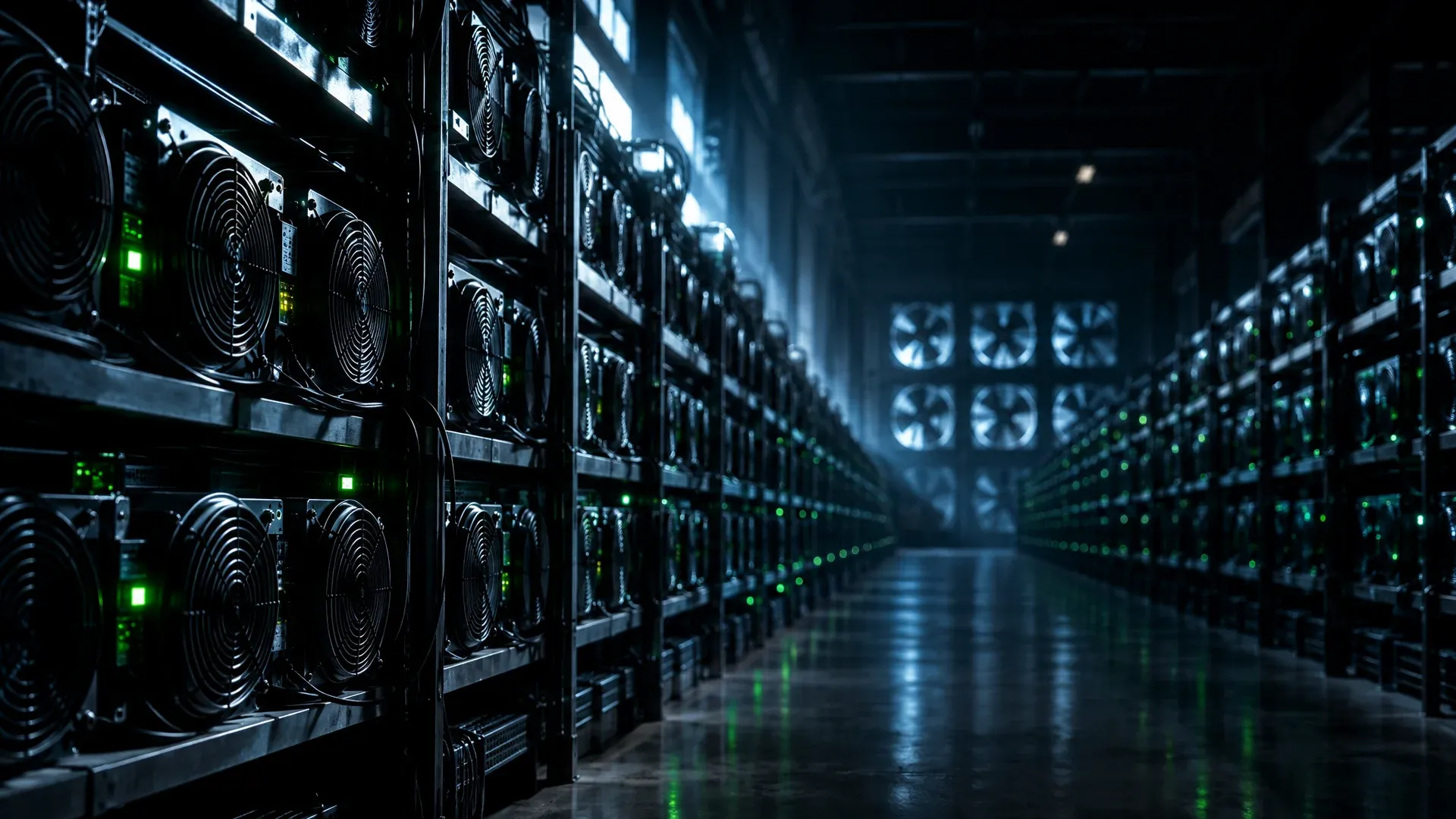
Merged mining: 84.5 percent of the scrypt budget comes from Dogecoin
Merged mining means a miner can find blocks for two blockchains at the same time with the same computational work. Since 2014, Dogecoin has ridden along with Litecoin this way. Both use the same hashing procedure, called scrypt, and a miner collects both rewards for the same electricity bill.
That shifts the weights considerably. Dogecoin pays out 10,000 DOGE per block and produced 1,374 blocks in 24 hours, or 13.74 million DOGE. At a price of $0.0776, that comes to around $1.07 million a day. Litecoin contributes the $196,000 mentioned above. Measured against the combined budget, 84.5 percent therefore comes from Dogecoin and 15.5 percent from Litecoin. Our newsroom had already measured this share once on October 11, 2026 and arrived at 83.5 percent for Dogecoin at the time; the shift of one point in two weeks shows how strongly the figure hangs on the DOGE price.
After the halving, Litecoin’s share falls from 15.5 to 8.4 percent. For a miner that means revenue does not drop by half but by around eight percent. That is why the halving has a markedly weaker effect on hashrate at Litecoin than at a blockchain which depends on its own reward alone.
Three halvings since 2015, documented by the blockchain’s timestamps
Every block carries a timestamp, so the blocks at the halving heights say precisely when the previous cuts arrived:
- Block 840,000 on August 25, 2015: from 50 to 25 LTC
- Block 1,680,000 on August 5, 2019: from 25 to 12.5 LTC
- Block 2,520,000 on August 2, 2023: from 12.5 to 6.25 LTC
The regularity is striking: 1,440 days lay between the first and the second halving, and 1,458 days between the second and the third. The network keeps its rhythm fairly precisely, then, despite all the swings in hashrate. Carrying the same interval forward from August 2023 also lands in the summer of 2027. Two independent routes, the same season.
What does not repeat is the price pattern. The story of the halving as a price driver rests on a handful of cases, and three data points carry no rule. A protocol parameter says something about supply; about demand it says nothing.
Hashrate after the 2023 halving against the hashrate today
The common expectation runs that miners switch off after a cut and hashrate collapses. At Litecoin this can be checked, because the difficulty of every block sits in the blockchain and grows with hashrate.
On June 29, 2023, a good four weeks before the third halving, difficulty stood at 26.4 million. At the halving block itself it was 27.6 million. Two months later, in October 2023, it stood at 28.0 million, and in April 2024 at 36.2 million. So instead of a collapse, a gain of 31 percent within eight months.
Today difficulty stands at 91.7 million, with hashrate averaging 2.54 petahash per second over the day. Against the halving block of 2023, the figure has more than tripled. The explanation sits in the section above: because Dogecoin pays the larger part of the bill, a miner’s decision to switch off hangs on the DOGE price rather than on the Litecoin reward.
For holders, that means one thing above all: a halving is no security risk for the network as long as the combined budget stays stable. The pot worth watching is the shared one, not the Litecoin reward on its own.
Transaction fees contribute 0.25 percent of block revenue
At Bitcoin, the consolation after every halving is that transaction fees will replace the lost reward over time. At Litecoin that argument does not hold so far.
Across the 120 blocks before October 24, 2026, fee income averaged 0.0159 LTC per block, the highest single value 0.12 LTC. Measured against total block revenue from reward and fees, that is 0.25 percent. A single transfer cost $0.0025 on the daily average, across 176,187 transactions in 24 hours.
Low fees are an advantage for users, and that is exactly what Litecoin was designed for. For miners, the same figure means that nothing fills the gap after the halving. The bill stays tied to the reward and to merged mining. Anyone following the network’s development will find the state of usage in our report on Litecoin’s 15th anniversary and the MWEB record, and all articles bundled in the Litecoin section.

Buying and storing Litecoin in Germany
LTC ranks among the oldest and most widely listed cryptocurrencies, and in Germany it can be bought by several routes. What matters is less the choice than the provider’s authorisation and the question of who owns the coins afterwards.
Since the European regulation on markets in crypto-assets, MiCA for short, providers need an authorisation from an EU member state in order to trade or hold crypto-assets in Germany. Whether a provider holds one can be looked up in the register of the competent supervisor, and reputable providers name their authorisation themselves in their legal notice. We keep an overview with fees and authorisation status in our exchange comparison.
Custody comes in two camps. Leave the coins on the exchange and you carry the provider’s risk while saving yourself the management of the keys. Move them to a wallet of your own and the responsibility for the recovery phrase sits with you, but your holdings hang on no company. For larger amounts, or a holding period over several years such as a halving cycle suggests, the second camp is the more usual choice.
Tax on LTC gains: the one-year period under section 23 of the Income Tax Act
The halving itself is not a taxable event. Nothing is paid out to you, your holdings do not change, and so nothing happens as far as the tax office is concerned. It becomes relevant only through what you do with your LTC.
In Germany, cryptocurrencies count as other assets. A sale, or a swap into another cryptocurrency, is a private disposal under section 23 of the German Income Tax Act. If more than twelve months lie between purchase and sale, the gain stays tax-free. Within that period it counts towards your taxable income, at your personal rate. A threshold of 1,000 euros applies to all private disposals of a year taken together, and the word threshold is to be read literally here: one euro above it makes the entire gain taxable, not only the excess part.
If you want to hold Litecoin until the halving in the summer of 2027, you are buying beyond the one-year mark anyway. Documentation matters more: you must be able to prove the purchase date, quantity and price for every acquisition, otherwise the period cannot be demonstrated later. The state of the planned reform of this rule keeps moving, which is why we track the current status of the procedure separately in our overview of the holding-period reform.
One note on mining: those who mine themselves realise no private disposal gains but, as a rule, business or other income. Separate rules apply there, and the one-year period is no help.
Litecoin halving: 3.125 LTC per block from summer 2027
The date sits in the block height, the effect on miners turns out smaller than the figure of 50 percent suggests because of merged mining, and for your tax the day itself plays no role. Three steps make sense all the same:
- Check your trading venue. Look up whether your provider holds a MiCA authorisation and what a purchase of more than 1,000 euros costs there in fees and spread. The figures stand side by side in our crypto exchange comparison.
- Decide on custody. If you want to hold beyond the cycle, the coins belong in a wallet whose keys you hold yourself. The devices and their differences are in our hardware wallet comparison.
- Document your acquisitions. Keep the date, quantity and price of every purchase so that the one-year period can be proven later. A crypto tax tool handles this automatically and produces the statement for your tax return.
And for context, which applies to every coin: Litecoin can lose heavily like any cryptocurrency, and a total loss is possible. Invest only money whose loss you can bear.
(As of October 24, 2026. This article is not investment advice. Prices and fee structures change; check the terms with the provider before you buy.)



Be the first to comment