

Ethereum advances Layer-2 upgrades, Solana expands high-speed applications, Cardano grows Plutus activity, and BlockDAG outlines its buyback structure.
Global financial markets are going through a rough patch right now, and digital asset participants are watching every move while comparing projects with active development and visible utility. Big institutions and everyday traders alike are focusing more on projects with clearer structures and stronger technical progress. The appetite for reckless, high-risk plays has cooled off significantly.
What matters most right now is finding crypto networks that offer real technological progress alongside defined ecosystem activity. Money is moving toward projects that can stay relevant even when broader markets become volatile. Capital protection and utility have become important themes in this current phase of crypto.
This publication is sponsored and written by a third party. Coindoo does not endorse or assume responsibility for the content, accuracy, quality, advertising, products, or any other materials on this page.
1. BlockDAG: Legacy Sale Is Live With USDT Buyback Structure
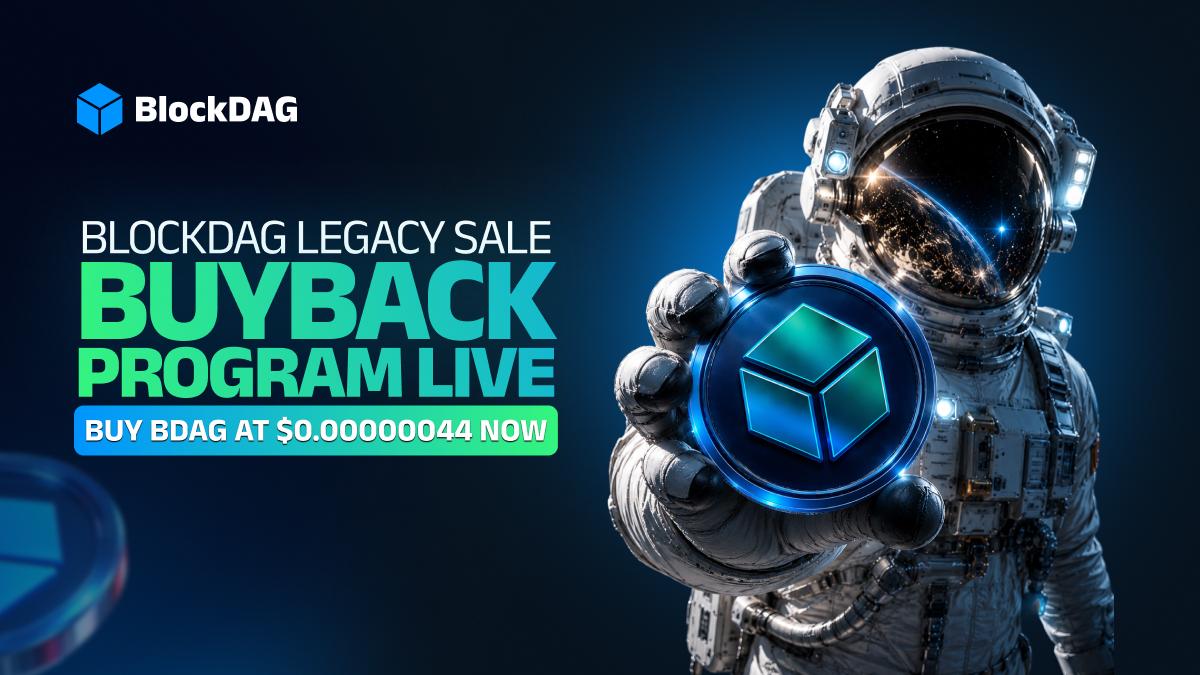
The BlockDAG Legacy Sale is officially live, and it has become part of the current discussion around structured crypto sale models. BDAG is available at $0.00000044, and the Buyback Program lets eligible participants sell at $0.001 per BDAG, with payouts settled directly in USDT under the project’s stated terms. That difference between entry price and buyback price is part of the project’s current sale structure, not a guaranteed market outcome.
Here is how the program works. Eligible BDAG can be registered directly from the dashboard. There are no transfers required for Legacy Sale buyers. Daily sell limits are uncapped. All buyback contract settlements are scheduled in USDT at the listed $0.001 price, which means the broader crypto market price does not directly determine the stated buyback settlement.

For those who already hold BDAG from earlier rounds, participation is still possible through BDAG Swap at 30% below the market price, with a buyback price of $0.00025 per BDAG. The maximum submission per wallet per day is 250,000,000 BDAG.
This is not only a token sale. The ecosystem behind BlockDAG is actively expanding through new utility, platform adoption, casino growth, miner deployment, and future integrations that are still being rolled out. The USDT settlement structure gives participants a dollar-pegged buyback process under the project’s current terms. When prices get volatile, stablecoin-based settlement can become an important feature for participants evaluating structured sale models.
2. Ethereum: Enhancing Layer-2 Infrastructure
Ethereum continues to serve as the core foundation of decentralized internet infrastructure in 2026. Several major network upgrades have been completed this year, all focused on cutting Layer-2 transaction costs and strengthening data availability across the ecosystem. The result has been a wave of institutional capital flowing into complex DeFi protocols built directly on the network. Ethereum consistently remains a key network for institutions looking for deep liquidity and proven infrastructure.
Development teams are still refining the proof-of-stake consensus system, with ongoing work aimed at improving validator efficiency and tightening overall network security. Zero-knowledge rollups have become a central part of Ethereum’s scaling strategy, and their widespread use has reinforced its position as a primary settlement layer for digital applications worldwide. Deep liquidity, a large developer base, and strong security keep Ethereum central to the crypto infrastructure stack.

3. Solana: Powering High-Frequency Applications
Solana has kept its reputation as one of the fastest major chains throughout 2026. High-frequency trading platforms and resource-heavy gaming applications have moved onto the network this year, drawn by its throughput and low latency.
Developers building complex decentralized protocols have found Solana practical for applications that require speed compared with older, slower blockchains. Speed-focused market participants frequently include Solana in discussions where transaction performance is the priority.
A recent client diversity upgrade has made meaningful improvements to network reliability, reducing the likelihood of outages that previously caused concern. Major financial firms have started piloting Solana for rapid asset settlement and cross-border payment testing. The overall infrastructure is well-suited for applications where speed and immediate transaction finality are important.
4. Cardano: Expanding the Plutus Smart Contract Ecosystem
Cardano has continued with its careful, research-first development philosophy, and in 2026 that approach is showing results across its ecosystem. Developer activity in the Plutus smart contract environment has increased, and a growing DeFi ecosystem has taken shape around it.
Cardano draws attention among market participants who value security and a peer-reviewed approach over hype. New scaling solutions have been rolled out successfully, allowing the network to handle larger transaction volumes without a major increase in energy consumption.
Community governance remains a strong feature, with treasury funds being directed toward network development through active participation from token holders. Cardano continues to offer a stable, research-driven infrastructure for users who prioritize security and functionality.
Conclusion
Comparing crypto projects often comes down to structure, utility, and execution. Ethereum brings the security and infrastructure that global decentralized applications depend on. Solana delivers speed for high-frequency trading and gaming platforms. Cardano provides a research-driven smart contract environment with steady growth.
BlockDAG takes a different path through its Legacy Sale and USDT-settled buyback structure. The project lists a buy price of $0.00000044 and a buyback rate of $0.001 under its stated terms, alongside broader ecosystem activity, including utility rollout, casino growth, miner deployment, and future integrations. Future outcomes will depend on adoption, execution, liquidity, and broader market conditions.

This publication is sponsored and written by a third party. Coindoo does not endorse or assume responsibility for the content, accuracy, quality, advertising, products, or any other materials on this page. Readers are encouraged to conduct their own research before engaging in any cryptocurrency-related actions. Coindoo will not be liable, directly or indirectly, for any damages or losses resulting from the use of or reliance on any content, goods, or services mentioned.

Krasimir Rusev is a journalist and digital content creator with over 4 years of experience and more than 1,000 published pieces in the financial space. His work focuses on stock markets and commodities, closely tracking asset movements and the factors that drive them.
He has a particular interest in gold and oil markets – not just their current movements, but their history, structure, and long-term trends. For him, understanding the context behind prices matters just as much as the prices themselves.
A self-described Bitcoin maximalist, Krasimir has been following crypto markets long before he became a journalist. What started as a casual interest in Bitcoin gradually turned into a deep conviction – one that shaped how he thinks about money, value, and the broader financial system. That perspective quietly informs everything he writes.
Beyond writing analysis and news, he actively creates content for social media including TikTok, Facebook, and Instagram, presenting market topics in a more accessible and visually engaging format. He believes financial information should reach a wide audience – not just those already following the markets.
At Coindoo, he contributes to both editorial content and the development of the platform’s digital presence. He works with tools like Photoshop, CapCut, and Canva, with a particular focus on visual storytelling – videos, infographics, and images that add an extra layer of value to news and analysis.



Be the first to comment