


Global fintech giant Revolut’s new euro-based stablecoin has elicited mixed reactions among analysts.
The firm debuted its stablecoin, EURR, on Wednesday, the 26th of August. Although this was its first push into the segment, the firm maintained that it will offer stablecoins pegged to other currencies as well.
Stablecoins are on-chain tokens pegged to traditional currencies such as the U.S. dollar. The dominant player, Tether’s USD-pegged USDT, has been delisted across Europe after it failed to get a MiCA license. Revolut is also set to ditch USDT by the end of August.
For critics such as Scott Melker, Revolut’s product is leveraging the opening left by USDT delisting. However, he doubted the competitiveness of overall euro-based stablecoins.

Nobody wants euros anywhere outside of Europe, and they don’t really want them there either; they’re just forced to use them. So, it’s not like this is going to compete with dollar-backed stablecoins.
Euro stablecoins see rising traction
Led by Tether’s USDT and Circle’s USDC, USD-based stablecoins account for over 90% of the market share. However, Euro-based stablecoins have also seen some strong traction since MiCA went into effect.
In fact, Zach Abrams, former CEO of institutional stablecoin transfer system Bridge, echoed a similar sentiment, noting that,
Our financial system will be increasingly tokenized over the next 5 years. First currencies, then treasuries, next stocks, and so on. Non-USD stablecoins will play a critical role in local settlement, collateral, FX, and more.
Europe currently ranks second in stablecoin transactions after North America with a 26% market share. Asia comes in third.
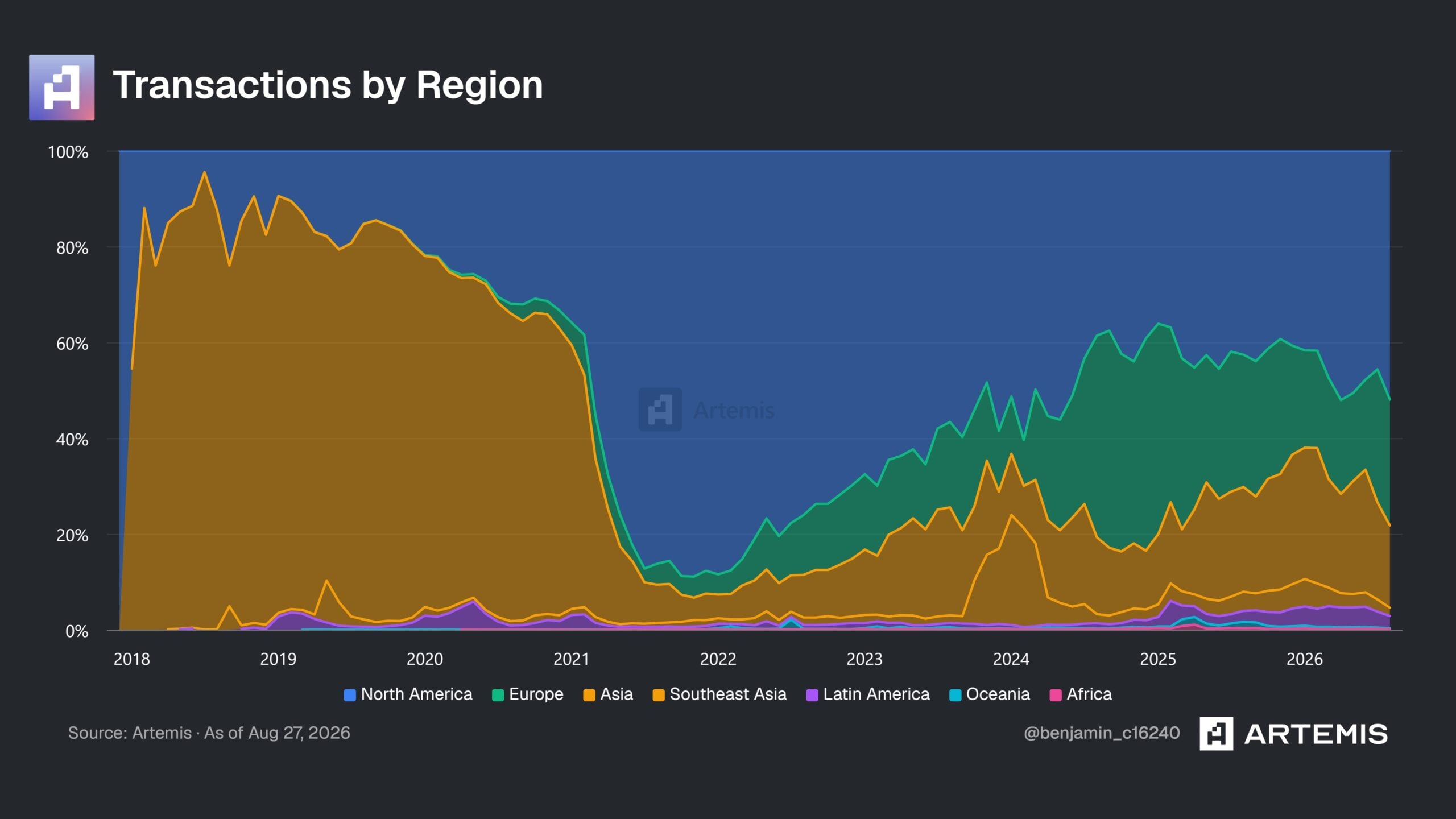
Interestingly, non-USD stablecoins (including euro alternatives) have recorded higher adoption compared to USD-based incumbents.
According to Artemis data, USD stablecoins hit nearly $7T in 30-day volume, marking a 22% increase. Although non-USD volume was slightly lower at $15B over the same period, it translated to triple-digit growth of 137%.

In particular, the Euro versions have recorded strong growth this year.
That said, the current euro stablecoins are mostly issued by private firms. In fact, Circle’s EURC is the largest with $455M in supply – that’s more than 50% of the total EUR-pegged stablecoin market of $772M.
However, the European Union is planning a digital euro by 2029 to protect banks from private stablecoin encroachment. Whether this will impact ongoing Euro stablecoin traction remains unclear.
Final Summary
- Revolut has launched its first Euro-based stablecoin ahead of USDT delisting on the 31st of August.
- Analysts expressed a mixed outlook for the global competitiveness of euro stablecoins despite posting a 137% adoption rate.


Be the first to comment