



Outpoll is a prediction market platform built around a clear product thesis: event markets should feel less like casual polls and more like trading infrastructure. Instead of asking users to simply pick an outcome and wait, Outpoll gives them order types, exit controls, API access, mobile-first access, integrated news, and market creation features aimed at traders, forecasters, and community-led audiences.
That makes Outpoll more interesting than another prediction market clone. The platform sits inside a fast-growing category where prices on elections, sports, macro data, crypto events, culture, and other real-world outcomes increasingly behave like live probability signals. Anyone comparing prediction markets and event contracts should separate the basic idea from the platform layer. A market can be simple, but the trading experience around it can be shallow or serious.
Outpoll is trying to compete on the serious side of that divide. Its strongest features are take-profit and stop-loss orders, limit and market orders, a public REST and WebSocket API, a news layer built into the trading interface, creator-led markets, and USDC-based settlement. Its weaknesses are also clear: the platform is young, liquidity is still developing, product documentation is not perfectly aligned across all public materials, eligibility is restricted in several major regions, and the hybrid CeDeFi model requires trust in Outpoll’s market operation, resolution process, account controls, and settlement flow.
What Outpoll Is
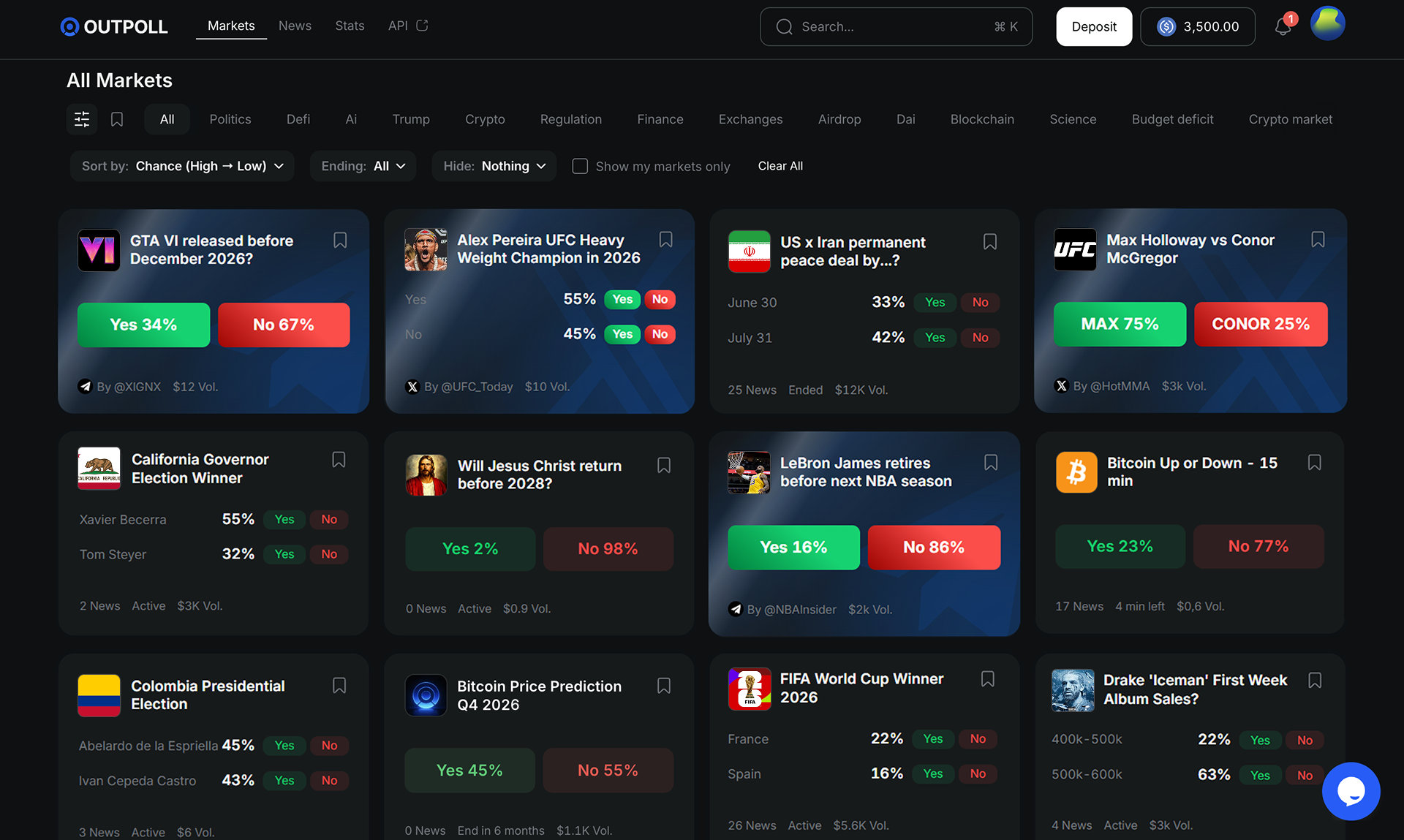
Outpoll is a real-world event trading platform where users can take positions on future outcomes. These outcomes can include politics, sports, finance, entertainment, macro events, crypto developments, and other topics that move on public information. The product is positioned for people who want to trade probabilities, not only read them.
At the core, a prediction market turns uncertainty into a tradable contract. A user can buy exposure to one side of an outcome, such as “Yes” or “No.” The price reflects what the market currently believes about the probability of that outcome. If the event resolves in favor of that side, the winning position settles at the defined payout. If it resolves against that side, the position expires with little or no value, depending on the contract structure.
Outpoll’s own product materials describe a hybrid CeDeFi model with proprietary blockchain and backend technology, stablecoin support, event-linked tokens, and dynamic odds that update as traders buy and sell positions. That puts the platform between a fully centralized event-contract exchange and a fully onchain prediction market. The user gets a trading-style interface and stablecoin settlement, while Outpoll still plays a central role in account access, market quality, resolution oversight, and platform operations.
That structure is not automatically bad. Many crypto users already interact with centralized exchanges, custodial accounts, offchain order books, payment processors, and hybrid settlement layers. It does mean Outpoll should be judged differently from a purely non-custodial protocol. Users are not only evaluating market selection and fees. They are also evaluating legal access, withdrawal reliability, resolution fairness, KYC triggers, API reliability, mobile access, liquidity depth, and whether the platform can scale beyond an early user base.
How Outpoll Works
Outpoll markets are built around event outcomes. A market defines the question, the possible outcomes, the resolution rules, and the authority or data source used to decide the final result. Users buy and sell positions before the market closes, and prices move as new information arrives.
The platform highlights fully collateralized markets at the contract level, with positions settled in USDC. That is a useful design choice because prediction markets need clear settlement. When a market closes, the winning side must receive its payout, and the losing side must be resolved without ambiguity. Collateralization reduces the risk that winners cannot be paid, while USDC settlement keeps pricing easier to understand for traders who do not want outcome exposure mixed with volatile collateral.
The market categories shown on Outpoll include sports, macro, politics, and major event themes. Those are natural prediction-market categories because they move on public information and attract active debate. A platform that only lists one or two broad categories can struggle to build daily habit. A platform with too many low-quality markets can create resolution disputes, thin liquidity, and noise. Outpoll’s creator-led market program is meant to expand coverage beyond centrally listed markets while keeping oversight on market quality and resolution rules.
That structure gives Outpoll a wider strategic opening. The best crypto prediction market platforms do not only list contracts. They build reliable market creation, credible resolution, liquidity incentives, risk controls, and a user experience that helps traders react to information quickly. Outpoll’s review should start there, because the category is no longer only about whether prediction markets are interesting. The harder question is whether a platform can support real trading behavior.
Trading Tools: Outpoll’s Strongest Advantage
Outpoll’s most important feature set is its order infrastructure. Prediction markets often attract users because the basic interface is simple: choose a side, buy a contract, and wait. That simplicity can also become a weakness when markets move sharply. A political headline, macro release, injury report, exchange listing, regulatory update, or sudden news cycle can reprice an event contract in minutes.
Outpoll adds tools that active traders already expect elsewhere. Limit orders allow price control. Market orders prioritize immediate execution. Take-profit orders let traders set an exit level when a position moves in their favor. Stop-loss orders create a defined exit when a position moves against them. These tools do not remove risk, but they force a trader to define risk before the market changes.
That is a meaningful improvement for prediction markets. Many event traders lose discipline because the market is not open in their mind as a normal trading position. They treat it like a bet, keep checking odds manually, and react late when the probability moves. Outpoll’s risk controls make event contracts look more like active trading instruments. Traders familiar with research, execution, and risk-control tools can apply a more structured approach to prediction markets.
The same logic applies to liquidity. Market orders can be useful during urgent moves, but they can be costly when the order book is thin. Limit orders help traders avoid bad fills, but they may not execute. Stop-loss orders can reduce unmanaged downside, but fast markets can still create slippage. Prediction-market traders need to understand that order tools are controls, not guarantees.
Outpoll’s trading toolkit is strongest for users who already think in terms of entry, exit, position sizing, and risk. It is less suitable for people who only want to click a yes-or-no outcome without understanding spreads, depth, and market structure. Prediction markets may look simpler than crypto spot trading, but thin books and binary settlement can make mistakes expensive.
API Access And Automated Strategies
Outpoll’s public REST and WebSocket API is one of the platform’s more serious additions. Prediction markets are information-sensitive, which makes them attractive to systematic traders, data analysts, news-driven strategies, and arbitrage teams. A public API can support price monitoring, order automation, protective exits, portfolio tracking, and external dashboards.
For a human trader, the API may not matter on day one. For a systematic user, it can define whether the platform is usable at all. A trader who wants to monitor multiple event markets, compare prices across platforms, trigger alerts, or manage exits automatically needs a machine-readable connection. Prediction markets that rely only on manual clicking are less useful for systematic strategies.
API support also opens the door to arbitrage and market-making behavior. If the same or similar outcome trades on several platforms, price differences can appear. Those gaps are not always easy money. Fees, order book depth, settlement differences, market definitions, legal access, and withdrawal timing can erase the spread. Still, a platform with a usable API is easier to integrate into a broader workflow around crypto arbitrage trading, monitoring, and execution.
The risk is that automation magnifies mistakes. API users must protect keys, set permission limits where possible, monitor failed orders, check rate limits, and account for downtime. Automated event trading can break when a market definition is misunderstood, when a resolution source differs across platforms, or when a strategy assumes liquidity that is not present. Broader algorithmic trading risk controls are just as relevant in prediction markets as they are in spot, perpetuals, and DeFi.
Outpoll deserves credit for building API access into the product pitch early. The feature gives the platform more credibility with serious traders. It also raises the standard for operational reliability, because API users will judge Outpoll by uptime, execution consistency, error handling, documentation quality, and the stability of market data feeds.
Mobile Experience And Integrated News
Prediction markets are unusually news-driven. A market can move because of a speech, court filing, injury update, poll release, inflation print, campaign announcement, exchange notice, or sudden geopolitical headline. The trading trigger often appears on the same phone where the user later opens the market.
Outpoll’s mobile-first approach fits that behavior. The platform’s launch materials emphasize a native Android application and an iOS roadmap, while the web platform already presents markets, news, and stats as part of the same ecosystem. Mobile availability should still be checked by each user because app access can vary by country, store policy, and eligibility rules. Real-money prediction-market apps also sit in a regulated category that can face strict platform and regional requirements.
The integrated news layer is one of Outpoll’s better product ideas. Traders usually move between news apps, social feeds, chats, charts, and trading screens. Each switch adds friction. If relevant headlines appear inside the same surface as the market, the trader can move from information to position faster.
That does not make the platform safer by itself. Faster reaction can improve execution, but it can also encourage overtrading. Users should still verify important information, read the market rules, and understand the difference between a headline and a resolved outcome. Prediction markets can overreact to early news, especially when liquidity is thin or a small number of traders dominate the book.
Funding, Settlement, Fees, And KYC
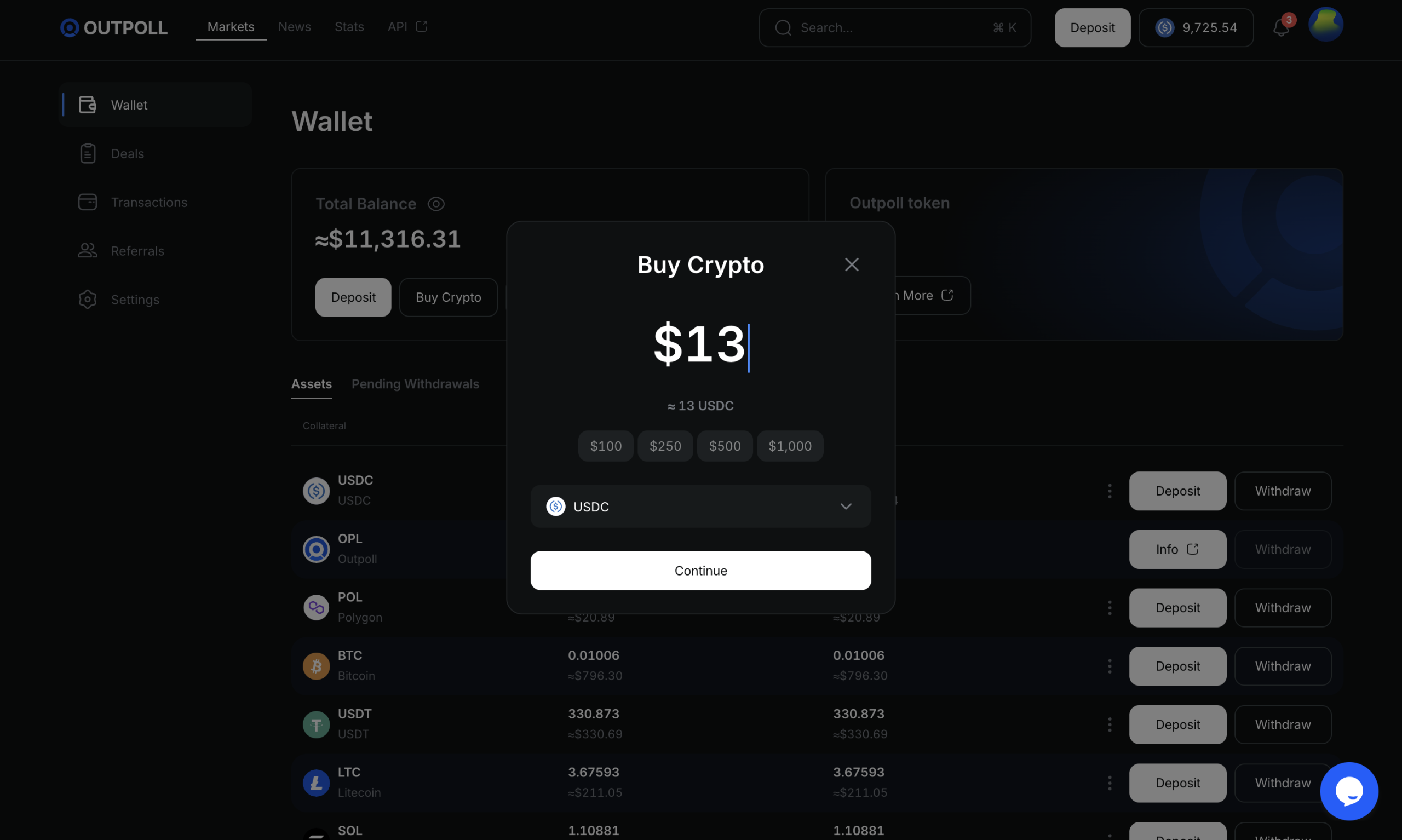
Outpoll positions USDC as the main settlement asset for market positions. Multi-currency deposits with in-app conversion to USDC are part of the user experience described in the launch materials. That reduces friction for users who hold different assets but want a stable settlement unit once inside the platform.
The trade-off is familiar across crypto platforms. Conversion can make onboarding easier, but users should still check the full cost of funding. Deposit fees, conversion spreads, withdrawal rules, network fees, minimums, and account restrictions can matter more than a headline trading fee. The same discipline used for crypto deposits and withdrawals applies to prediction markets because settlement only feels simple when users can move funds in and out reliably.
Outpoll’s launch materials cite trading fees of approximately 0.1% per trade, with no extra charges inside the order flow. That is competitive if the effective spread is also reasonable. Fees are only one part of trading cost. A market with a low fee and weak liquidity can still be expensive. A market with a slightly higher fee and strong depth can sometimes deliver better execution.
KYC is handled through a risk-based, trigger-driven process. That means some users may not face the same onboarding requirements at the same time, depending on activity, geography, behavior, platform rules, or compliance triggers. Risk-based KYC can reduce friction for low-risk users, but it can also create uncertainty if verification is triggered during withdrawal, high activity, or account review.
Eligibility is a major review factor. Outpoll’s restricted regions include the United States, United Kingdom, European Union, Singapore, Belarus, Ukraine, Russia, Israel, Iran, Syria, and other regions that may be updated. VPN bypassing is prohibited. Any user considering Outpoll should check current terms before depositing, especially because prediction markets can sit between derivatives, gaming, gambling, and financial regulation depending on jurisdiction.
Creator-Led Markets And Community Coverage
Outpoll’s creator-led market program is designed for approved community leaders, channel owners, and subject-matter experts who want to launch or curate markets for their audiences. That could become an important distribution channel if the platform executes it carefully.
Prediction markets work best when topics have active attention and a clear resolution path. A centrally managed team cannot understand every niche community, sports league, protocol ecosystem, entertainment cycle, local political issue, or creator-driven trend. Community-led market creation can surface markets closer to where attention already exists.
The risk is quality control. Poorly defined markets create disputes. Ambiguous wording can turn a good idea into an impossible settlement question. Creator incentives can also become messy if the person promoting a market influences the audience, trades the market, or frames information in a way that creates unfair advantages.
Outpoll’s creator program needs strong market standards: clear wording, objective resolution criteria, credible sources, conflict rules, and platform oversight. Prediction markets are only as credible as their settlement. A popular market that resolves poorly can damage trust faster than a small market with weak volume.
Outpoll Token And Cashback Rewards
Outpoll also promotes a cashback program where active traders receive Outpoll Token rewards credited to their accounts. Rewards can support retention because active traders often care about net fee cost, volume incentives, and platform perks. The model is similar in spirit to exchange loyalty systems, fee rebates, and activity-based programs used across crypto trading platforms.
The token side should be treated carefully. Cashback rewards can be useful if they reduce effective costs or unlock platform benefits. They should not be treated as guaranteed investment value. Token rewards depend on utility, liquidity, distribution, emissions, user demand, listing access, and whether the reward structure creates real alignment or only short-term farming behavior.
For traders, the clean way to judge the program is simple: the core platform must stand on its own without rewards. Strong markets, fair resolution, low friction, and good execution are more important than promotional tokens. Rewards improve the experience only after the trading product already works.
Security, Custody, And Platform Risk
Outpoll is not just a website with opinions. It handles account access, deposits, conversions, order placement, event positions, settlement, market data, and resolution outcomes. That creates a broader risk surface.
The platform’s hybrid structure may appeal to users who want smoother execution than a fully decentralized system can offer. It also means users rely on Outpoll’s internal controls. Custody, withdrawal processing, account security, compliance reviews, market integrity, and resolution management all sit inside the trust model. Users who prefer fully self-custodial interaction may find this trade-off uncomfortable.
Fully collateralized markets reduce a specific risk: unpaid winners. They do not remove every risk. A user can still face account restrictions, KYC reviews, regional limitations, market disputes, interface downtime, API problems, conversion spreads, or delayed withdrawals. Prediction-market positions also carry binary outcome risk, where the final settlement can be unforgiving.
Liquidity deserves special attention. A market can show attractive pricing but still be hard to enter or exit size. The same concepts behind market making and liquidity depth apply to event contracts. Traders need to check spread, available size, recent trades, market activity, and whether the quoted probability can handle real order flow.
Account security is another layer. Users should use strong passwords, 2FA if available, separate email security, withdrawal checks, and careful device hygiene. API users should avoid exposing keys, restrict permissions where possible, and monitor activity. Trading automation and AI workflows can improve discipline, but weak permissions or unsupervised strategies can create losses faster than manual trading.
Pro Et Contra
| Pros | Cons |
|---|---|
| Take-profit, stop-loss, limit, and market orders make Outpoll more trader-focused than many casual prediction platforms. | The platform is still young, and liquidity depth may vary widely by market. |
| Public REST and WebSocket API access supports systematic strategies, alerts, and external infrastructure. | API users face key-management, downtime, rate-limit, and execution-risk issues. |
| USDC settlement gives traders a stable unit for event-contract pricing and payouts. | Users must still check conversion costs, withdrawal rules, minimums, and account-review triggers. |
| Integrated news and mobile-first design fit the way prediction markets react to headlines. | Faster information flow can encourage overtrading or impulsive entries in thin markets. |
| Creator-led markets can broaden coverage beyond centrally curated topics. | Poorly worded or weakly supervised markets can create settlement disputes. |
| Risk-based KYC may reduce initial friction for some users. | Eligibility restrictions exclude several major regions, and KYC can still appear later in the account lifecycle. |
| Cashback rewards can lower effective cost for active users. | Token rewards should not be treated as guaranteed value or a substitute for product quality. |
Outpoll Compared With Polymarket, Kalshi, And Other Prediction Markets
Outpoll’s clearest difference is tooling. Polymarket is known for crypto-native market depth and cultural relevance. Kalshi is known for regulated U.S. event contracts. Other platforms compete through niche coverage, sports focus, wallet integrations, or simplified mobile interfaces. Outpoll is trying to stand out by bringing a more complete trading toolkit into the prediction-market workflow.
That positioning makes sense. Prediction markets are moving away from novelty status. As the category matures, active users will care about order types, liquidity, API access, market quality, fees, and mobile speed. A clean probability display is no longer enough. Traders want execution control.
Outpoll’s challenge is proof. Strong feature lists are useful, but prediction markets are judged in live conditions. The real test is how order books behave during volatility, how markets resolve, whether fees remain competitive after spreads, how API connections perform, and whether users can deposit and withdraw without friction. Product quality in this category is measured during messy events, not quiet markets.
Who Outpoll Is Best For
Outpoll is best suited for traders who already understand order execution and want to apply that discipline to event markets. It should also interest systematic forecasters, API users, data-driven traders, and community operators who want prediction markets around specific audiences.
The platform may fit users who want stablecoin-denominated event exposure rather than direct spot crypto exposure. A trader who wants to express a view on a recession, election, sports result, crypto milestone, or cultural outcome may prefer an event contract over buying a token that only loosely reflects the same thesis.
Outpoll is also a better fit for users who are comfortable with hybrid platforms. Anyone who already uses centralized exchanges, custodial accounts, or trading apps may understand the trade-off. They give up some control in exchange for account-based convenience, mobile access, order tools, and platform-managed settlement.
Who Should Avoid Outpoll
Outpoll is not ideal for users in restricted regions, users who cannot complete potential KYC checks, or users who need a purely non-custodial trading environment. It is also not ideal for beginners who do not understand order books, slippage, binary settlement, market rules, or the legal uncertainty around prediction markets.
Users who treat prediction markets like casual sports bets may misuse the platform’s trading tools. A stop-loss does not make a weak thesis strong. A take-profit order does not guarantee a clean fill. A market order can still punish the user when liquidity is thin. Event contracts need the same discipline as crypto trading, and sometimes more, because the final outcome can settle the position completely.
Users looking for passive income, guaranteed rewards, or token upside should also be cautious. Outpoll’s cashback system can be a useful perk, but the platform should be evaluated primarily as a trading product. Rewards are secondary.
Review Score
| Category | Score | Reason |
|---|---|---|
| Trading Tools | 8.5/10 | Strong order types for a prediction-market platform, especially take-profit and stop-loss controls. |
| Market Experience | 7.5/10 | Integrated news, mobile-first design, and creator-led markets are useful, but live liquidity still needs time to prove itself. |
| API And Automation | 8.5/10 | REST and WebSocket access make the platform more attractive to systematic users. |
| Funding And Settlement | 7/10 | USDC settlement is clear, while conversion, withdrawal, and account-review details need user-side verification. |
| Compliance And Eligibility | 5.5/10 | Restricted regions exclude several major markets, and prediction-market regulation remains complex. |
| Documentation Clarity | 5.5/10 | Product and legal materials should become more consistent as the platform matures. |
| Overall | 78/100 | Outpoll has a strong trading-tool angle, but liquidity, eligibility, documentation, and platform maturity remain important risks. |
Verdict
Outpoll is one of the more interesting new prediction-market platforms because it focuses on trader infrastructure instead of only market discovery. Take-profit and stop-loss orders, limit and market orders, API access, integrated news, USDC settlement, and creator-led markets give the platform a serious product angle.
The review is not purely bullish. Outpoll is still early. Liquidity, user growth, market quality, regional access, documentation consistency, app availability, and withdrawal reliability need to prove themselves over time. The platform also operates within a sensitive category where legal treatment can vary sharply by jurisdiction.
For active traders who understand event contracts, order execution, and platform risk, Outpoll is worth watching. For beginners, restricted-region users, passive users, or anyone who wants a fully decentralized prediction market, the safer approach is to study the category first, compare alternatives, and avoid depositing until the current terms, access rules, and funding flow are clear.
Conclusion
Outpoll brings a credible trading-infrastructure angle to prediction markets. Its best features are not cosmetic. Stop-loss orders, take-profit orders, limit orders, market orders, API access, integrated news, mobile-first delivery, creator-led markets, and USDC settlement all address real pain points in event trading.
The platform still needs time to prove liquidity, reliability, documentation quality, and regional compliance in live market conditions. Prediction markets can be powerful because they turn public uncertainty into tradable probabilities, but that same structure can expose users to sharp repricing, settlement disputes, access restrictions, and poor execution when markets are thin. Outpoll is strongest for disciplined users who treat prediction markets as active trading instruments, not as casual forecasts or guaranteed opportunities.
Disclosure: This is a sponsored post. Crypto Adventure cannot and does not contain financial advice. The information is provided for general informational and educational purposes only and is not a substitute for professional advice. Trading cryptocurrencies is a highly risky activity and can lead to major losses. Accordingly, before taking any actions based upon such information, we encourage you to consult with the appropriate professionals. We do not provide any kind of financial advice. THE USE OR RELIANCE OF ANY INFORMATION CONTAINED ON THE SITE IS SOLELY AT YOUR OWN RISK. Learn More



Be the first to comment