



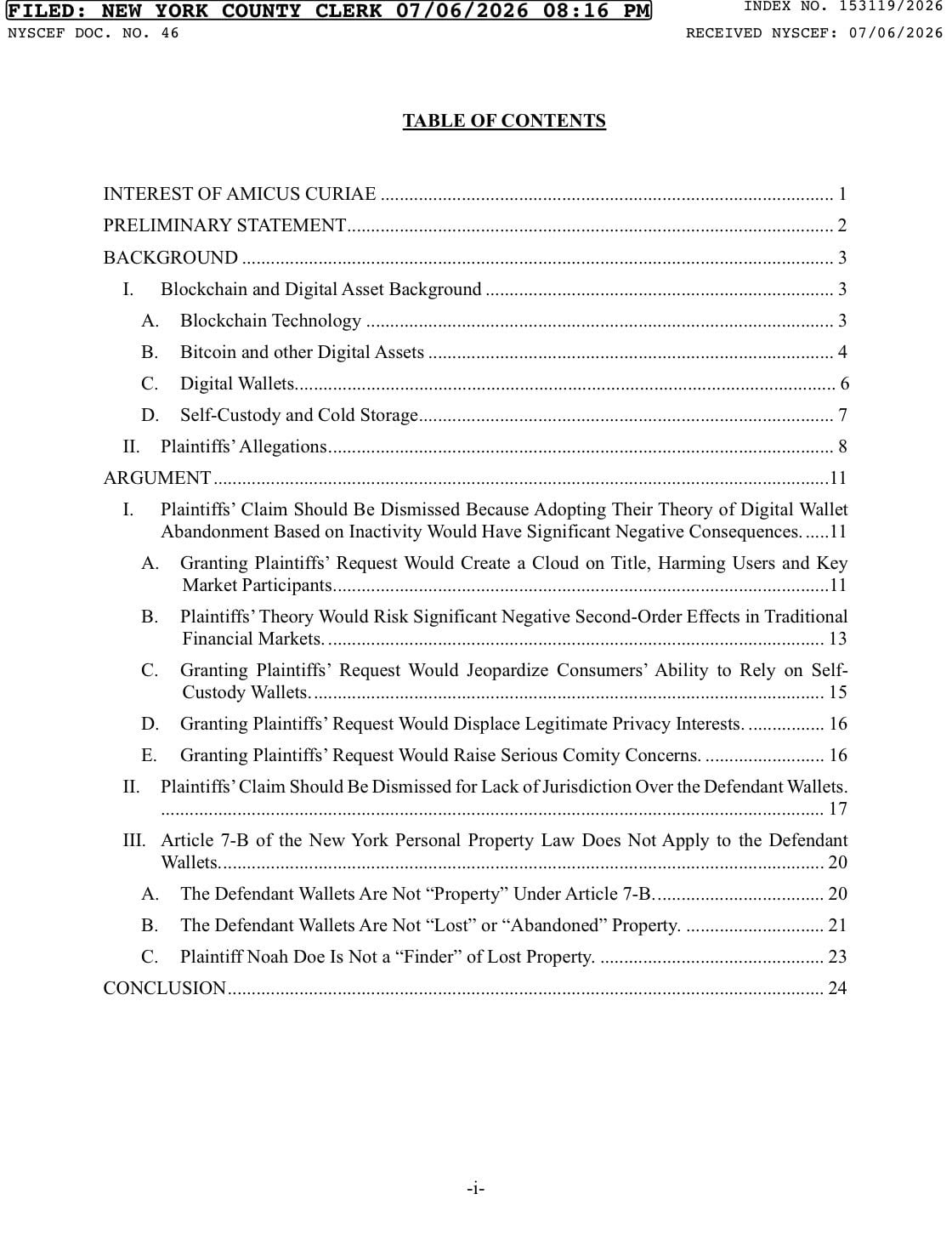
The Digital Chamber, a lobbying organization for the crypto industry, has filed an expert amicus brief with the New York State Supreme Court, urging the court to dismiss a lawsuit seeking to classify 3.8 million BTC as “abandoned property.”
The reason for the lawyers’ emergency intervention was an unprecedented lawsuit filed by an anonymous claimant, identified in court documents under the judicial pseudonym Noah Doe, who is trying to use New York’s 1958 lost-property law, Personal Property Law Article 7-B, to obtain rights to 39,069 inactive crypto wallets.
The list also includes addresses linked to Bitcoin creator Satoshi Nakamoto, while the total value of the Bitcoin at risk is estimated at $240 billion.

Why dormant Bitcoin wallets aren’t lost property
The plaintiff’s logic comes down to the idea that if something remains untouched for a long time, it can be declared “abandoned.” The anonymous claimant even sent court notices directly into the blockchain through the technical transaction field OP_RETURN and, after receiving no response, demanded that the coins be handed over to him.
According to the filed document, the Digital Chamber argues that old legal norms are completely inapplicable to blockchain assets and points to three key factors:
- The absence of transactions from wallets for many years is a classic case of holding Bitcoin, not a waiver of property rights.
- Granting the lawsuit would create permanent legal uncertainty, or a cloud on title, for all cold-wallet holders.
- A legal article governing “items found on the street” cannot regulate decentralized digital addresses.
You Might Also Like

While the court is reviewing the filing, the blockchain itself is refuting the plaintiff’s claim about “dead” wallets. According to Galaxy Digital, 31 addresses from the court list suddenly became active over the past month, with unknown owners moving a total of 17,527 BTC.
In addition, one actual holder has officially entered the case under the defensive pseudonym John Doe 33 and demanded that the lawsuit be dismissed, telling the court that he is a living person, not an inanimate line of data.
At the moment, the New York Supreme Court judge has temporarily stayed all proceedings in the case to prevent the plaintiff from winning by default due to the absence of the other 39,000 wallet owners. The next hearing, where the court will consider the Digital Chamber’s filed objection, is scheduled for July 14, 2026.



Be the first to comment