
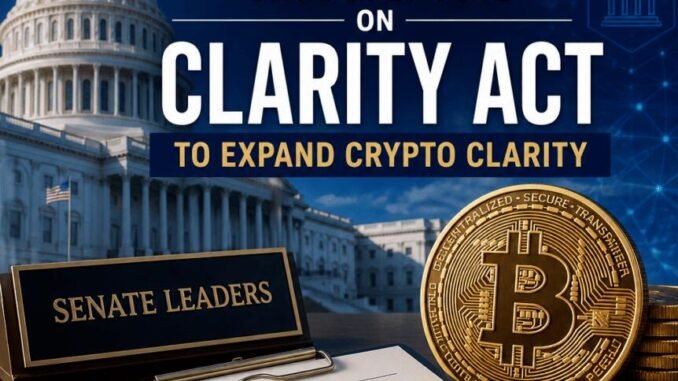

The fate of the US Digital Asset Market Clarity (CLARITY) Act has become harder to predict as lawmakers head into another round of state work periods and President Donald Trump disrupts the legislative calendar by delaying related signings.
After clearing the US House in July 2025 and advancing through the Senate Agriculture Committee and Senate Banking Committee in January and May respectively, the CLARITY Act is still positioned for Senate consideration—potentially as early as July. But recent presidential actions and broader concerns inside Congress, particularly around ethics and how the bill treats stablecoin-related issues, have introduced fresh uncertainty for investors and crypto businesses waiting for regulatory clarity.
Key takeaways
- The CLARITY Act passed the US House in July 2025 and advanced through two Senate committees on party-line votes, but its path to the full Senate remains exposed to scheduling and political conditions.
- President Donald Trump canceled a signing ceremony for a separate housing bill that includes a CBDC ban, tying his signature to passage of the SAVE America Act—adding unpredictability to the legislative outlook.
- Senate Republican leaders have said they want a CLARITY vote in July, but Democrats’ demand for ethics provisions could complicate the math.
- With the Senate needing 60 votes to proceed on many matters, any failure to reach that threshold before August could push debate into the next Congress.
- Senator Cynthia Lummis said the bill’s latest work focuses on areas including DeFi, illicit finance, and ethics, with lawmakers aiming to release text around July 4 before moving forward in July.
CLARITY’s stalled momentum enters a tighter window
Since its House passage in July 2025, the CLARITY Act has faced a series of internal and stakeholder challenges that delayed a clean march toward the Senate floor. According to earlier reporting, it has drawn pushback from parts of the industry, including around stablecoin rewards, while also attracting scrutiny from lawmakers concerned about ethics.
Procedurally, the bill advanced in the Senate in steps. It cleared the Senate Agriculture Committee in January and the Senate Banking Committee in May, with those panels voting along party lines. That movement placed CLARITY on a path toward potential full-chamber consideration, but the calendar has continued to matter as much as the votes themselves.

Now, with the US Senate scheduled to be out of Washington, DC and in state work periods until July 13, Republican leaders are effectively working with a shortened window to move the bill before an August state break lengthens the delay risk.
Trump’s broader legislative pause clouds the near-term outlook
While Trump’s comments and actions concerned a different piece of legislation, they still ripple into how the CLARITY timeline is being interpreted across Washington.
Trump canceled the signing ceremony for the 21st Century ROAD to Housing Act—reportedly because it contains a ban on central bank digital currencies (CBDCs). The president said he would not sign the bill until Republicans in Congress pass the SAVE America Act, which would require voters to provide proof of US citizenship in person to register.
Trump also indicated in March that he would “not sign other bills” until SAVE America is enacted. If that stance extends to the CLARITY Act or related legislative efforts, the bill’s timing could face further complications, even if the Senate reaches agreement.
The question then becomes whether Trump would ultimately sign CLARITY if it lands on his desk. The Constitution provides a mechanism if a president neither signs nor vetoes a bill within 10 days while Congress is in session: the measure would automatically become law. Otherwise, if Trump vetoes CLARITY, Congress could still override him with a two-thirds vote in both chambers.
That framework means the clock is not only about Senate scheduling; it is also about how quickly CLARITY could reach Trump’s desk in a Congress that is already planning around recurring legislative breaks.
Senate Republicans press for a July vote—but ethics demands raise the stakes
Senate Republicans have publicly argued for momentum. Republican leaders, including Senate Banking Committee chair Tim Scott and majority leader John Thune, said they are pushing to pass CLARITY in July.
However, passing legislation in the Senate is rarely just about whether a bill exists—it is also about whether the coalition can meet the thresholds required for floor action. With Republicans holding a slim majority, the Senate often needs some level of Democratic support to move quickly. Many Democratic lawmakers have pushed for ethics provisions in CLARITY.
Those demands have been tied to broader concerns about potential conflicts of interest, referencing reporting about the Trump family’s connections to the crypto industry through the president’s memecoin and his sons’ involvement in the World Liberty Financial platform and a Bitcoin mining company.
If Republicans are unable to secure the support needed to reach the Senate’s 60-vote threshold before the August state work period, experts cited in earlier coverage expect passage could slip into the next Congress—potentially 2027. For stakeholders, that matters because “clarity” delayed can be nearly as costly as clarity denied: businesses may continue operating under patchwork enforcement, and market participants may remain cautious until rules stabilize.
Where the bill stands: DeFi, illicit finance, and the push to release text
Even as scheduling becomes the central political variable, lawmakers have also continued to refine the substance. Senator Cynthia Lummis, a prominent CLARITY proponent, told Fox Business that negotiations have been ongoing for months and emphasized that the bill’s remaining work includes multiple contentious areas.
In comments published last week, Lummis said lawmakers are still working on “DeFi,” “illicit finance,” and “ethics,” describing the process as arduous. She added that the goal is to put out the bill’s text around July 4 so “people” can review it thoroughly, followed by movement in July.
“We’re still working a little bit on DeFi, we’re working [on] illicit finance, we’re working [on] ethics [..] We’re finally to the point where we’re going to put out the text over the July 4th, and give people one last really thorough look at the bill, and then we’re moving in July.”
That sequencing is significant. Releasing draft text close to a major holiday can compress the time for stakeholders to analyze changes and for lawmakers to negotiate amendments—while also signaling that the bill is still not “final-final.” For investors and builders, that implies the next few weeks could feature meaningful edits rather than mere procedural motion.
At the same time, ethics-focused amendments remain a live wire. If Democrats insist on changes tied to conflict-of-interest concerns and Republicans resist, the Senate’s ability to reach a supermajority—or even to command broad enough support for the path to proceed—could remain uncertain right up to the critical vote window.
What to watch next
Readers should watch whether Senate leaders stick to a July push before the July 13 break, and—just as importantly—what changes appear when CLARITY text is released around July 4. The ethics negotiations will likely determine whether the coalition can clear the Senate’s 60-vote hurdle, while Trump’s broader willingness to sign or hold other bills may influence how investors think about timing after the Senate acts.



Be the first to comment