

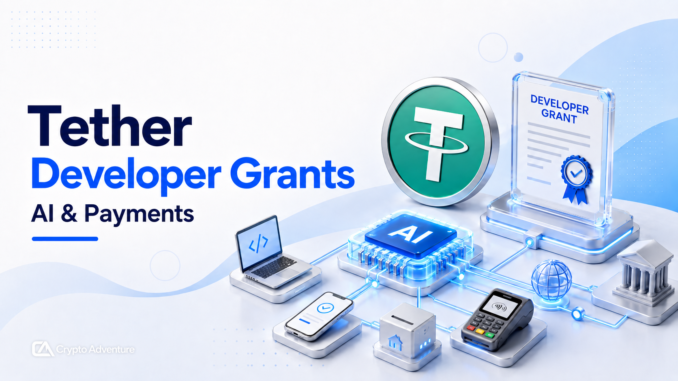
Tether has launched a developer grants program to fund builders working on local-first AI, wallet infrastructure, browser extensions, e-commerce integrations and decentralized payment tools.
The program is open now through tether.dev and has no total payout cap. Tether said grants will be paid in USD₮ or Bitcoin and tied to specific technical deliverables rather than broad, open-ended funding. Current individual payouts range from roughly $1,500 to $4,000, depending on the task and completed work.

The launch gives Tether a clearer developer-infrastructure push beyond stablecoin issuance. The company is trying to support software that runs locally, holds value directly, and reduces dependence on hosted APIs, custodians, exchanges and centralized cloud providers. That direction fits Tether’s broader messaging around peer-to-peer finance, Bitcoin support, open-source tooling and self-custody.
Tether CEO Paolo Ardoino said most infrastructure forces developers into trade-offs between centralized platforms and incentives built around user data. “If you can build something that runs locally, holds value directly, and doesn’t rely on external providers, we’ll fund it,” he said.
QVAC And WDK Sit At The Center
The grants are organized around Tether’s growing open technology stack. That includes QVAC, a local AI platform designed to run inference directly on devices instead of sending data to remote servers. Tether is positioning QVAC as an alternative to cloud-dependent AI systems, where costs, latency and data exposure can increase as products scale.
The payment side centers on WDK, Tether’s Wallet Development Kit. WDK is designed to let developers embed self-custodial wallets directly into applications, generate and manage keys locally, sign transactions and move funds without relying on custodial services or hosted APIs.
Tether said grants will support core libraries for QVAC, MDK, WDK and Pears, along with documentation, onboarding resources, applications, decentralization research, edge AI, peer-to-peer networking, cryptography, tooling, integrations and open standards. Each grant is attached to a defined task, payout and deadline.
Payments, AI And USDT Infrastructure Converge
The grants arrive as Tether’s stablecoin footprint continues to expand across payment and settlement rails. Tether recently minted another $1 billion USDT on Tron, pushing renewed attention toward the network’s role in low-cost dollar transfers and exchange settlement.
The developer program points to the next layer of that strategy. Stablecoin supply gives markets liquidity, but applications need wallets, signing tools, local data services, payment modules and user-facing interfaces that can operate without fragile third-party dependencies. Tether is trying to fund those components directly, especially where AI agents, local inference and self-custodial payments overlap.
The company also linked the program to its history of open-source support, including grants to BTCPay Server Foundation, support for OpenSats and education funding through the Plan₿ initiative in Lugano.
Tether’s new grant model gives developers a more direct path into its infrastructure stack: build a defined component, meet the deliverable and receive payment in USDT or Bitcoin. The measurable follow-through will come from the tools that ship from the program, especially wallet integrations, local AI modules and payment applications that can move stablecoin utility beyond exchange balances and into software people actually use.



Be the first to comment