



Circle’s euro stablecoin EURC just recorded the busiest days in its four-year history, and the numbers still fit in a small town.
Santiment data shows EURC printed 1,760 daily active addresses and 713 new wallets in a single day this week, both all-time highs, arriving almost immediately after July 1, the date a MiCA license became mandatory for serving EU customers across all 27 member states.
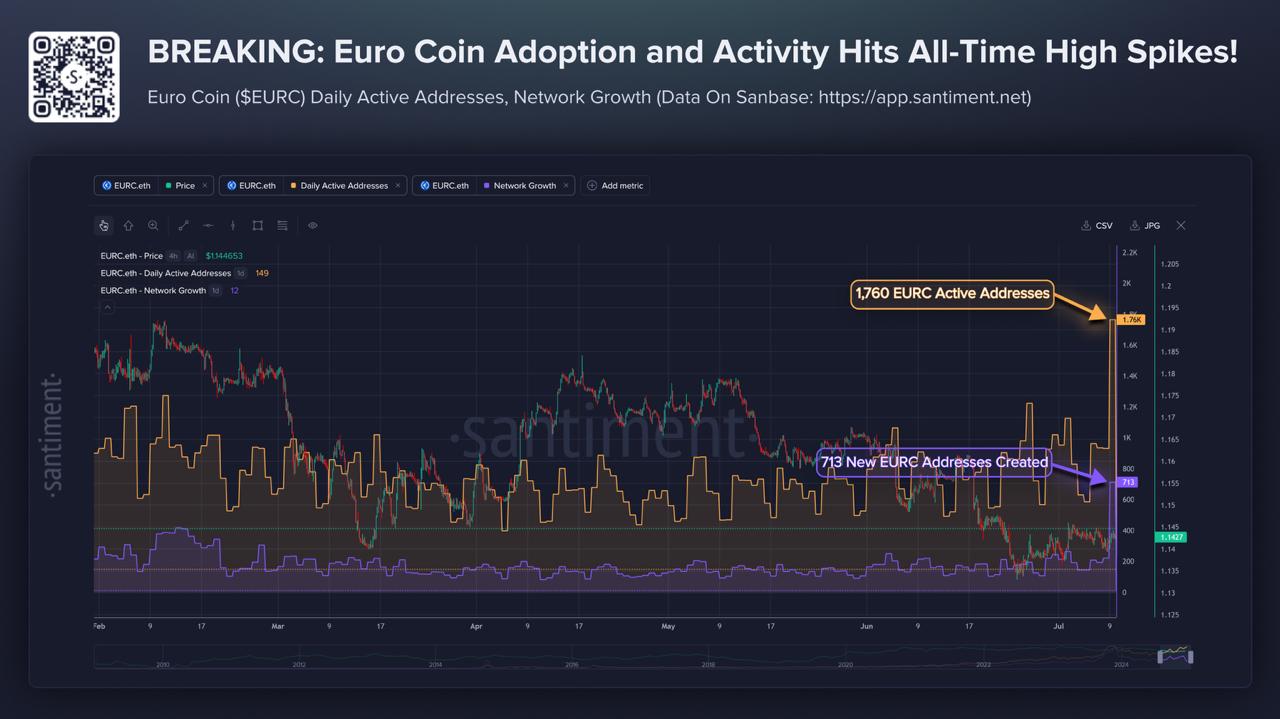
The new-wallet figure is the meaningful one. Active addresses can spike when existing holders shuffle funds; record wallet creation means fresh users are arriving. With unlicensed platforms locked out of Europe, payment teams and apps need compliant assets, and a euro token issued under Circle’s French-regulated entity is one of the few on the shelf.
The longer trend runs the same direction. EURC’s market cap has grown from under $100 million a year ago to roughly $430 million, tracking MiCA’s phase-in almost step for step, per Coinglass data. For a stablecoin that is the demand chart, since the price is pinned to one euro and adoption shows up in supply, not candles.
So the compliant euro lane is getting traffic. Then came July 9, and a number that puts the records in scale.
Teng’s 70%
Binance did not obtain a MiCA license in time and suspended EU services, forcing millions of users to decide where their balances go. CEO Richard Teng gave the result: roughly 70% of withdrawn funds moved to self-custodied wallets. Only 30% landed on MiCA-compliant platforms, reported by Yahoo Finance.
Given a forced choice between regulated venues and their own keys, most affected users took the keys, moving assets outside both Binance and MiCA’s oversight entirely. Teng said the quiet part himself, arguing the migration raises questions about whether the law is achieving its consumer-protection goals, since self-hosted wallets sit beyond the supervision the framework exists to apply. EURC exchange netflows corroborate the direction, printing sustained weekly outflows through the transition, including $1.43 million in the week of July 6.
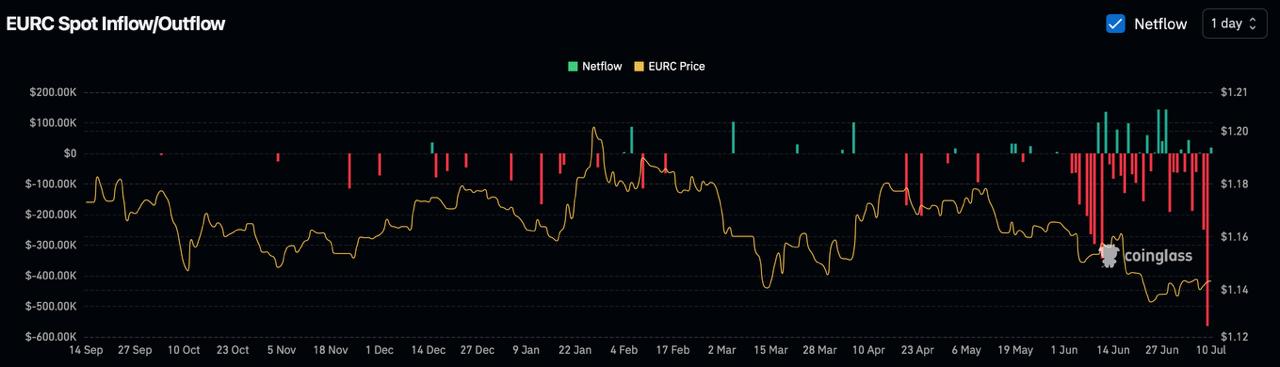
Put the two stories side by side and the gap is the point. EURC’s record day involved fewer than two thousand addresses; Binance’s European base numbered in the millions. All-time highs and irrelevance are coexisting on a $430 million base, while the self-custody exit absorbed the bulk of a major exchange’s EU float in days. Investors are sampling the compliant lane. Most of the money, so far, is declining to drive in it.
Two Weeks Is Not a Referendum
There are fair reasons to withhold the verdict. Self-custody may be a waiting room rather than a destination, since parking assets in a hardware wallet costs nothing while users watch which licensed venues earn trust, and Teng noted several EU jurisdictions have already invited Binance to apply for local licenses. If the exchange returns licensed, much of the 70% could flow back inside the perimeter and the July snapshot would read as transition friction. The euro-rail build-out also does not need Binance’s refugees: EURC’s growth is driven by platforms integrating a compliant instrument, the slower, infrastructural version of success MiCA’s drafters would settle for.
But the test is now defined, and it is measurable. EURC supply rising while the self-custody share shrinks would say Europe’s investors are accepting the framework. Records on a small base while 70% of forced movers choose their own keys says the acceptance is partial, and the burden of proof sits with the regulated lane. A rule built to bring users under supervision has, in its first two weeks, moved most of the affected money beyond it. That is the number MiCA will be judged against.
The information provided in this article is for educational and informational purposes only and does not constitute financial, investment, or trading advice.

Alex is Editor-in-Chief of Coindoo and co-founder of Millennial Media Group, with nearly a decade of experience covering financial markets – crypto first, then everything else.
It started in 2016 with Bitcoin. Like most people at the time, he didn’t fully understand it – so he kept digging. Blockchain, tokenomics, the projects, the cycles. That curiosity never stopped, and eventually pulled him into traditional markets too: equities, commodities, macro. Not because he left crypto behind, but because you can’t properly understand one without the other.
What drives him is straightforward: he wants to know why something is happening, not just that it’s happening. Most market coverage stops at the headline – price up, price down, here’s a chart. Alex finds that kind of reporting actively unhelpful. If you walk away from an article without understanding the mechanism behind the move, what did you actually learn?
He holds a degree in Tourism from New Bulgarian University – not the most obvious path into financial markets, but markets have a way of pulling in people who are simply too curious to stay out. He has authored over 200 in-depth analyses and more than 10,000 articles across crypto and traditional finance. He still thinks every day in markets teaches him something new. That’s probably why he hasn’t stopped.



Be the first to comment