

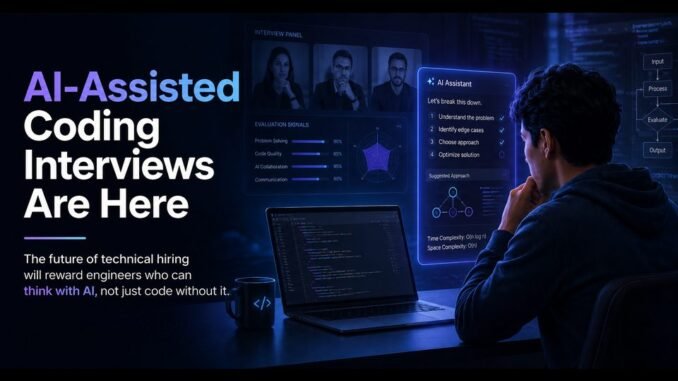

For years, the technical interview has been treated almost like a controlled laboratory experiment. A candidate enters an artificial environment, opens a blank editor, receives a problem, and is expected to produce a correct solution under time pressure. No real development environment. No AI tools. No search. No documentation. No teammate. No messy production code. No ambiguity beyond the problem statement. Just the candidate, the interviewer, and the expectation that good engineering ability can be measured through a short, isolated coding exercise.
That format made sense for a certain period in software history. When engineering work was more strongly associated with individual implementation speed, syntax recall, data structure fluency, and algorithmic problem solving, the traditional coding round had some relevance. It gave companies a way to filter candidates at scale and compare them through a somewhat standardized process. But software engineering has changed dramatically. The tools have changed. The workflows have changed. The expectations from developers have changed. Most importantly, the way engineers now create software has changed.
Today, developers are not just writing code line by line. They are reading existing systems, debugging unfamiliar codebases, integrating APIs, interpreting documentation, reviewing generated suggestions, writing tests, refactoring legacy modules, and making trade-offs between speed, reliability, security, and maintainability. Increasingly, they are also doing all of this with the help of AI coding assistants. Tools like Gemini, ChatGPT, GitHub Copilot, Cursor, Claude, and other AI-native development environments have already entered the daily workflow of millions of developers. For many engineering teams, AI is no longer an experimental add-on. It is becoming part of the development stack.
This creates a major gap in technical hiring. Most companies are still assessing developers as if AI does not exist, while most developers are already working in environments where AI is becoming unavoidable. The result is a mismatch between how companies hire and how engineering work actually happens. A candidate may be excellent in a real development environment but perform poorly in a restricted interview that bans every tool they would normally use. Another candidate may perform well in a conventional coding round but struggle when asked to review AI-generated code, debug a complex issue, or make judgment-based decisions in a real codebase. The traditional interview is no longer capturing the full signal.


This is a significant signal from one of the most influential engineering organizations in the world. Google is not simply making interviews easier by allowing candidates to use AI. It is acknowledging that the nature of engineering competence itself is changing. The future developer will not be judged only by whether they can write code from scratch. They will also be judged by whether they can understand code quickly, ask the right questions, use AI responsibly, identify flawed outputs, improve generated solutions, and explain the reasoning behind technical decisions.
That distinction is important. Allowing AI in interviews does not reduce the need for talent. It raises the bar in a different direction. When AI can generate a solution in seconds, the value of the engineer shifts from simply producing code to evaluating whether that code is correct, safe, efficient, scalable, and appropriate for the problem. AI can accelerate output, but it cannot replace engineering judgment. It can suggest patterns, but it cannot fully understand business context. It can generate a function, but it may miss edge cases. It can produce tests, but it may not know what matters most in production. It can make a weak candidate look productive for a moment, but over time, only strong reasoning can separate reliable engineering from superficial output.
This is where the hiring challenge becomes more serious. If every candidate can use AI, then the final answer alone becomes a weaker signal. A polished submission does not automatically prove strong engineering ability. It may only prove that the candidate knew how to ask an AI assistant for help. Hiring teams now need to understand the process behind the output. Did the candidate break down the problem properly? Did they understand the existing codebase? Did they blindly accept the AI’s suggestion or challenge it? Did they test the generated code? Did they notice hidden assumptions? Did they improve the architecture? Did they explain trade-offs clearly? Did they know when not to use AI?
These are the new signals that technical assessments need to capture.

The old interview model was built around scarcity of help. The new engineering model is built around abundance of assistance. That does not make developers less important. It makes their decision-making more visible and more valuable. In a world where AI can generate ten possible solutions, the developer’s job is to know which one deserves to exist. In a world where AI can complete repetitive tasks, the developer’s job is to define the right task in the first place. In a world where AI can produce code quickly, the developer’s job is to ensure that speed does not come at the cost of reliability, maintainability, or security.
This is why code comprehension may become more important than pure code generation in interviews. Real engineering rarely starts with a blank file. Most developers join existing systems. They inherit old decisions. They work with incomplete documentation. They debug issues introduced by someone else. They modify code they did not originally write. They need to understand context before changing behavior. An interview that asks candidates to read, debug, and optimize existing code is much closer to actual engineering work than one that asks them to solve an isolated algorithmic puzzle under artificial constraints.
The introduction of AI makes this even more relevant. A candidate who can use AI to summarize a codebase, identify likely failure points, compare possible fixes, and then independently validate the right solution may be far more useful than someone who simply memorized interview patterns. But this ability has to be assessed carefully. AI fluency is not just prompting. It includes knowing how to inspect outputs, how to ask follow-up questions, how to detect hallucinated logic, how to write targeted tests, and how to maintain ownership of the final answer.
Research on AI-assisted software development supports this broader concern. Studies have found that developers already use AI assistants for code generation, security-related tasks, vulnerability detection, and development support, but they also remain cautious because AI-generated code can introduce quality and security risks. This means the future of software work is not about replacing developer judgment with AI output. It is about combining AI speed with human verification and responsibility.
Another recent study on developer productivity in the age of AI coding assistants argues that productivity cannot be measured only through short-term output. It points toward a more holistic view that includes long-term ownership, technical understanding, and human-centered factors. This is highly relevant for hiring because the same principle applies to candidate evaluation. A hiring process that only measures whether code was produced quickly may miss whether the candidate truly understood the problem, owned the solution, and could maintain it in a real engineering environment.
This shift also matters because AI is changing what junior and mid-level engineering work looks like. Historically, junior engineers were often evaluated on how quickly they could implement small tasks or solve standard problems. But in an AI-assisted environment, implementation alone becomes less differentiated. The more valuable junior engineer is the one who can learn quickly, ask precise questions, use tools intelligently, verify outputs, and develop strong engineering habits early. For mid-level engineers, the bar moves further toward system understanding, debugging maturity, code review ability, and practical judgment.
That means technical hiring can no longer treat AI as a cheating risk alone. For a long time, many companies responded to AI in assessments by trying to block it, detect it, or design around it. That approach may still have a place in certain contexts, but it cannot be the full strategy. If developers are expected to use AI at work, then interviews must eventually evaluate how they use it. A company that bans AI completely during hiring may end up testing for an outdated version of engineering. A company that allows AI without structure may end up measuring tool output instead of candidate ability. The better path is controlled, observable, AI-assisted assessment.
This is the important middle ground. AI should not be secretly used by candidates in a way that hiring teams cannot evaluate. It should be openly integrated into the assessment design. Candidates should know what tools are allowed. Interviewers should know what behaviors to observe. The task should be built to test reasoning, not just completion. The scoring should capture the candidate’s process, not only the final code. This creates a fairer and more realistic evaluation environment.
For companies, especially startups and fast-growing engineering teams, this is not just a philosophical issue. It directly affects hiring quality. Technical hiring is expensive. Bad hires are costly. Slow hiring cycles hurt growth. Overly rigid assessments filter out strong candidates. Overly easy assessments create false positives. In an AI era, the risk of false signal becomes even higher. A candidate can produce impressive-looking code with limited understanding. Another candidate may demonstrate strong reasoning but be undervalued by outdated screening systems. Hiring teams need better tools to separate genuine engineering ability from AI-generated polish.
This is why the next generation of technical assessments will likely move away from simple pass-fail coding tests and toward workflow-based evaluation. Instead of asking, “Can this candidate solve this problem without help?” companies will ask, “Can this candidate solve real engineering problems in the way our teams actually work?” That includes understanding requirements, working inside a realistic coding environment, using AI as a support layer, validating the output, debugging, improving tests, explaining trade-offs, and producing maintainable code.
The change will also affect how companies define merit. In the past, a strong candidate was often the one who could reach the optimal answer fastest in a constrained setting. In the future, a strong candidate may be the one who can navigate ambiguity best. The one who can use AI without becoming dependent on it. The one who can move fast while still checking assumptions. The one who can identify when the AI is confidently wrong. The one who can combine problem-solving, communication, debugging, and tool fluency into a single workflow.
This is especially important because AI-assisted development can create a dangerous illusion of competence. Code may compile but still be architecturally weak. A solution may pass basic tests but fail at scale. A generated answer may look elegant but misunderstand the domain. A candidate may be able to prompt effectively for common tasks but fail when the problem becomes unfamiliar. Hiring teams need assessments that reveal these differences. The future interview will not only ask candidates to produce output. It will ask them to defend the output.
Google’s reported pilot is therefore not just another interview update. It is part of a wider market signal. When a company of Google’s scale starts experimenting with AI-assisted technical interviews, it tells the rest of the industry that AI-native evaluation is moving from an edge case to a serious hiring design problem. Other companies will watch closely. Some will adopt similar formats. Some will create hybrid interviews where AI is allowed in one round and restricted in another. Some will build role-specific simulations. Some will continue using traditional tests for a while, but the direction of travel is clear.
The software interview is becoming less about isolation and more about collaboration with tools. Less about memorized patterns and more about applied judgment. Less about writing code in a vacuum and more about understanding, debugging, improving, and validating code in context.
For candidates, this shift means preparation will also change. Learning data structures and algorithms will still matter, but it will no longer be enough. Developers will need to become better at explaining their reasoning. They will need to show how they use AI responsibly. They will need to demonstrate code review discipline. They will need to understand testing, debugging, and system behavior more deeply. They will need to prove that AI makes them stronger, not careless.
For hiring teams, the shift is even bigger. They will need to redesign assessments around real work. They will need to decide which AI tools are allowed, what kind of tasks are appropriate, how to observe candidate behavior, how to score AI usage, and how to prevent the assessment from becoming either too subjective or too easy to game. They will need to move beyond the final answer and evaluate the workflow behind it.
This is where a new category of technical hiring infrastructure is emerging. The industry needs systems that can create realistic coding assessments, allow controlled AI assistance, track how candidates approach problems, and generate structured evaluation signals for hiring teams. The goal is not to replace interviewers or make hiring fully automated. The goal is to give companies better evidence. Better evidence about how candidates think. Better evidence about how they debug. Better evidence about how they use AI. Better evidence about whether they can contribute inside a modern engineering team.
That is the larger problem Swiftcruit has been quietly building around. The platform is based on a simple belief: modern developers should be assessed in modern development conditions. Instead of relying only on outdated coding tests, it helps teams create role-specific technical assessments inside AI-assisted workflows, evaluate how candidates reason and debug, and generate structured scorecards that make hiring decisions clearer. The focus is not on whether a candidate can avoid AI. The focus is on whether they can use it with judgment, ownership, and technical depth.
Swiftcruit fits into this shift because it treats technical assessment as a workflow, not a memory test. Its approach is built around the way developers actually work today: understanding a role-specific problem, using AI as part of the coding environment, validating generated suggestions, debugging issues, improving code quality, and explaining trade-offs clearly. For hiring teams, this creates a stronger signal than a traditional coding test because it does not only show whether a candidate reached the final answer. It shows how they got there, how much judgment they applied, and whether they can use AI responsibly without outsourcing their thinking. As AI becomes part of everyday engineering, platforms like Swiftcruit can help companies move from outdated screening formats to assessments that reflect real developer capability.

Discuss this news on our Telegram Community. Subscribe to us on Google news and do follow us on Twitter @Blockmanity
Did you like the news you just read? Please leave a feedback to help us serve you better
Disclaimer: Blockmanity is a news portal and does not provide any financial advice. Blockmanity’s role is to inform the cryptocurrency and blockchain community about what’s going on in this space. Please do your own due diligence before making any investment. Blockmanity won’t be responsible for any loss of funds.



Be the first to comment