


The Bitcoin network’s quantum defense has seen a major step forward this week. On the 27th of August, the StarkWare and MARA Foundation teams announced that they conducted the “first known quantum-resistant” Bitcoin transaction.
Reacting to the milestone, Eli Ben-Sasson, CEO of StarkWare, hailed the update as “huge” for the path forward for the post-quantum era for Bitcoin and other chains.
This is huge! First, because the fact that we can have a quantum-safe tx on Bitcoin is a real accomplishment. Second, it shows that we can actually find and implement solutions to make Bitcoin and other chains, quantum-ready. We just need to decide that this is the path forward.
Currently, Bitcoin at rest, especially behind most modern wallet addresses such as Pay-to-Public-Key-Hash (P2PKH) and Native SegWit (P2WPKH), is quantum resistant. They only show a hash, which hides the public key on public blockchains.
While this makes it challenging to crack by quantum computers, the moment one spends using these addresses, the actual key is revealed to the blockchain.

This makes reusing these addresses susceptible to theft if quantum computers arrive. To close this gap, StarkWare came up with a solution.
Bitcoin’s quantum-safe transfers without a softfork
In April 2026, StarkWare’s Avihu Levy floated a scheme called “quantum-safe Bitcoin (QSB) transactions” that would improve security without the need for a softfork. The goal? Offer quantum-resistant protection during BTC’s spending process.
This would buy the network time as it explores a protocol-level or consensus change for a network-wide upgrade.
But the only current challenge to the QSB scheme is that it can only work with private mempools (a waiting room before miners validate or confirm transactions). This particular transaction was made possible by MARA’s private mempool Slipstream.
Speaking on the same, Isabela Foxen, head of the MARA Foundation, said,
While we don’t believe private mempools are an appropriate long-term solution for Bitcoin quantum resistance, we’re happy to explore ways Slipstream can support break-glass techniques while we wait for a consensus change.
Separately, Adam Back’s Blockstream also released a Bitcoin Improvement Proposal (BIP) for a post-quantum signature scheme dubbed SHRINCS.
The firm called it a “very good trade-off” amongst current options for the final network-wide upgrade.
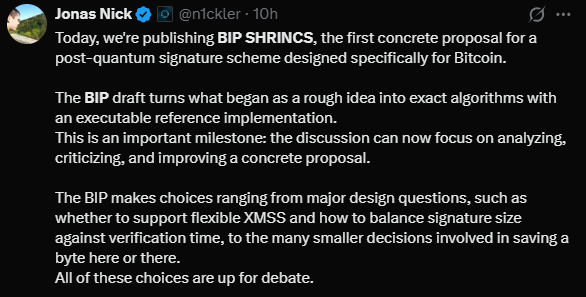
Despite Adam Back downplaying the immediacy of quantum threats, his firm has been actively behind the scenes to fast-track its advancement. Still, the BIP will need to be discussed, criticized, and improved before it can be adopted as the ultimate post-quantum upgrade.
Currently, the market is pricing only a 5% chance that such an upgrade could happen this year.
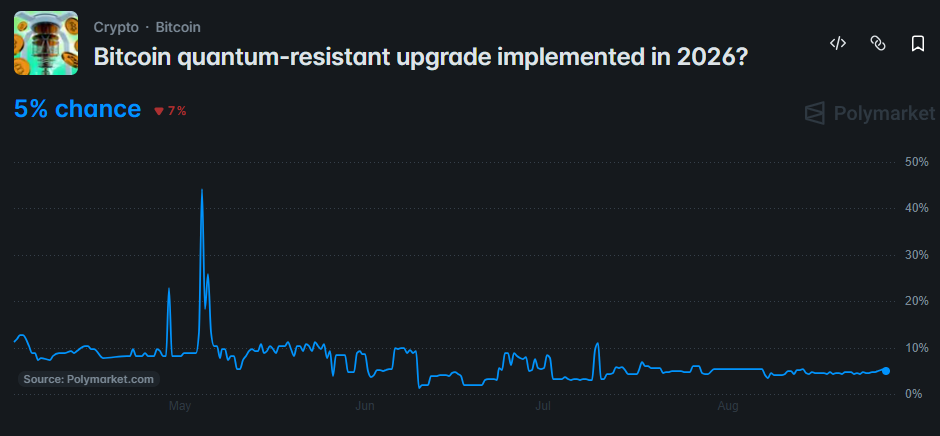
Overall, Bitcoin’s first quantum-safe transaction without a softfork is commendable and positive. However, a final and lasting network-wide upgrade pathway remains uncertain as of writing.
Final Summary
- Bitcoin recorded its historic quantum-safe transaction via a private mempool
- The market was pricing only a 5% chance of a final network-wide post-quantum upgrade



Be the first to comment