



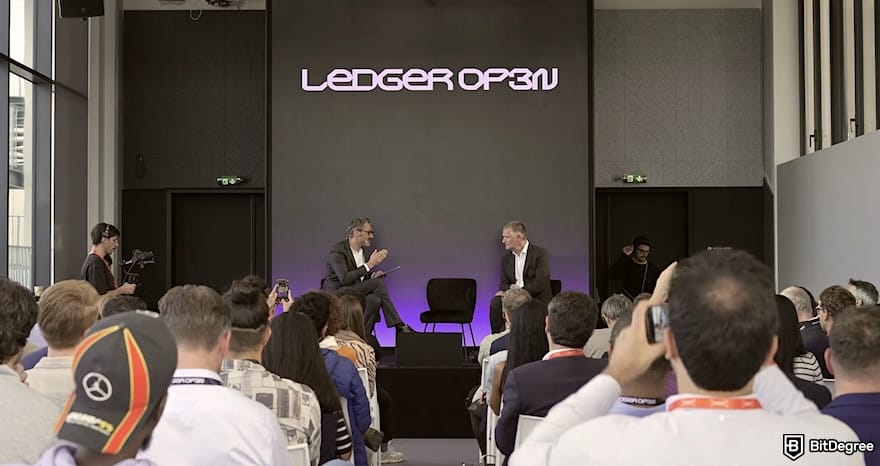
Ledger announced the Ledger Atom on 15 October 2026 at its Op3n event in Paris. The Ledger Atom is a new device from Ledger that runs everyday Android apps and signs crypto transactions in a separate secure mode. The Founders Edition costs $849. It ships in summer 2027, pending certification.
Ledger does not call the Atom a hardware wallet or a phone. This article explains what the Atom does, what is new, and what Ledger has not shared yet.
BitDegree was at the event. Ledger invited BitDegree to Op3n 2026 and covered travel; this coverage is our own.
What the Ledger Atom Is


Did you know?
Subscribe – We publish new crypto explainer videos every week!
Where to Trade Crypto: 3 Best Approaches Explained (Animated)


Ledger describes the Atom as its first device that pairs a connected signer with a mobile operating system, without giving up the security of a Ledger signer. The Atom runs two modes side by side on physically separate chips. Standard Mode is the mobile OS for everyday life, and Secure Mode runs Ledger OS on a Secure Element, a chip with a CC EAL6+ certification.
A custom hardware switch, driven by Ledger OS, cuts Standard Mode off from the screen and touch panel when a sensitive action starts. Ledger says software on the mobile OS, even a compromised app, cannot override this; the seed stays in the Secure Element and approvals stay under your control. The team says its hardware security covers select built-in and partner apps, not every app you install. App availability will be confirmed before shipping.
Ledger’s shop page lists a 6.77-inch AMOLED screen, a 50 MP rear camera, a 32 MP front camera, a 4,000 mAh battery, and a fingerprint sensor in the power button. It also supports 5G eSIM, Wi-Fi, NFC, and USB-C. The Atom measures 164 x 78 x 9 mm and weighs 250 g. RAM, storage, and the chip are not listed yet. Ledger says only that the battery should last more than a day.
How the Two Modes Work
Standard Mode uses the Android Open Source Project, while Secure Mode switches to Ledger OS. Ledger’s whitepaper says the two modes share one display and touch panel, with a patented hardware isolation built so Android cannot bypass it.
An FPGA (a chip with configurable logic) runs in two modes, and only Ledger OS can command a mode change. In Secure Mode, Ledger OS takes over the whole screen, and a bar called the Secure Bar shows when Ledger OS is in control. It also says the Ledger OS firmware, the MCU firmware, and the FPGA bitstream are each signed by Ledger and checked at boot.
Therefore, if Android is hacked, it should not be able to fake the signing screen. However, this is Ledger’s design claim. Independent researchers have not tested it on shipped units yet.
What Ledger Says You Can Do With the Atom
Ledger says the Atom does more than any of its earlier signers. It names five uses:
- Apps and signing in one device. Secure Mode covers the moments that matter, such as approving a transaction. Everyday apps run on the Android side for everything else.
- Control over AI agents. Ledger says agents can propose actions, but you review each one on the secure screen before it runs. Agent Intent is already live and free on Nano Gen5, Flex, and Stax, so you do not need an Atom for it, but the Atom gives the best experience.
- Crypto management. You can manage your portfolio, digital payments, and DeFi in the Ledger Wallet app. Each transaction is on the Secure Screen.
- dApp access. It is possible to connect to dApps and review the details before you approve.
- Privacy switch. One physical switch cuts the camera and microphone at the circuit level.
Two more features are new with the Atom. The first is Solana Mobile’s Seeker app, which comes preinstalled. According to the Solana Mobile and Ledger announcement, it combines a wallet with the Solana dApp Store, which lists more than 1,500 dApps. The second is encrypted private messaging, though details about how the feature works have not yet been disclosed.
Ledger says the Atom is for people who build with AI agents, those with digital wealth and the organizations that protect it, those who hold digital assets and want to use them, and those who value reliable privacy.
The October Reseller Incident
The announcement came five days after Ledger confirmed a hardware implant in signers sold by CryptoBilis, a reseller in Southeast Asia. Ledger said on 9 October that it was investigating customer losses, and confirmed the implant on 10 October.
The Block reports that Ledger’s security team says the implant captures the 24-word recovery phrase during setup and sends it over LTE. Loss estimates of $86M-$93M are on-chain estimates, unconfirmed by Ledger. Ledger says the Atom’s tamper protection is designed to block this type of implant.
Ledger Atom Price and Release Date
The Ledger Atom price is $849 for the Founders Edition. You can reserve one with a refundable deposit. Ledger says you can cancel for a full refund before it ships. Founders buyers also get a $50 BTC voucher, a protective accessory and screen protector, a Ledger Recovery Key, and an optional three months of Ledger Recover.
Ledger’s terms say the cellular bands may still change before launch, and the final price may be calculated from its euro price, so it can move before you pay.
There is no fixed Ledger Atom release date yet, but it is expected in summer 2027, pending certification (such as FCC). The Atom is sold only through Ledger.com.
For context, Ledger’s Nano and Flex devices cost between $69 and $399. The Atom costs more than double the top of that range. Most people do not need that. If you want a signer you can buy today, read my Ledger Flex review.


Be the first to comment