



Tokenized equities are moving closer to regulated markets as the US Securities and Exchange Commission prepares to finalize an “innovation exemption” that could reshape how stocks are issued and traded on-chain.
SEC Moves Toward Tokenized Equities Framework
The US Securities and Exchange Commission (SEC) is preparing to release a formal framework for tokenized stocks, Bloomberg reported, citing people familiar with the matter.
The plan would allow crypto platforms and DeFi protocols to offer digital representations of public company shares with reduced compliance requirements and is expected to be finalized this week.
A Shift in How Stocks Enter Crypto Markets
In practice, the SEC’s “innovation exemption” would function as a regulatory sandbox allowing crypto platforms and DeFi protocols to trade tokenized stocks without first securing full broker-dealer or national exchange licenses, as long as they operate within defined limits and reporting requirements.

A key controversial element is that these tokenized stocks could, in some structures, be issued by third parties without direct approval from the underlying companies, meaning they may track the price of a stock without being traditional equity ownership.
However, regulators are expected to consider imposing guardrails, potentially requiring removal from listing if tokens do not provide core shareholder rights such as voting power or dividends.
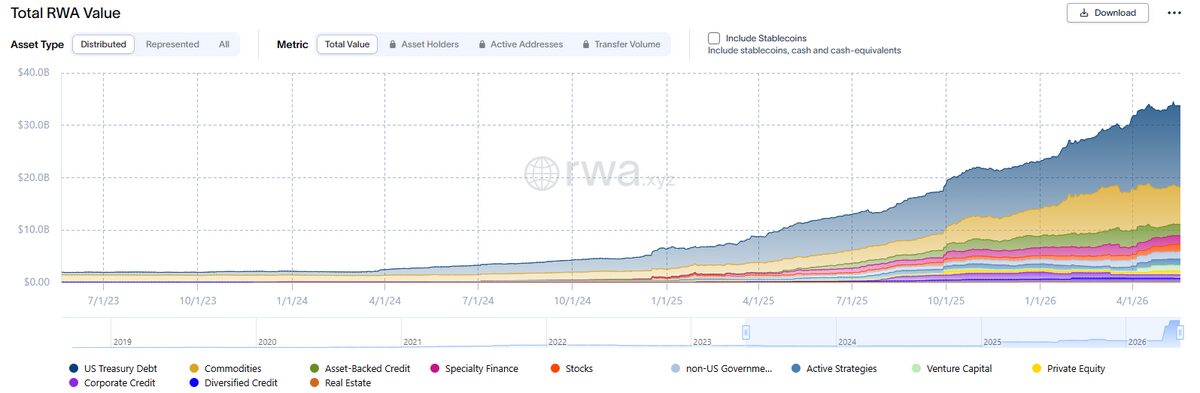
Tokenized stocks currently represent about $1.43 billion in value, according to RWA.xyz, a fraction of the broader $33.7 billion tokenized real-world asset market.
The Race to Capture Tokenized Equities
The potential policy shift has prompted crypto platforms and infrastructure providers to prepare for a regulated on-chain equities market.
Kraken: Early Lead, Geographic Limits
Kraken is among the most established players in tokenized real-world assets.
Its xStocks product has generated more than $25 billion in trading volume, offering regulated perpetual exposure to equities including Apple, Nvidia, and Tesla with leverage of up to 20x across 110 countries.
However, access remains restricted in key markets, including the US, UK, Canada, and Australia. Domestic participation would depend on finalized SEC rulemaking.
Coinbase: Distribution Advantage, Regulatory Gap
Coinbase combines a large US retail base with its Layer-2 network, Base, but has avoided direct exposure to tokenized equities pending regulatory clarity.
The company recently integrated Yahoo Finance data into its consumer app, tightening the loop between price discovery and trading activity.
Long term, Coinbase aims to host tokenized assets on Base. In the near term, it remains constrained by licensing requirements, including potential Alternative Trading System authorization or explicit SEC exemptions.
If regulatory pathways open, Coinbase’s distribution advantage could become a decisive factor.
Ondo Finance: The Infrastructure Layer Emerging
Ondo Finance operates further down the stack, positioning itself as a core issuance and settlement layer for tokenized assets.
The protocol supports more than 260 tokenized US equities and ETFs across Solana, Ethereum, and BNB Chain, with $3.76 billion in distributed assets.
In May 2026, Ondo completed a cross-border tokenized Treasury settlement involving J.P. Morgan, Mastercard, and Ripple, executed in under five seconds.
The company has also confidentially filed a registration statement with the SEC. Approval would make it one of the first regulated issuers of transferable tokenized equities in the US.
Unlike exchanges, Ondo is not competing for end users. It is positioning itself as the underlying infrastructure for platforms that may emerge once regulatory access expands.
Investor Rights and Market Structure at Stake
The SEC’s decision is less about a new asset class and more about market architecture.
If the exemption proceeds as expected, it could shift equities trading toward crypto-native venues while embedding traditional financial instruments into blockchain settlement layers.
The outcome will depend on how regulators define ownership, custody, and investor protections, not just whether tokenized stocks are permitted.
Explore DailyCoin’s popular crypto news today:
HBAR-Powered AI Startup Gets Handpicked By Google
UK’s First Water Credit System Now Flows Through Algorand
People Also Ask:
It is a proposed regulatory framework that would allow crypto platforms and DeFi protocols to test tokenized stock products under lighter regulatory requirements within a controlled environment.
Tokenized stocks are digital representations of public company shares issued on a blockchain. They are typically designed to track the price of the underlying equity.
Not always. Depending on the structure, tokenized stocks may not include full shareholder rights such as voting power or dividend entitlements.
DailyCoin’s Vibe Check: Which way are you leaning towards after reading this article?






Be the first to comment