

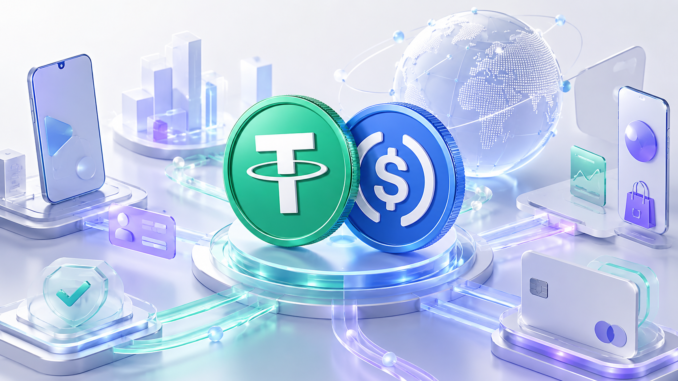
Crypto spent years selling itself through volatility. Prices moved fast, communities formed around tokens, and a lot of early Web3 products assumed users were comfortable holding assets that could swing sharply in a single session. That worked for traders. It did not always work for normal platform use. The next wave of digital platforms is being built around a simpler idea: most users do not want every transaction to feel like a market position. They want speed, access and stable value. That is why USDT, USDC and other fiat-pegged assets have become so important.
Stablecoins are no longer just parking spots between trades. They are becoming the connective tissue between traditional finance and decentralized platforms. Stablecoin payments typically start from a customer wallet and move through a payment request that defines the amount, asset, destination address and blockchain network. That sounds technical, but the user logic is simple: move a digital dollar from one place to another with less friction.

Utility Is Beating Speculation
The most important change in Web3 is not cosmetic. It is behavioral. Users are becoming more selective. They may still hold Bitcoin, ETH or other Layer-1 tokens as investments, but they do not necessarily want to use volatile assets for every app, game, marketplace or subscription. That is where stablecoins fit. USDT and USDC give users a familiar unit of value while keeping the speed and programmability of blockchain rails. One dollar-like token is easier to understand than constantly converting between asset prices.
The transition from volatile Layer-1 tokens to fiat-pegged assets is redefining how users interact with modern decentralized applications (dApps). By removing the anxiety of price fluctuation, platforms can focus on providing a more consistent service loop. Today, USDT and USDC have become the industry standard for high-speed transaction environments, a trend visible across major ecosystems like xtp.com, allowing for a smoother transition between a user’s digital wallet and active balance without the overhead of market timing. That is the real story. Stablecoins make Web3 feel less like a trading desk and more like usable infrastructure.
The Volatility Hedge
Volatility is exciting when someone is actively trading. It is annoying when someone is trying to use a platform. Imagine depositing ETH into a digital platform and leaving it there for an hour. If ETH drops during that time, the user’s balance has changed before the platform experience has even finished. That creates an unnecessary second layer of risk. Stablecoins reduce that problem. They allow users to separate platform activity from portfolio exposure.
That separation matters for:
- Gaming platforms
- Creator marketplaces
- Digital subscriptions
- Cross-border apps
- DeFi tools
- Online services with fast settlement needs
The point is not that stablecoins remove all risk. They still depend on issuers, reserves, networks and platform execution. But they reduce one obvious problem: the balance does not have to move just because the broader crypto market is having a bad day. For non-speculative activity, that is a major usability upgrade.
Why USDT and USDC Became the Default
Stablecoins have reached scale because they solve a plain problem. Users need a digital unit that behaves more like cash than a volatile token. DefiLlama’s stablecoin dashboard shows total stablecoin market capitalization at more than $320 billion, with USDT holding the largest share and USDC among the biggest dollar-pegged assets. That scale matters because liquidity creates confidence. Users go where the markets, wallets, exchanges and platforms already support the asset.
USDT tends to dominate where liquidity depth and broad exchange support matter most. USDC is often favored where transparency, compliance posture and institutional integrations are more important. Usability depends heavily on route costs, issuer controls and where the token will actually be used. That is a mature way to look at it. The question is not only “Which stablecoin is best?” The better question is “Which stablecoin works best for this specific platform, network and user journey?”
The Institutional Trust Layer
Stablecoins also matter because institutions are no longer treating them as a side issue. Reuters reported that Circle’s quarterly revenue and reserve income rose to $694 million, supported by demand for USDC during market volatility, with USDC circulation up 28 percent year over year to $77 billion. That kind of growth shows how stablecoins are becoming part of the mainstream financial infrastructure conversation, not just a crypto-native convenience.
The institutional interest is easy to understand. Stablecoins offer a bridge between bank money and on-chain movement. They are programmable, fast and globally accessible, while still being denominated in a familiar unit. For developers, this matters because a platform built around stablecoins can design with more predictable accounting. Pricing, balances, rewards, subscriptions and settlements can all be expressed in a unit users already understand. For users, it lowers the cognitive load. They do not need to keep asking, “What is this worth right now?” The answer is meant to stay close to one dollar.
The UX Shift in dApps
The most successful dApps in 2026 are not necessarily the ones with the most exotic token mechanics. They are the ones that make blockchain disappear into the background. That sounds strange, but it is where the industry is heading. Users should not need to think about market timing every time they interact with a platform. They should not need a spreadsheet to understand what they spent. They should not feel punished for choosing the wrong moment to use an app.
Stablecoins help because they create a calmer user experience. A good stablecoin flow lets a user move from wallet to platform, use the service, and understand the balance without constantly translating from crypto volatility into real-world value. That is why stablecoins are especially useful in high-frequency environments. The more often users transact, the more important stable denomination becomes.
The Next Web3 Standard
Stablecoins are not replacing Bitcoin, ETH or Layer-1 assets. Those assets still have their own roles in settlement, security, collateral and investment portfolios. But for everyday platform use, the market is clearly moving toward stability. The “stablecoin-ization” of Web3 is really about product maturity. Speculation brought people into crypto. Utility is what keeps them using it.
USDT and USDC are driving that shift because they reduce friction at the exact point where many platforms used to lose users: pricing, settlement and balance management. The next generation of digital platforms will not win because they make users feel like traders all day. They will win because they make blockchain feel normal. Stablecoins are how that starts.


Be the first to comment