



AI Summary
- A JPMorgan and Oliver Wyman report presented in the source material identifies XRP as a possible settlement instrument while also flagging volatility and spread costs.
- Ripple’s potential role in cross-border payments depends on more than transaction speed because banks also require liquidity, compliance, risk controls and reliable integration.
- Oliver Wyman’s separate work with Ripple describes service providers as an important route into digital assets for institutions that cannot build complete systems internally.
- Institutional research establishes that Ripple and XRP are being evaluated, but it does not prove deployment, adoption or future transaction volume.
The common narrative around Ripple is that recognition by major financial institutions automatically validates widespread use of XRP. The concrete fact in the supplied material is narrower: a cross-border payments report associated with JPMorgan and Oliver Wyman mentioned Ripple’s infrastructure and XRP as a potential settlement instrument while also identifying volatility and spread costs as barriers.
That distinction matters. Institutional research can establish that a technology belongs in the evaluation set without proving that banks have selected it for production. Our analysis is that the strongest case for XRP bank integration rests on its proposed settlement function, but the decisive questions concern liquidity, compliance, operational control and the ability to connect with existing financial infrastructure.
The broader context comes from Oliver Wyman’s work with UK Finance, JPMorgan and Ripple. Together, the cited materials describe a financial sector examining distributed ledgers, CBDCs and private digital assets as possible components of future market infrastructure. They do not establish that XRP has been adopted across the global banking system.

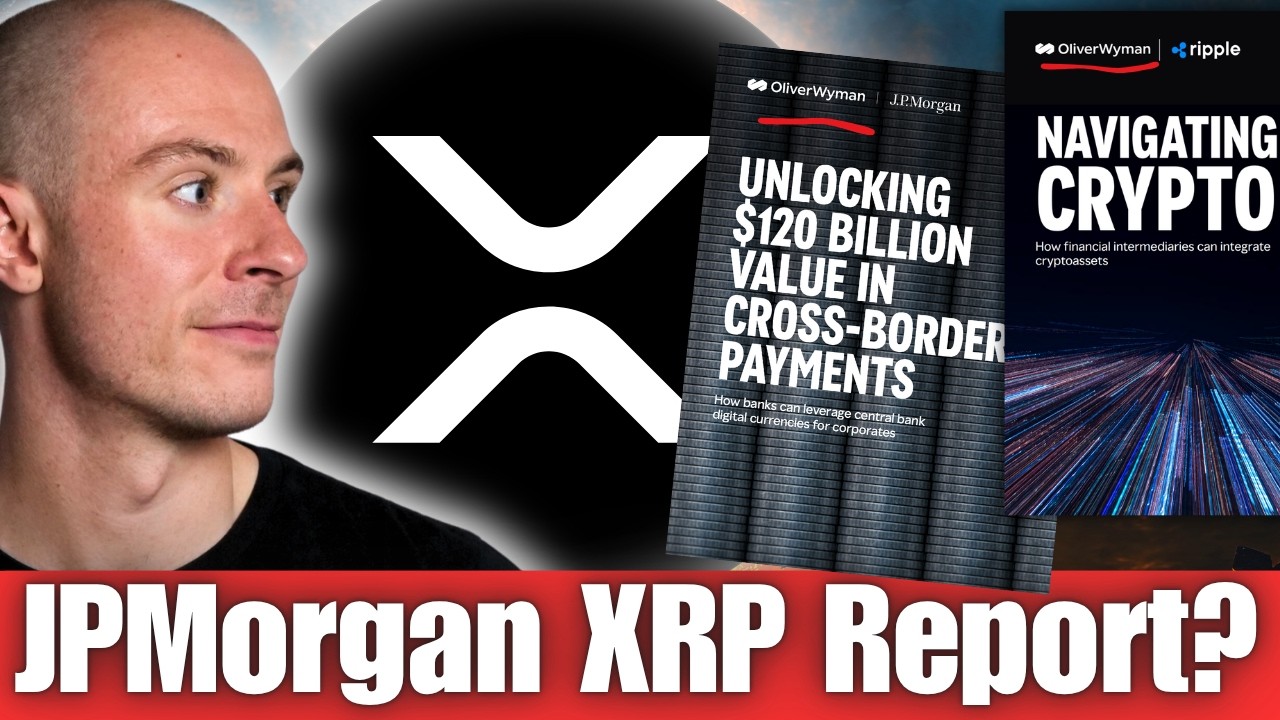
JPMorgan Mention Ripple XRP As A Solution…. Rabbit Whole!
JPMorgan’s reference identifies both utility and friction
The report described in the source material examines how banks could use multi-central-bank digital currency arrangements for corporate cross-border payments. Within its comparison of commercial and central-bank initiatives, it includes Ripple and identifies XRP’s intended role directly:
Ripple cross-border payment infrastructure intends to use cryptocurrency XRP as a settlement instrument.
This is relevant because it places Ripple inside an institutional assessment of payment infrastructure rather than treating XRP solely as a traded crypto asset. However, a reference in a research report is not an implementation announcement, partnership confirmation or commitment by JPMorgan to use XRP.
The same material records objections that are central to bank adoption:
High volatility of the XRP leading to limited willingness from banks in using uh it to facilitate payments, relatively high costs owning to spreads between fiat and XRP.
The wording is imperfect because it comes from the transcript, but the underlying issues are clear. A settlement asset must be judged across the full conversion path, not merely by the fee charged by its underlying network.
- Volatility: Price movement during the payment process can change the economics of a transfer.
- Spreads: Converting fiat into XRP and back can introduce costs beyond the protocol fee.
- Liquidity: Institutions need sufficient depth in the required currencies and jurisdictions.
- Control: Banks need compliance, reporting and risk procedures around every stage of settlement.
Cross-border economics create the opening
The opportunity exists because conventional correspondent banking can be expensive, slow and difficult to track. Figures cited in the source describe global corporates moving nearly $23.5 trillion across borders annually, with approximately $120 billion in annual transaction charges. The cited average cross-border fee was $27 before foreign-exchange costs, while settlement could take two to three days.
Those figures were presented as report data associated with an earlier period; they should not be treated as a current market measurement without the underlying document and methodology. Even so, the pain points they illustrate are coherent:
- Cost: Multiple institutions and currency conversions can add fees and spreads.
- Time: A payment may remain unsettled across business days and operating windows.
- Visibility: Corporate users may have limited information about payment status.
- Settlement risk: Delays create exposure while obligations remain incomplete.
XRP’s proposed value is to act as a bridge settlement instrument within this process. The investment thesis is therefore not simply that the XRP Ledger can transfer value quickly. It is that a service using XRP might reduce the capital, coordination and waiting time required to move between currencies. Whether it achieves that result depends on the complete service and market structure surrounding the ledger.
Oliver Wyman connects payment reform with bank capability
Oliver Wyman is the connective institution across the material. It worked with UK Finance on “Building Digital Markets of the Future,” with JPMorgan on the cross-border payment analysis, and with Ripple on research concerning how financial intermediaries could integrate crypto assets.
The UK Finance connection supplies useful context, particularly alongside AllinCrypto’s reporting on the UK Finance tokenization push. It shows that distributed ledger technology is being assessed as financial-market infrastructure. It does not, by itself, make XRP the selected network or asset for that work.
The Ripple and Oliver Wyman research makes a broader institutional point:
Banks and other traditional intermediaries have shown interest in building capabilities to serve the demonstrated demand for crypto assets today and to position themselves for a future in which digital assets could become more important building blocks for the financial market infrastructure.
This is a capability thesis rather than a prediction about one token. Banks that learn custody, execution, short settlement cycles, provider oversight and digital-asset risk management may be better equipped to support future instruments. Those instruments could include crypto assets, stablecoins, CBDCs or tokenized products.
Bank adoption depends on an operational stack
The transcript identifies five areas institutions must address: strategic, technological, organizational, risk and regulation, and delivery. That list helps explain why a fast ledger is necessary but insufficient. A bank must integrate the asset and network into a governed service that satisfies customers, regulators and internal risk teams.
- Strategy: The institution needs a defined customer problem and commercial model.
- Technology: Systems must connect wallets, execution, records and existing payment infrastructure.
- Organization: Teams need ownership of provider management and digital-asset operations.
- Risk and regulation: Controls must address compliance, market exposure and operational failure.
- Delivery: Customers require a reliable service rather than access to isolated blockchain functions.
The research presented in the source suggests that integrated providers will be particularly important for smaller institutions:
For all but the largest institutions, service providers will be the main way through which banks and other intermediaries access crypto capabilities.
This creates a plausible commercial opening for Ripple. The company’s relevance would come from delivering a manageable integration point and sourcing the liquidity required for a payment or asset service. XRP usage remains a separate question: a Ripple product can be institutionally relevant without every function necessarily using XRP.
Ripple Liquidity Hub broadens the proposition
The supplied research also introduces Ripple Liquidity Hub as a platform through which businesses could buy, sell or hold crypto internally or for customers. It describes smart order routing, access to liquidity pools and optimized pricing across assets including Bitcoin and Ethereum.
That proposition shifts the analysis beyond one bridge asset. An institution evaluating Ripple may be interested in execution and access to multiple digital assets, while deciding independently whether XRP improves a specific payment corridor. For XRP holders, that separation is important because growth in Ripple’s institutional footprint does not mechanically establish demand for XRP.
Our view is that the stronger thesis treats XRP as one component in a broader institutional stack. Its potential advantage must survive comparison with direct fiat routes, CBDCs, stablecoins and other settlement arrangements. The transcript also references mCBDC structures and mBridge, demonstrating that banks and central banks are considering multiple architectures rather than converging on one solution.
What this means
1. Institutional recognition is evidence of evaluation, not adoption. Ripple and XRP appearing in research associated with JPMorgan and Oliver Wyman shows that the model was considered relevant enough to assess. It does not show that JPMorgan has selected XRP for its own payment operations.
2. XRP must solve the full transaction, not only ledger transfer. Speed and low protocol fees matter, but spreads, market depth, compliance and fiat conversion determine the final institutional cost.
3. Integration capacity may be Ripple’s most defensible institutional proposition. Banks often need a service provider that combines technology, liquidity and operational support. XRP benefits only where its settlement role produces a measurable improvement inside that service.
Bigger picture
The institutional environment described here fits a broader shift toward governed onchain infrastructure. AllinCrypto has reported on CFTC market-rule review as tokenization accelerates and an SEC innovation exemption aimed at onchain stock trading. These developments matter because regulated access and clear operating rules affect whether financial institutions can move from experiments to customer-facing services.
Technical readiness is equally important. Research covered in AllinCrypto’s analysis of XRP Ledger network hardening illustrates another part of the adoption test: infrastructure intended for financial use must remain dependable under adverse conditions.
We therefore see the JPMorgan reference as a meaningful data point, but not a final verdict. The credible case for XRP rests on demonstrable payment economics and resilient institutional delivery. Claims about inevitable integration or enormous future volume go beyond the evidence supplied.
XRP bank integration FAQ
Did JPMorgan announce that it will use XRP?
No such announcement is contained in the supplied material. The evidence is that a JPMorgan and Oliver Wyman report mentioned Ripple’s infrastructure and XRP as a settlement instrument while assessing cross-border payment initiatives.
Why could XRP be used in cross-border payments?
XRP is presented as an intermediary settlement instrument between currencies. The proposed benefit is faster settlement and potentially lower friction, provided that conversion spreads, liquidity and operational costs remain competitive.
What barriers did the cited report identify?
The source identifies XRP volatility, limited willingness among banks and costs arising from fiat-to-XRP spreads. Institutional users must also address technology, organization, regulation, risk and service delivery.
Does every Ripple service require XRP?
The supplied material does not establish that. Ripple Liquidity Hub is described as supporting access to multiple crypto assets, including Bitcoin and Ethereum, while XRP has a distinct proposed role as a settlement instrument.
How should the institutional evidence be interpreted?
It supports the conclusion that Ripple and XRP are part of serious institutional research into digital payments. It does not prove current deployment, guaranteed adoption or future price performance.
Sources
This article is for informational purposes only and does not constitute financial advice.



Be the first to comment