


XRP whale outflows from Binance have reportedly fallen to their lowest level in five years, with the 90-day moving average reaching $49.7 million as the cryptocurrency trades near $1.30 amid weak market momentum.
Summary
- Crypto analyst Darkfost reports that XRP whale outflows from Binance have fallen to a five-year low on a 90-day moving average.
- The reported average of $49.7 million is nearly 99% below the approximately $3.5 billion peak observed in February 2025.
- XRP trades near $1.30, with its daily moving averages indicating continued weakness despite attempts to stabilize.
- Analyst Carolina identifies a possible longer-term reversal pattern, but her price targets depend on confirmation and trading volume.
- An XRP Ledger bug-fix amendment could activate October 23, while the network’s lending proposals remain short of validator approval.
According to crypto analyst Darkfost’s October 20 assessment, the decline follows a prolonged fall in exchange withdrawals by large XRP holders since activity reached approximately $3.5 billion on the same measure in February 2025. The analyst believes the quieter market could indicate that major investors are waiting for more attractive prices before increasing their exposure.

The reported figure places Binance whale outflows around levels last observed in October 2021, based on Darkfost’s analysis. However, the observation concerns one exchange and a 90-day average, not all XRP transactions or purchases across the cryptocurrency market.
Meanwhile, XRP traded near $1.30 on October 20, with CoinGecko recording a daily range between $1.29 and $1.32. The cryptocurrency remained under pressure after a weekly decline, while daily chart indicators continued to favor sellers.
XRP whale outflows fall from the 2025 peak
Darkfost’s analysis identifies a substantial decline in the value of XRP leaving Binance wallets associated with large holders.
At the February 2025 peak, the analyst placed the 90-day average at approximately $3.5 billion. By October 20, 2026, that measure had fallen to $49.7 million, representing a decrease of roughly 98.6% from the reported high.
The peak figure was around 70 times the latest reading. Both amounts are dollar-denominated measures, so their movement can be influenced by changes in XRP’s market price as well as the number of tokens transferred.
Exchange outflows record assets moving from a trading platform to external addresses. Analysts sometimes examine large withdrawals for evidence of potential accumulation, although a withdrawal does not establish who ultimately owns the transferred tokens or whether the transaction represents a purchase.
Transfers between an exchange’s internal and external wallets, custody arrangements and other operational movements can affect flow data. A decline in outflows therefore does not necessarily mean large holders have stopped buying XRP.
Darkfost interprets the five-year low as a sign that whale activity has cooled significantly. He suggested that XRP’s relative resilience during the downturn may have left potential buyers waiting for prices they consider more attractive.
The analyst compared current conditions with 2022 and 2023, periods when lower XRP prices coincided with greater activity from large holders in his historical analysis. His latest observation does not identify individual investors or confirm their current intentions.
A 90-day moving average reduces the influence of isolated daily transfers and follows activity over a longer period. Since the measure incorporates approximately three months of observations, a decline does not describe only the most recent day’s behavior.
The reported outflow low should not be confused with falling exchange inflows. Deposits into an exchange and withdrawals from it measure opposite directions of movement, and neither metric alone establishes the volume of completed spot-market purchases.
XRP price remains below four major moving averages
While exchange withdrawals have slowed, XRP’s price chart continues to show weak buying momentum.
According to CoinGecko market data, XRP traded around $1.30 at press time, with a market capitalization near $82 billion and daily trading volume of approximately $1.28 billion. The 24-hour trading range stood between $1.29 and $1.32, while the seven-day range stretched from $1.26 to $1.38.
The daily technical chart places XRP below its four major exponential moving averages. Its 20-day EMA stands at $1.3689, the 50-day at $1.3743, the 100-day at $1.3353 and the 200-day at $1.3742.
Together, the averages form an area of potential resistance from approximately $1.33 to $1.37. A sustained recovery through those levels would place XRP above price points where the market has recently struggled to maintain momentum.
The Relative Strength Index stands at 36.49 in the supplied chart, below its signal average of 39.83. Readings below 50 generally indicate weaker upward momentum, while an RSI below 30 is commonly used as a reference for oversold conditions.
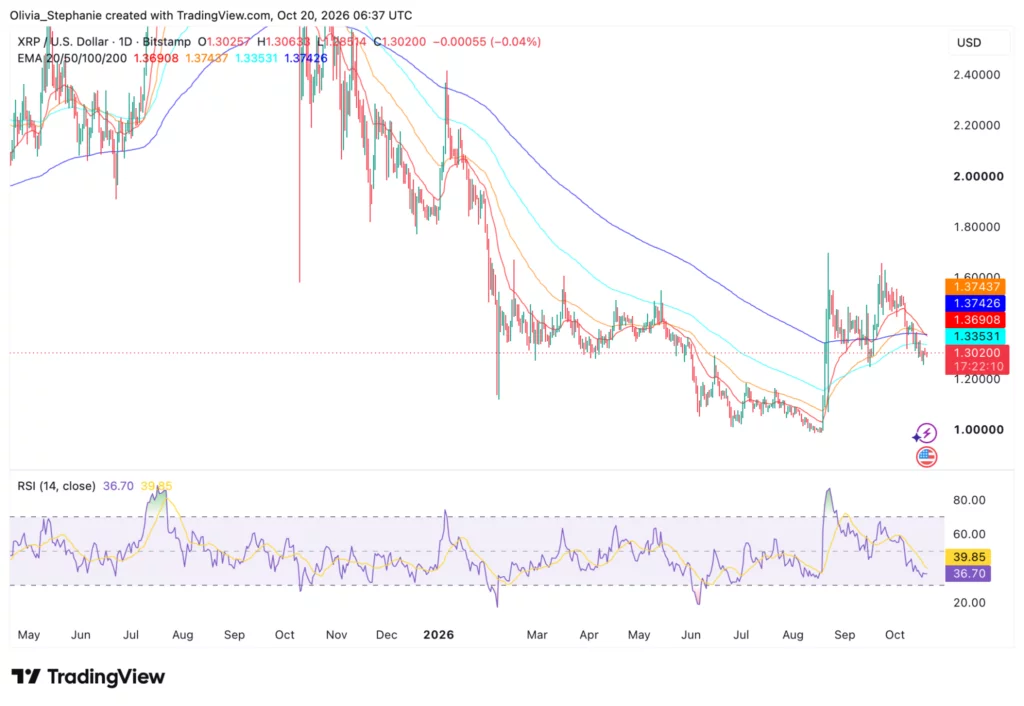
The indicator has not reached that lower threshold. Its current position does not establish that XRP must fall further, since RSI readings can remain weak or recover without a corresponding long-term trend change.
On October 19, crypto.news reported XRP’s price rebound to $1.31 following an earlier weekly period in which U.S. spot XRP ETFs recorded $1.84 million in net withdrawals, ending 13 consecutive weeks of inflows. The report discussed elevated exchange reserves, providing another measure of investor activity separate from Darkfost’s whale-withdrawal analysis.
However, spot XRP ETFs recorded zero net flows on October 19, with neither net inflows nor net outflows reported for the day. The flat daily reading differs from the earlier weekly withdrawals and does not establish a renewed trend of institutional buying or selling.
ETF fund flows reflect net subscriptions and redemptions of investment products, while Binance whale outflows measure cryptocurrency transfers from an exchange. The two indicators cover different markets and cannot be used interchangeably to determine whether large XRP investors are accumulating tokens.
Analysts identify $1.28 support and possible XRP recovery patterns
XRP’s immediate support region lies around 1.28–1.30, according to the October 20 technical assessment.
If selling takes the price below $1.28 and the breakdown holds, the next identified support zone is between $1.20 and $1.25. The analysis places another lower support area around 1.00–1.05, although a decline to either region remains conditional.
Initial resistance stands near the 100-day EMA at $1.3353. Above it, the remaining daily moving averages and recent trading highs form a more substantial barrier between $1.37 and $1.38.
The supplied assessment identifies a possible recovery toward 1.45–1.50 if XRP closes decisively above $1.38. Those levels are technical scenarios based on chart structure, not independently established future prices.
Crypto analyst Carolina has taken a longer-term view of the same market. In an October 20 post, she described an accumulation area developing across XRP’s historical chart and highlighted 0.50–0.60 as a potential support zone during a much deeper correction.
Carolina outlined a hypothetical sequence involving $1.50, $1.80 and $2.40 before a possible move beyond $3. Her longer-term scenario included $5, but she presented that level as a projection dependent on price behavior, not a guaranteed outcome.
In a separate analysis, Carolina suggested that XRP might be developing an inverse head-and-shoulders pattern near $1. The formation could continue into mid-December if its right shoulder takes a similar amount of time to develop as the left.
An inverse head-and-shoulders pattern involves a series of price lows that can resemble a central lower trough between two shallower ones. Technical analysts generally look for a move above the pattern’s neckline, accompanied by sufficient trading activity, before treating it as a completed bullish setup.
Carolina placed a possible target near $2.80 if the pattern is confirmed. The structure remains incomplete in her account, and a failure to establish the right shoulder or break the neckline would weaken the proposed scenario.
The difference between the two timeframes is substantial. XRP’s immediate chart focuses on the $1.28 support level and resistance near $1.38, whereas Carolina’s deeper accumulation zone lies far below the current market price.
XRP Ledger bug fix approaches October 23 activation
Developments on the XRP Ledger provide a separate network update while traders monitor price and exchange activity.
The fixCleanup3_4_0 amendment is approaching a possible October 23 activation after gaining enough validator support to enter the required two-week approval period. The software package addresses several technical issues involving transactions, automated market makers and proposed lending-related functions.
On October 19, the amendment had 29 affirmative votes among 35 trusted validators, meeting the minimum threshold under the network’s voting rules. Support must remain above 80% for two continuous weeks before activation can occur.
The latest XRPL amendment update placed the expected activation around 09:34 UTC on October 23, subject to validator support holding. The actual change would occur at an eligible flag ledger after the waiting period, not necessarily at the exact moment the period expires.
The proposed lending system remains at a different stage. LendingProtocol and its LendingProtocolV1_1 companion each had 19 affirmative votes as of the October 19 report, leaving them 10 votes short of the required 29.
SingleAssetVault, which would provide the pooled assets used by the lending system, had 21 supporting votes and needed another eight to meet the same threshold. The planned lending features therefore cannot be described as active merely because the unrelated bug-fix package is approaching approval.
The September software release introduced the updated lending amendment and the cleanup package through version 3.4.0 of the XRP Ledger server software. Its release made the new code available to operators, while separate validator approval remains necessary before the proposed rules take effect.
The October 19 tracker placed the confidentiality-related amendment at 22 supporting votes, below the required majority. Transaction batching had already activated on October 9, according to the network update.
Disclosure: This article does not represent investment advice. The content and materials featured on this page are for educational purposes only.


Be the first to comment