

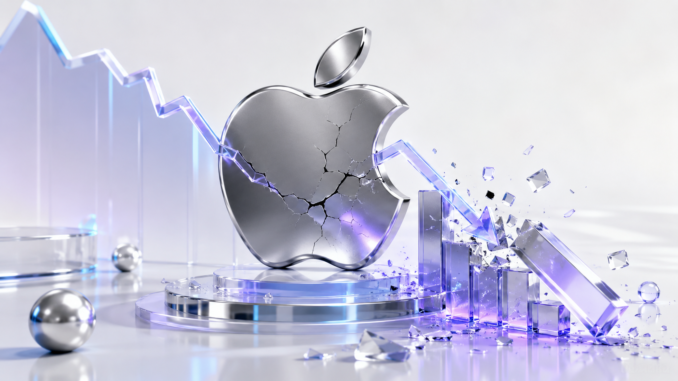
Apple erased roughly $230 billion from its intraday market value after unveiling Siri AI, as investors sold the stock even while the broader tech market finished higher.
AAPL touched about $317 during the session before closing at $301.54, down 1.89%. The widely shared 4.95% drop reflects the move from Apple’s intraday high to the close, not the decline from the prior closing price. Using Apple’s current share count, that peak-to-close slide equals roughly $230 billion in market value.
The selloff followed Apple’s biggest AI software reveal yet. The company introduced Siri AI, a rebuilt version of Siri with more conversational responses, personal context understanding, onscreen awareness, web answers, a dedicated app and deeper integration across Apple devices.
The update is part of the broader next generation of Apple Intelligence, covering iOS 27, iPadOS 27, macOS 27, watchOS 27, visionOS 27 and tvOS 27. Apple is making Siri AI available for developer testing first, with a user beta planned later this year.
Investors Wanted A Clearer AI Growth Signal
The market reaction suggests Apple’s AI update did not fully answer the question investors care about most: how quickly the company can turn AI into stronger growth, upgrades and services revenue.
Siri AI gives Apple a more credible assistant after years of criticism, but the rollout still carries limits. Apple said Siri AI will not initially be available on iOS and iPadOS in the EU, and the new Apple Intelligence features will not be available in China while the company works through regulatory requirements. That leaves two major markets outside the first wave of the iPhone and iPad rollout.
The timing also matters. Apple is trying to catch up while the rest of the AI market is raising, spending and listing at extreme scale. OpenAI’s confidential S-1 has pushed the AI IPO race deeper into public-market territory, while Anthropic’s $35 billion private-credit deal for Google TPUs shows how quickly AI companies are locking in dedicated compute.
Apple’s model is different. It is not trying to win the race by building the largest external model cluster or selling frontier AI subscriptions first. Its advantage is device distribution, privacy architecture, software control and integration across more than two billion active devices. Investors still want evidence that those advantages can produce a faster revenue cycle.
AI Trade Gets More Selective
Apple’s drop also shows that markets are becoming more selective inside the AI trade. Investors have rewarded companies tied directly to chips, data centers, private AI funding and compute bottlenecks. They are less patient with AI stories that sound strategic but do not immediately show monetization, launch certainty or platform control.
That pressure is spreading across the AI complex. Arthur Hayes recently warned that the AI bubble could burst if mega IPOs, higher energy costs and political pressure start hitting the same trade at once. Apple’s selloff is not the same as an AI-bubble collapse, but it fits the wider market mood: AI announcements now need to prove they can support valuations.
For Apple, the challenge is practical. Siri AI must become useful enough to change how people use iPhones, Macs, iPads and Vision Pro. It must also support upgrades, services engagement and developer activity without weakening Apple’s privacy pitch.
The first market verdict was harsh. Apple finally showed the Siri overhaul investors had been waiting for, but the stock still gave back nearly 5% from its intraday high. The next test is whether Siri AI can move from WWDC demo to user habit before investors decide Apple’s AI reset is still behind the curve.



Be the first to comment