



AI Summary
- Goldman Sachs reportedly plans to make Financial Square Treasury funds accessible through LYNQ, a private Avalanche network.
- The reported arrangement focuses on moving cash into fund shares and redeeming them within existing institutional trading infrastructure.
- Chainlink and Swift represent a separate but complementary effort to connect financial institutions with blockchain based transaction systems.
- Institutional adoption can strengthen demand for blockchain infrastructure without automatically transferring equivalent value to its associated tokens.
- Claims about a coming altcoin repricing remain speculative and should be separated from the concrete infrastructure developments.
Institutional blockchain adoption is often presented as a broad promise about a future financial system. The more concrete development in the supplied source is narrower: Goldman Sachs reportedly plans to make its Financial Square Treasury funds accessible through LYNQ, a private Avalanche layer one network. It is another reason to examine Avalanche infrastructure as an institutional rail rather than treating AVAX only as a traded asset.
The same source describes parallel initiatives involving Chainlink, Swift, Coinbase, Citi and Morgan Stanley. Together, these reports support a measured conclusion: regulated firms are testing how tokenization, stablecoins and blockchain connectivity can fit existing financial operations. They do not, by themselves, establish that every associated token will capture the economic value created by that infrastructure.
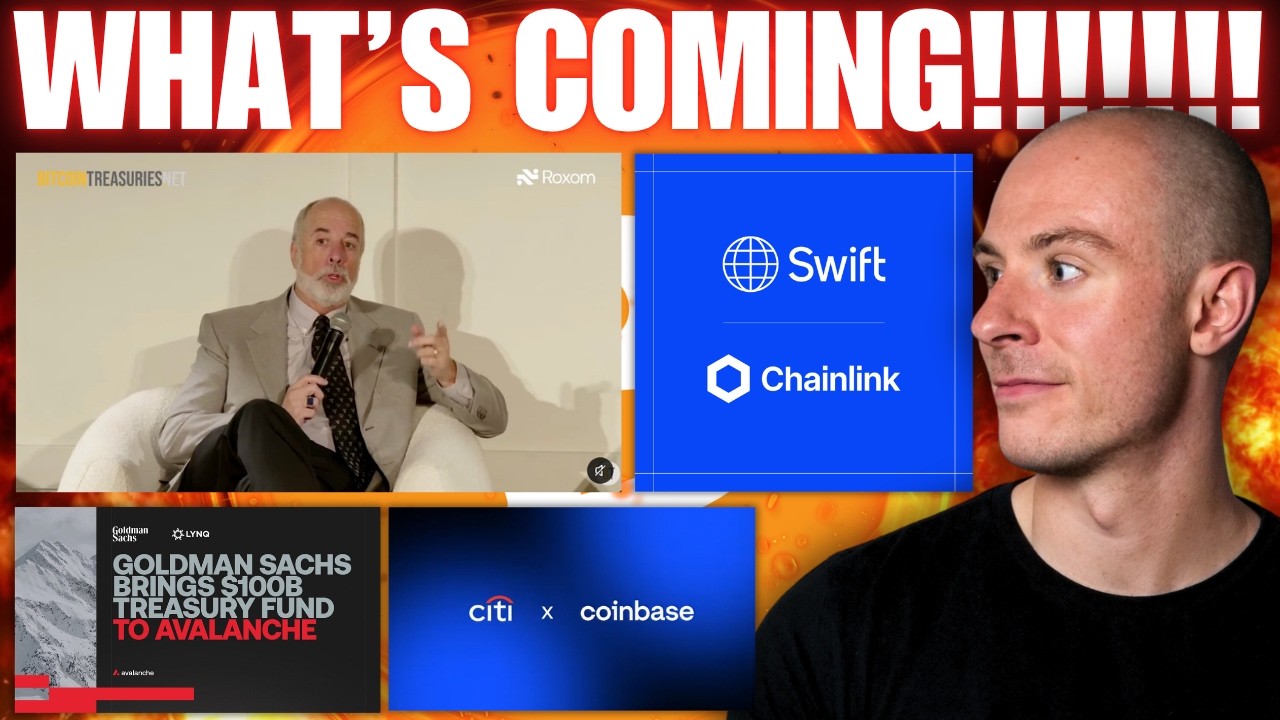
This Will SHOCK Even The Most Bullish People! Swift, Chainlink, Coinbase, Citi, Goldman, AVAX, Ondo!
Treasury funds meet private Avalanche infrastructure
The reported Goldman Sachs arrangement concerns Treasury fund access inside institutional trading infrastructure. According to the source, clients would be able to move cash into the fund and redeem shares without leaving that environment. Access would occur through regulated broker dealers, with the source contrasting immediate processing with the T+1 settlement convention it identifies for eligible US participants.
Goldman Sachs is integrating its hundred billion dollar financial square treasury instruments funds onto LYNQ, a private avalanche layer 1 network that already serves over 30 firms like B2C2 and Galaxy.
This is a source-backed claim rather than an independently documented announcement in the material supplied to us. No Goldman Sachs or LYNQ primary document was provided. That limitation matters, particularly for the reported $100 billion figure: it describes the referenced fund complex and should not be interpreted as $100 billion already issued, settled or deposited on Avalanche.
- Named institution: Goldman Sachs is the reported fund provider.
- Named network: LYNQ is described as a private Avalanche layer one.
- Operational objective: The reported design keeps subscriptions and redemptions close to existing trading infrastructure.
- Necessary caveat: The supplied material does not quantify completed transactions or resulting demand for AVAX.
The distinction between access and migration is essential. A financial product can become available through blockchain connected infrastructure without all its assets, records or cash flows moving onto a public network. Our analysis therefore treats this as evidence of institutional experimentation with Avalanche treasury rails, not proof of wholesale market conversion.
Chainlink and Swift target institutional connectivity
A second reported development places Chainlink between financial institutions and a Swift blockchain ledger. The source says institutions in the Swift community would be able to read from and write to that ledger, supporting tokenized deposits and continuous cross border payments. It also presents Chainlink Runtime Environment as a connectivity layer for onchain systems.
This matters because institutional tokenization is not only a question of which ledger records an asset. Banks also need ways to connect existing systems, coordinate messages and execute workflows across different environments. The recent scrutiny of Chainlink in settlement infrastructure illustrates why interoperability claims require careful analysis alongside the underlying asset rails.
- Ledger access: The reported work would let Swift participants interact with blockchain based records.
- Tokenized deposits: Bank liabilities represented on new rails are one identified use case.
- Cross border payments: Continuous operation is presented as an objective rather than a demonstrated production result.
- Value capture: Greater use of Chainlink technology does not automatically specify how much value accrues to LINK.
We see the Avalanche and Chainlink developments as complementary but distinct. Avalanche is presented as the environment supporting a private institutional network. Chainlink is presented as a connectivity and execution layer. Conflating those roles would obscure the different technical and economic questions facing each protocol.
Stablecoins move closer to bank grade infrastructure
The source also reports a partnership between Coinbase and Citi intended to bring stablecoins into banking infrastructure. It characterizes the arrangement as enabling institutional stablecoin acceptance through regulated systems. Separately, it says Coinbase clearing received CFTC approval and describes a USDC native clearing house designed for continuous settlement of futures, options and swaps.
Those assertions point toward a practical role for stablecoins as settlement instruments, but the supplied source does not provide the underlying approvals, product terms or implementation timetable. We would therefore avoid treating every described capability as fully operational. The relevant signal is that Coinbase, Citi and USDC are being positioned around the interface between regulated market infrastructure and digital cash.
That direction fits the wider institutional focus on tokenized bank money. AllinCrypto has separately examined how tokenized deposits could connect with RTP and CHIPS and how investment banks are approaching tokenized repo. In each case, integration with established rules and settlement processes is at least as important as the choice of blockchain.
Institutional experiments span funds, deposits and DeFi
Morgan Stanley is reported to have launched a digital asset lab for testing stablecoin, tokenization and DeFi applications before broader deployment. The areas named in the source include tokenized deposits, central bank digital currencies, money market funds and DeFi vaults intended to automate investment strategies around the clock.
- Cash instruments: Treasury funds and money market funds can test blockchain based issuance, access or administration.
- Bank money: Tokenized deposits preserve a direct connection to regulated banking institutions.
- Settlement assets: Stablecoins such as USDC can support continuous transfer where rules and infrastructure permit.
- Automation: DeFi vaults represent a more experimental attempt to encode investment workflows.
- Distribution: Ondo Finance and other tokenization platforms depend on connections between products, intermediaries and eligible investors.
The categories should not be treated as interchangeable. A tokenized deposit is not the same instrument as a stablecoin, while access to a tokenized fund does not necessarily imply unrestricted public trading. The reported effort involving South Korean stocks and overseas investors adds another distribution model, but the transcript does not establish its final offering structure. The separate connection between DTCC and Ondo Finance provides useful verified context for how conventional fund distribution can intersect with tokenized products.
Bitcoin allocation claims are opinions, not a benchmark
The institutional infrastructure reports were paired with a much more aggressive portfolio thesis from financial adviser Rick Edelman. He said his position had moved beyond an earlier 1% Bitcoin allocation and described a range of 10% for a conservative portfolio, 25% for a moderate portfolio and 40% for an aggressive portfolio. Those figures are Edelman’s opinion, not a general allocation standard or an AllinCrypto recommendation.
The 60/40 is broken.
Edelman connected that view to longevity, arguing that investors may need higher exposure to growth assets for longer periods. He also suggested that a 1% Bitcoin position is too small to motivate advisers to overcome the learning, reputational and client communication costs associated with crypto.
We need to increase our allocations. We need to argue for an increased allocation.
That argument is analytically separate from the Goldman Sachs, Avalanche, Chainlink and Swift reports. Institutional use of blockchain technology does not determine an appropriate Bitcoin portfolio weight. Nor does a larger proposed Bitcoin allocation establish a case for proportional exposure to altcoins. Portfolio construction depends on risk capacity, liquidity needs and assumptions that are not resolved by infrastructure adoption alone.
Utility does not guarantee token value capture
The source advances a bullish scenario in which functional cryptoassets become the digital commodities of a new financial system and altcoins undergo a major repricing. It also forecasts Bitcoin near $116,000 to $117,000 and suggests assets outside the top ten could more than double their share of market dominance toward 20%. These are speculative market opinions based on technical analysis, not outcomes established by the institutional reports.
In our view, the missing bridge is token value capture. A protocol can support useful financial infrastructure while activity occurs on a private network, fees remain limited, or users avoid holding the public token directly. Investors evaluating AVAX or LINK therefore need to distinguish four layers:
- Institutional interest: Whether named firms are genuinely testing or deploying the technology.
- Production activity: Whether real transactions move beyond demonstrations and limited pilots.
- Public network demand: Whether that activity uses the open network and requires its native asset.
- Token economics: Whether fees, staking or other mechanisms create durable demand relative to supply.
The first layer can be positive while the remaining three are unresolved. That is why announcements involving major institutions can strengthen a protocol’s credibility without justifying a particular token price or an immediate altcoin cycle.
What this means
-
Avalanche is gaining a more specific institutional use case. The reported LYNQ integration concerns cash management and fund access, giving the Avalanche thesis a concrete financial workflow to evaluate. Confirmation, transaction activity and public network interaction remain the next evidence points.
-
Connectivity may be as important as asset issuance. Chainlink and Swift address how institutions interact with ledgers, while Coinbase and Citi focus attention on regulated access to stablecoins. The emerging architecture is likely to involve several specialized layers rather than one chain replacing every existing system.
-
The market thesis remains ahead of the evidence. Institutional experimentation supports a stronger fundamental case for blockchain infrastructure, but forecasts for Bitcoin, AVAX, LINK or the wider altcoin market require separate analysis of adoption, economics and risk.
Bigger picture
The wider pattern is a gradual connection between digital assets and established financial plumbing. Recent work involving tokenized deposits, fund distribution, repo and settlement shows that institutions are testing multiple entry points rather than converging immediately on one universal model. Regulatory design remains part of that process, as reflected in the CFTC market rule review.
Our analysis is that the strongest signal is not a promised altcoin repricing. It is the growing specificity of the proposed workflows: Treasury funds accessed through LYNQ, Swift participants connecting with a blockchain ledger, stablecoins entering institutional systems and bank laboratories testing tokenized products. Specific workflows can eventually produce measurable adoption. Until primary documentation and operating data are available, however, the investment implications remain uncertain.
Sources
This article is for informational purposes only and does not constitute financial advice.



Be the first to comment