



Key Takeaways
- Drake warns ECDSA could face a classical computing threat in months, not years.
- Bitcoin holders with exposed public keys face fresh scrutiny as Drake cites 20,000 early BTC addresses.
- Ethereum’s cryptographic roadmap needs faster defenses, Drake argued ahead of a November event.
Ethereum Researcher Sounds Alarm Over AI and Crypto Security
Justin Drake has a warning for the cryptocurrency industry, and it doesn’t involve waiting for quantum computers and the so-called “Q-Day.” The Ethereum Foundation researcher believes artificial intelligence (AI) could uncover mathematical shortcuts capable of cracking widely used digital signatures using conventional computing hardware. On Wednesday, he urged major holders to begin preparing for a controlled migration of assets into addresses whose public keys remain concealed.
“Today I call upon the blockchain industry to calmly begin planning for “bunker mode”,” Drake wrote on X. “My personal recommendation is to set in motion a controlled mass migration of assets to fresh addresses, i.e. addresses whose pubkeys remain hidden behind a hash.”
The idea is to reduce exposure before any potential breakthrough turns a theoretical weakness into a very expensive problem. Drake recommends that sophisticated holders move funds into addresses that have never signed transactions and transfer remaining balances to fresh addresses whenever they spend.

“Holders, starting with large and sophisticated ones, should consider moving the bulk of their funds to addresses that have never signed a transaction,” Drake explained in the post. “And when they do sign one, they should also move remaining funds to a new address (possibly generated from the same seed phrase).”
Drake isn’t claiming anyone has cracked ECDSA, the elliptic-curve signature algorithm used throughout the crypto industry. His concern is that rapid mathematical advances could overturn assumptions that have protected digital assets for decades.
“[In my opinion] it is now reasonable to brace for the possibility that ECDSA breaks before Q-Day, in the worst case in months not years,” Drake warned. “By ‘break’ I mean fast private key recovery (e.g. in one week) on available hardware (e.g. a large GPU cluster).”
Despite the ominous warning, Drake cautioned against making hasty decisions. A poorly executed migration could introduce security problems of its own, particularly for institutional custodians managing substantial cryptocurrency holdings. “Don’t rush,” he advised. The researcher continued:
“While I believe there is cause for action, a rushed migration would do more harm than good. Don’t panic either. Moving assets to protected addresses is a simple, preventative step which does not require new cryptography or new wallets.”
AI Mathematics Raises an Uncomfortable Question
For years, the industry’s cryptographic anxieties have centered on quantum computing. Drake is considering something potentially more immediate—a mathematical breakthrough that allows ordinary computers to solve problems previously considered computationally impractical.
“Recent days have been humbling for human mathematical intuition,” Drake observed. “Long-held, unquestioned hypotheses have fallen. This includes the n log(n) bound for integer multiplication and the 3SUM conjecture. In hindsight, May’s unexpected disproof of the Erdős unit distance conjecture was our warning shot.”
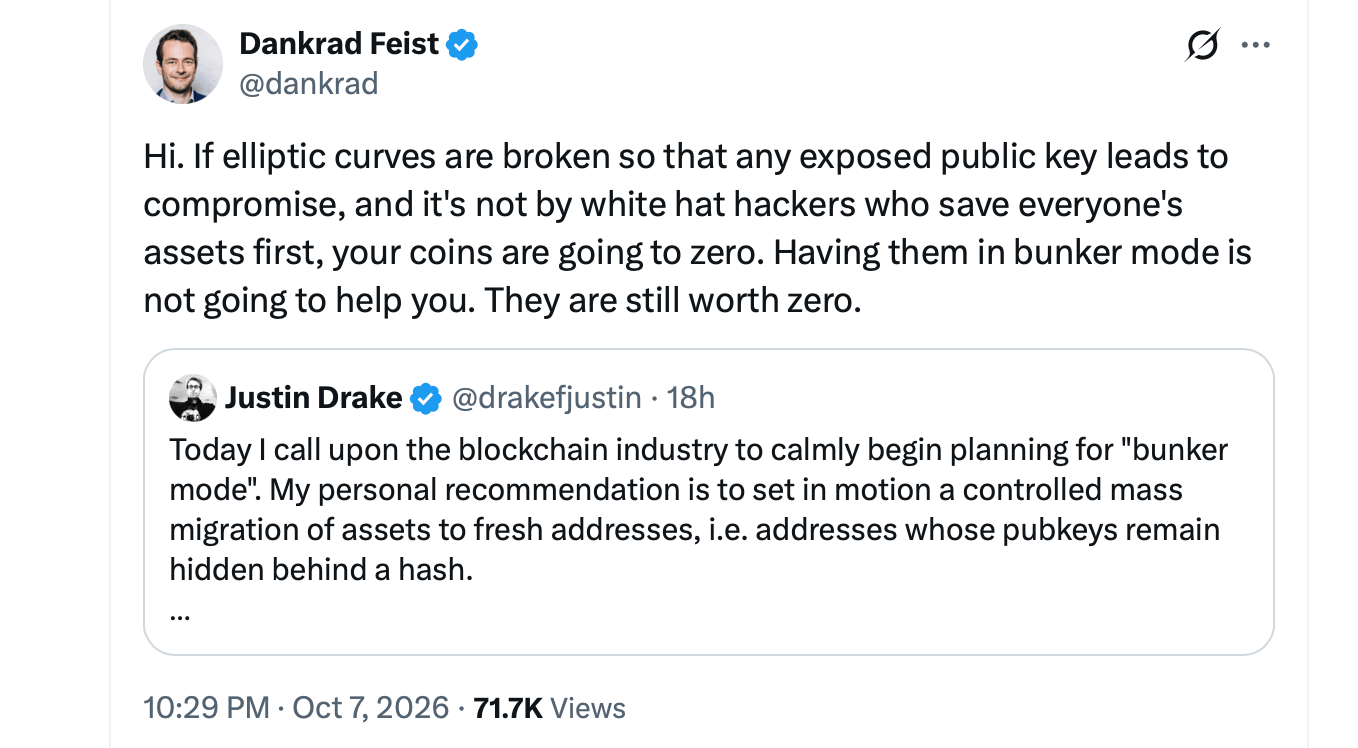
Drake pointed directly to OpenAI’s recent mathematical research, arguing that AI-assisted discoveries could arrive far faster than conventional expectations suggest. Still, advances in unrelated mathematical problems do not establish that ECDSA is vulnerable, and no practical classical attack of the kind he describes has been demonstrated.
“Yesterday’s OpenAI drop made it clear that mathematical superintelligence is upon us,” Drake wrote. “They say there are weeks where decades happen. We are about to live through weeks where centuries of mathematical progress happen. Could our magic 64-byte ECDSA signatures be too good to be true? Was it just security through obscurity all this time?”
The distinction matters because cryptocurrency security depends on mathematical problems remaining extraordinarily difficult to solve. Drake is asking whether increasingly capable AI systems might find shortcuts that generations of researchers missed, potentially putting digital assets and conventional financial infrastructure in a bind.
Crypto Giants Named as Industry Weighs Bunker Mode
Drake singled out Binance, Bitbank, Robinhood, Bitfinex, and the stablecoin issuer Tether as institutions that could strengthen their cold storage. He also pointed to Project Eleven’s tracker of exposed bitcoin public keys and referenced approximately 20,000 early addresses holding 50 BTC apiece, describing their potential attractiveness to attackers as “Satoshi’s shield.” That isn’t a guarantee of safety for smaller wallets.
Drake wrote:
“I urge large, sophisticated actors to lead by example. Project11’s “risq list” (bitcoin-risq-list.projecteleven[.]com) is a great tracker of exposed BTC pubkeys. Binance, Bitbank, Robinhood, Bitfinex, and Tether have an opportunity to harden their cold storage.”
The warning drew responses from several industry figures. Crucible General Partner Meltem Demirors questioned what Drake’s proposal would mean for institutional custody and everyday security devices. “Thank you for the measured PSA. What are the implications for multisig custodial solutions and hardware like ledgers, etc?” Demirors asked in response to Drake’s post.
Bitgo offered a considerably shorter response, suggesting the defensive approach wasn’t entirely new. “We’ve been offering ‘bunker mode’ since 2013. Great read,” the cryptocurrency custody company replied. Others were less comfortable with the discussion’s reception. One X user questioned whether the industry appreciated the potential seriousness of Drake’s warning.
“Wow…. The comments even give me more concern as no one is taking this serious,” one individual wrote on X.
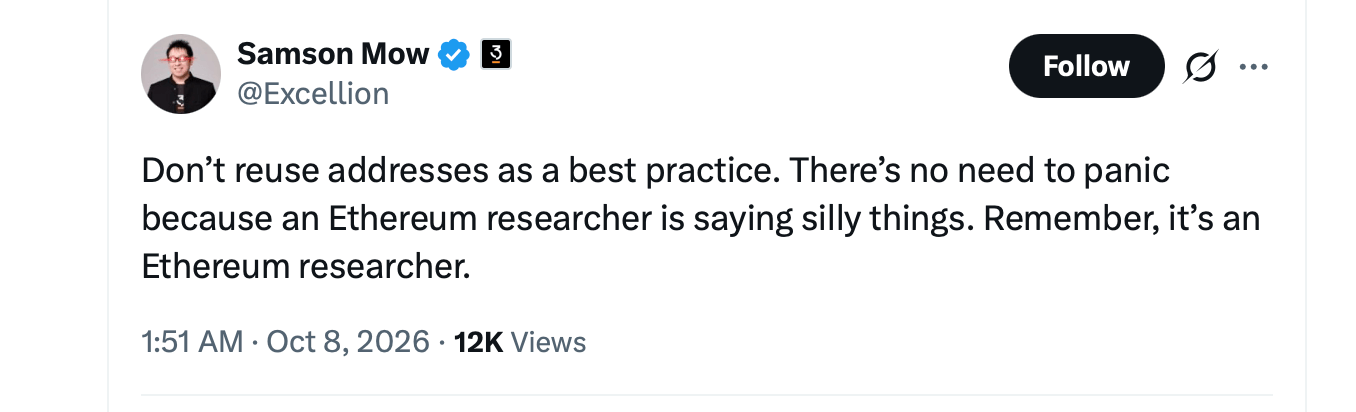
Dragonfly managing partner Haseeb Qureshi also weighed in, acknowledging the gloomy implications while arguing that precautionary measures were reasonable given recent mathematical advances.
“Doomerism has now hit cryptography,” Qureshi wrote on X. “Unfortunately, on reflection, I think this is a very sober call. No reason to be taking unnecessary risk with all of the rapid progress happening in mathematics. The risk is not quantum, but just conventional mathematics overturning unproven cryptographic hardness assumptions.”
Qureshi finished his assessment with another observation about the defensive posture cryptocurrency holders might adopt. “It’s UTXO-mode for a while,” he concluded, referring to transaction practices that can help limit public-key exposure in Bitcoin.
Ethereum’s Security Roadmap Faces a Faster Clock
Drake ultimately favors hash-based cryptography over systems dependent on mathematical structures such as elliptic curves. He wants Ethereum’s existing security roadmap accelerated, with formal verification and hash-based signatures taking greater priority. The proposed transition would involve technical trade-offs and considerable coordination across wallets, custodians, and blockchain infrastructure.
“The Ethereum roadmap on strawmap[.]org fully embraces hash-based cryptography with end-to-end formal verification as a response to the quantum threat,” Drake wrote. “Those timelines must now be revisited and accelerated in light of mathematical superintelligence. I’ll be pushing for maximum defensive acceleration.”
Coinbase Cryptography Chief Rips ‘Bunker Mode’ Warning as Buterin Urges Caution
For now, there is no demonstrated classical attack capable of recovering ECDSA private keys at the speed Drake fears. His “bunker mode” warning is about preparing for a mathematical breakthrough before one materializes, rather than responding to an existing compromise. The industry’s uncomfortable question is whether it can afford to wait for proof when that proof might arrive in the hands of an attacker first.
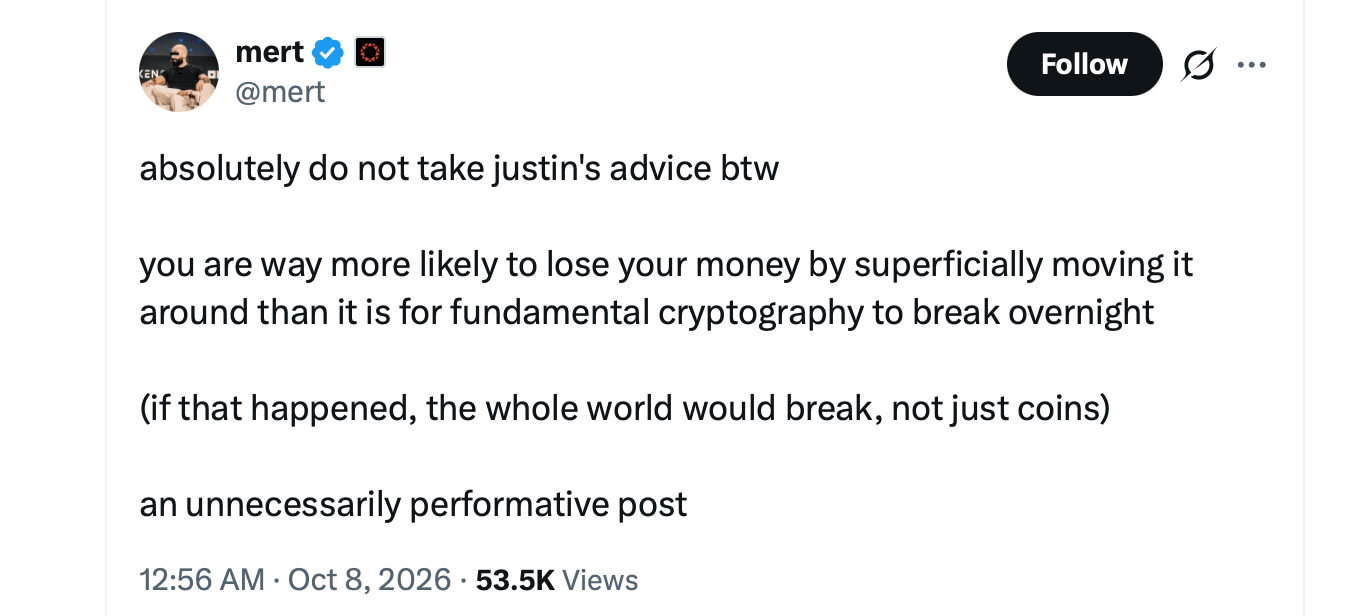
While Drake’s concerns could materialize in the distant future, advances in OpenAI-assisted mathematical discovery do not necessarily translate into vulnerabilities in established cryptographic systems. And not everyone is buying Drake’s warning.
Coinbase Head of Cryptography Yehuda Lindell pushed back sharply, arguing that advances in AI-assisted mathematics offer no evidence that longstanding cryptographic assumptions are about to collapse.
“To my understanding, there is no evidence whatsoever pointing to a break of decades old hardness assumptions like elliptic curve cryptography,” Lindell wrote on X. He went further, calling the warning irresponsible and accusing Drake of fostering “FUD,” or fear, uncertainty, and doubt:
“In conclusion, making such statements without any evidence is the opposite of responsible behavior. It is the very definition of FUD — it cannot be proven wrong but there’s also no evidence whatsoever of it being true.”
Ethereum co-founder Vitalik Buterin took a more measured position, acknowledging the potential risks while cautioning against hasty wallet migrations.
“I don’t recommend anyone scramble to move their funds to new wallets today,” Buterin wrote on X, although he agreed that AI-assisted mathematics deserves serious consideration. He favors hash-based cryptography where practical and believes AI could eventually expose weaknesses in other cryptographic systems, including lattice-based schemes.
Still, Buterin offered a particularly telling admission about the dangers of rushing into defensive measures. “Be careful about migrations; I personally have lost more money in botched migrations than I have lost in all hacks combined,” he remarked.








Be the first to comment