


Cardano price remains under pressure despite a 25.8% increase in the network’s stablecoin market capitalization to $68.3 million over the past 90 days, according to Cardanians (CRDN).
This growth points to an expansion in stablecoin activity across the network, even as ADA confronts fresh selling pressure and traders keep an eye on crucial support levels.
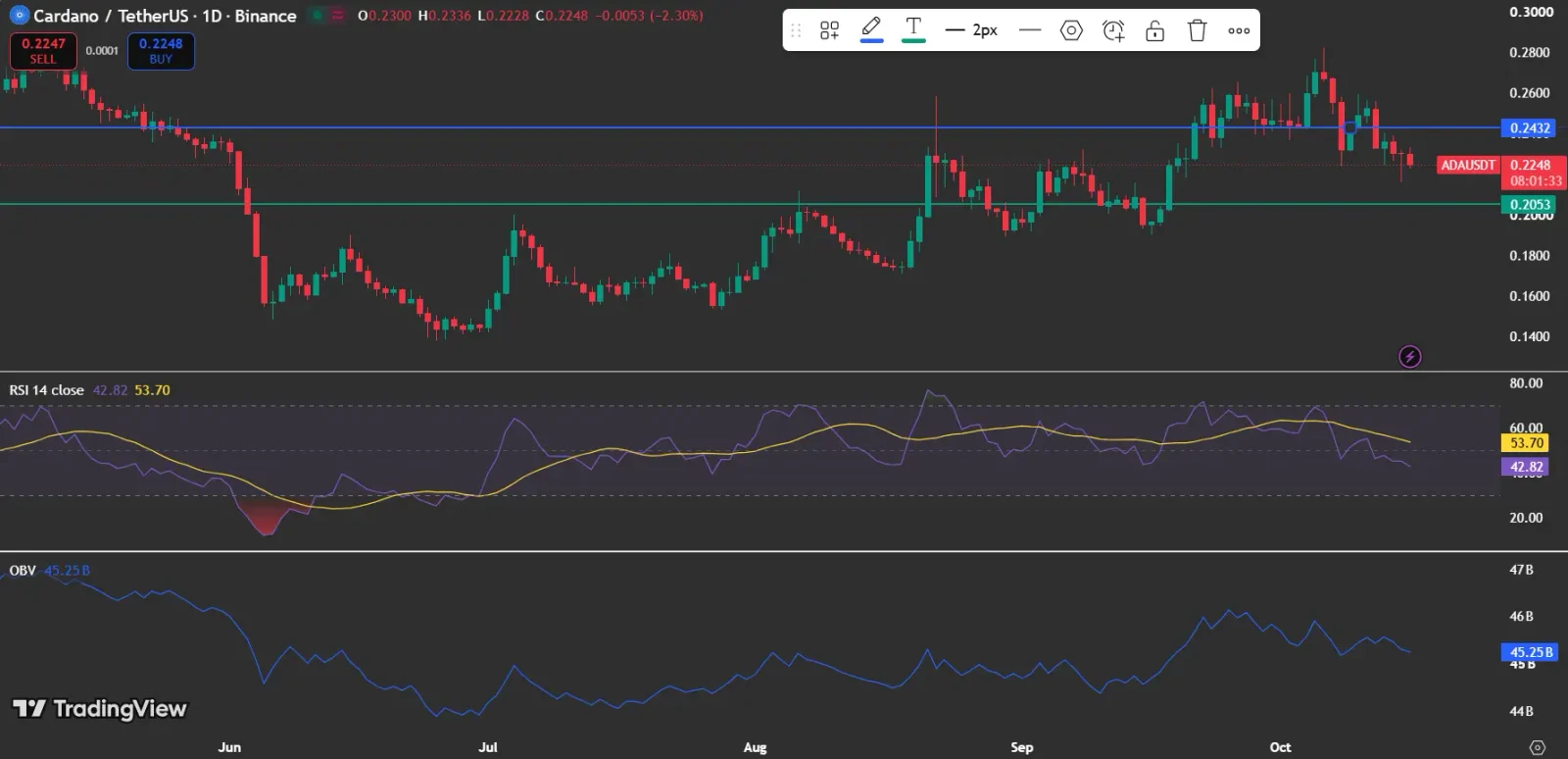
As of press time, Cardano (ADA) is changing hands at $0.2248, a 2.30% drop over the previous 24 hours, based on the supplied TradingView chart.
The drop in price stands in contrast to the growth in stablecoin capitalization, prompting questions about whether rising ecosystem activity can underpin an ADA recovery.

Also Read: Cardano Ecosystem Development Brings ADA Price Trend Into Focus
Why Is Cardano’s Stablecoin Market Cap Rising?
In a recent post on X, Cardanians pointed to the rise in Cardano’s stablecoin market capitalization, noting the total hit $68.3 million. USDC held the biggest share at $44.4 million, followed by USDM at $13.5 million and RealFi’s USDrf at $5.1 million.
Cardanians highlighted that Cardano’s stablecoin market capitalization had grown by 25.8% over 90 days. These numbers indicate that a growing amount of dollar-pegged assets is being held within Cardano’s ecosystem.
Stablecoins can facilitate trading, decentralized finance (DeFi) applications, and transfers without making users shift directly between cryptocurrencies and traditional currencies.
This expansion is a favorable sign for the network, though it does not necessarily mean demand for ADA will rise. Traders will need to determine whether the growth in stablecoin capitalization comes alongside stronger on-chain activity and increased usage of applications built on Cardano.
Also Read: ADA Price Falls Despite Cardano Active Addresses Surging After CIP-0113 Launch
What Does the Cardano Price Chart Indicate?
The daily TradingView chart reveals ADA pulling back after its early October climb toward $0.28. Since then, the price has dropped below the marked resistance level at $0.2432, shifting focus to whether buyers can reclaim that level.
The next significant support level lies around $0.2053. Holding above this zone might allow ADA space to consolidate, whereas a breakdown could leave the token vulnerable to additional downside pressure.
A move back above $0.2432 would put ADA closer to its recent trading range, but buyers would need to sustain that level to strengthen the recovery case. Until then, the price remains below the marked resistance, leaving the short-term outlook uncertain.
Also Read: Cardano Price: 3 Key Signals Offer Hope for a Stronger ADA Recovery
Could Cardano’s Price Bounce Back Even as the RSI Weakens?
ADA’s Relative Strength Index (RSI) sits at 42.82, which is lower than its moving average of 53.70. The RSI has likewise drifted downward with the recent price drop, implying that bullish momentum has lost strength.
The indicator is still positioned above the conventional oversold level of 30, meaning the chart has yet to signal an oversold condition. Even so, buyers might need to lift the RSI back above 50 to show that momentum is improving.
The On-Balance Volume (OBV) indicator, now near 45.25 billion, has likewise slid from its recent peaks. This decline is consistent with weakening buying pressure, although OBV alone cannot confirm whether a sustained recovery is approaching.
In What Ways Does Open Interest Shape the Cardano Price Outlook?
CoinGlass data indicates that ADA futures open interest has dropped from its early October peak of roughly $650 million to around the $500 million mark. This decrease suggests that overall open positions in ADA derivatives have declined as the price pulled back from its recent highs.
The liquidation chart also reveals activity among both long and short positions, showing that leveraged traders have come under pressure during price fluctuations.
Falling open interest alongside a declining price can indicate that speculative exposure is being reduced, but the metric alone cannot establish whether traders are exiting long or short positions.
This distinction matters because a decline in open interest does not automatically signal a bullish or bearish reversal. Traders may need to watch whether open interest stabilizes as ADA approaches support, alongside price action and changes in momentum.
Also Read: Cardano Expands RealFi Push as ADA Price Setup Gains Attention
How Does DeFi Activity Affect Cardano Price?
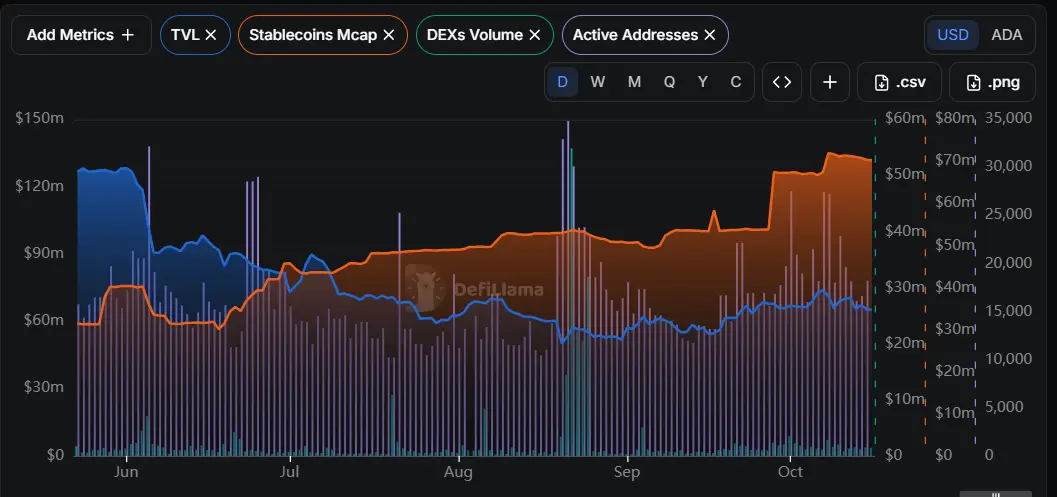
DeFiLlama reports that Cardano’s total value locked (TVL) was around $65.21 million as of October 16, with decentralized exchange (DEX) trading volume reaching $1.45 million over a 24-hour period.
These figures offer further insight into the network’s DeFi activity as its stablecoin market capitalization grows. Still, rising stablecoin capitalization alone does not confirm increased DeFi participation.
Changes in TVL and DEX trading volume remain useful indicators to monitor when assessing activity across Cardano’s DeFi ecosystem.
What Should Traders Keep an Eye On Next?
Cardano’s near-term prospects hinge on whether improving ecosystem indicators can align with a rebound in price momentum. A climb above $0.2432, backed by a rising RSI and stronger buying activity reflected in OBV, would provide a clearer sign of recovery.
On the other hand, a drop below $0.2053 could undermine the technical outlook even with the growth in stablecoin capitalization. Traders will also be monitoring whether open interest stabilizes and whether Cardano’s stablecoin growth persists.
The rise in stablecoin capitalization offers a constructive signal for Cardano’s ecosystem, yet the technical picture stays cautious.
The key question is whether the growth in stablecoin activity will be accompanied by stronger demand for Cardano-based applications while ADA attempts to regain resistance.
Cryptocurrency markets are still highly volatile, so traders should keep an eye on price action, market sentiment, and upcoming catalysts before making investment decisions.
Also Read: Cardano Price Rises 3% as a Nine-Year Milestone Fuels Optimism
This article contains market analysis and price predictions. These are not guarantees. Crypto markets are volatile. Always DYOR. Not financial advice.


Be the first to comment