

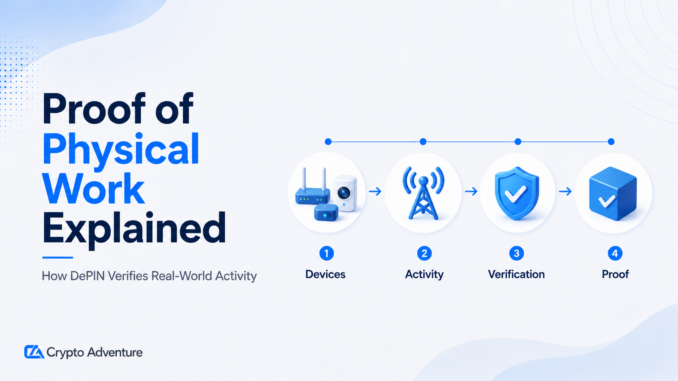

Proof of physical work is the verification layer that lets a DePIN network reward real-world activity instead of only digital transactions. In a DePIN network, contributors provide physical resources such as wireless coverage, storage, compute, mapping data, sensors, or energy assets. Proof of physical work is the set of rules that decides whether that contribution actually happened, whether it was useful, and whether it deserves rewards.
The phrase can sound broader than one formal consensus mechanism, and that distinction matters. It does not always mean one universal cryptographic proof like proof of work in Bitcoin or proof of stake in validator networks. It usually means a category of verification methods built around a specific physical service. Wireless networks verify coverage. Storage networks verify that data remains stored. Mapping networks verify route freshness and image quality. Compute networks try to verify hardware availability and job completion.

That makes proof of physical work one of the most important pieces of DePIN design. Token rewards can bring contributors into a network, but verification decides whether those rewards create useful infrastructure or subsidize empty activity.
Why Real-World Verification Is Hard
Blockchains are good at verifying digital state. They can confirm balances, signatures, smart contract calls, and token transfers. Real-world activity is harder because the network must reason about things that happen outside the chain. A hotspot may claim to provide coverage in a specific location. A driver may claim to have mapped a route. A storage provider may claim to hold data. A GPU provider may claim to run a job on specific hardware.
The system needs evidence, not trust. That evidence can come from cryptographic proofs, hardware signatures, location checks, peer observations, user payments, data quality scoring, device telemetry, staking, slashing, audits, oracles, or demand-side feedback. Strong DePIN networks often combine several methods because no single proof can capture every real-world condition.
The goal is not perfect knowledge. The goal is economically reliable verification. If it costs more to cheat than to contribute honestly, and if rewards flow toward useful service over time, the network can become credible enough for users and operators.
Wireless Coverage: Helium And Proof Of Coverage
Wireless is the easiest place to understand the idea. Helium coordinates decentralized wireless infrastructure across IoT and mobile networks. Hotspot operators deploy hardware, but the network still needs to verify that coverage exists and that the hardware contributes something useful.
Helium’s proof-of-coverage model is designed to validate wireless coverage rather than simply reward device ownership. That is a critical difference. A hotspot sitting in a weak location, a spoofed location, or an oversupplied area should not receive the same economic treatment as a device that improves coverage where the network needs it.
The payment side also matters. Data Credits are used for Helium network usage, while HNT sits at the center of the broader burn-and-mint economy. That structure helps separate customer usage from raw token speculation. Rewards become more credible when they are connected to real data transfer and network demand, not only to hardware deployment.
Mapping: Hivemapper And Useful Data
Mapping networks face a different verification problem. They are not proving radio coverage. They are proving that contributors captured useful, fresh, location-specific map data. Hivemapper uses contributor rewards to build and refresh a decentralized map, but the value depends on the quality and usefulness of the submitted imagery.
A map does not improve just because more files are uploaded. It improves when imagery covers roads that matter, refreshes stale areas, and meets quality requirements. Hivemapper’s reward logic includes contribution quality, freshness, and data consumption. The HONEY reward model also connects data usage to Map Credits, which are created by burning HONEY.
This creates a cleaner proof-of-physical-work loop. Contributors earn for improving the map, while customers consume map data when it has value. The stronger that demand loop becomes, the less the network depends on rewards that only attract supply.
Storage: Filecoin And Cryptographic Proofs
Storage is one of the clearest cases where cryptographic proofs matter. Filecoin uses Proof of Replication and Proof of Spacetime to verify storage commitments. Proof of Replication checks that a storage provider created and stored a unique copy of data. Proof of Spacetime checks that the provider continues storing that data over time.
This is proof of physical work in a stricter technical sense because the network needs to know that disk space is being used for a real storage service. A provider cannot simply claim capacity and collect rewards indefinitely. The system requires recurring proof that storage remains available.
Filecoin also uses collateral and penalties to add economic discipline. That matters because storage buyers need reliability, not only cheap capacity. If proofs are missed or data is lost, the provider can face consequences. The incentive model is therefore both positive and negative: rewards for correct service, penalties for failure.
Compute: The Harder Verification Frontier
Compute is more difficult to verify because workloads vary widely. A storage proof can focus on whether a piece of data remains available. A compute network may need to verify that a GPU exists, that it has the claimed performance, that a job completed correctly, that data was handled safely, and that the result was not manipulated.
Networks such as Render and Akash approach decentralized compute from different angles. Render focuses on GPU rendering and compute supply, while Akash offers a decentralized cloud marketplace where providers compete to supply resources. In both cases, useful verification has to include provider performance, workload completion, pricing, uptime, and user experience.
Compute verification may use benchmarking, reputation, redundancy, job validation, provider staking, signed results, or specialized proof systems. The hardest AI workloads may require stronger assurance than simple container hosting or rendering jobs. That is why decentralized GPU networks need to be judged by execution quality, not only by available hardware counts.
Anti-Gaming Is Part Of The Product
Proof of physical work exists because open infrastructure networks are easy to game if rewards are poorly designed. Operators can cluster hardware in the wrong places, spoof location, upload low-quality data, overstate capacity, chase emissions, or route fake demand through the system. The reward program becomes the target if the network pays for activity that is easier to fake than useful service.
Good DePIN design pushes rewards toward scarcity and demand. Missing coverage should be worth more than redundant coverage. Fresh data should be worth more than stale data. Reliable storage should be worth more than claimed capacity. Completed compute should be worth more than idle hardware. Customer-paid usage should matter more over time than pure emissions.
That is why DePIN analysis needs the same depth as tokenomics research. Rewards are only meaningful when the network can define and verify valuable work.
What To Check Before Trusting A DePIN Proof Model
A credible proof model should answer several questions clearly. What is being verified? Who verifies it? How often does verification happen? Can contributors fake the signal? Are rewards tied to useful demand or only to supply growth? Are there penalties for failure? Can governance change reward rules if gaming appears?
The strongest DePIN networks make the proof path visible enough for users and operators to evaluate. The weakest ones hide behind vague reward language, broad hardware counts, or maps that do not prove real customer value. Due diligence should focus on measurement quality, demand, concentration risk, governance control, and whether the network would still attract useful contributors if token rewards fell.
Conclusion
Proof of physical work is the mechanism that turns DePIN from a token incentive idea into a real infrastructure model. It gives a network a way to verify wireless coverage, storage, mapping, compute, and other physical services before rewards are distributed.
The quality of that verification decides whether the network creates durable value. Strong proof systems reward scarce, useful, measurable work. Weak systems pay for activity that looks impressive but does not produce service customers want. DePIN can only scale beyond speculation when proof of physical work makes real-world contribution hard to fake and economically worth maintaining.



Be the first to comment