



Two new decisions have been taken around World Liberty Financial, and both bear on how many tokens can reach the market in the coming months. The stake held by US President Donald Trump is contractually locked until May 2028. And from October 1, holders are to receive rewards if they lock their WLFI for 180 days and vote regularly. The price has barely reacted so far: according to CoinGecko data, WLFI stands at $0.0584 on Saturday evening, September 19, 2026, equivalent to around 0.051 euros, almost unchanged from the previous day.
What is documented in this article: the price data, the terms of the lock-up contract and the proposal for the rewards programme. Where the discussion turns to price movement, it is an assessment by the editorial team, and we mark it as such.
World Liberty Financial price: the numbers at a glance
Over one week WLFI is up 2.3 percent, over 30 days it is down 4 percent. The all-time low of $0.0483 dates only from September 11, 2026, and the current price sits around 21 percent above it. From the all-time high of $0.331 in September 2025, WLFI is a good 82 percent away. Market capitalisation stands at around $1.9 billion, placing the token in 54th place. In 24 hours, WLFI worth roughly $30 million changed hands.
Trump’s WLFI stake: locked until May 2028
The project’s founders were able to move their previously indefinitely locked tokens into a new plan: two years of full lock-up, followed by release in instalments over three years. Anyone taking part has to burn ten percent of their tokens, destroying them permanently. According to an analysis by CoinDesk, the largest wallet contributed 15.75 billion WLFI to the lock-up contract and kept 14.175 billion after the burn. That matches the stake Trump has disclosed, worth around $830 million at the current price. The first of these tokens become freely sellable in May 2028 at the earliest.
Lock-up contract: almost half of all WLFI is tied up
In total, according to CoinDesk, the lock-up contract holds 46.1 billion WLFI, almost half of the entire supply of 96.7 billion tokens. That makes the contract by far the largest single holder. The original cap stood at 100 billion tokens. For the price this means a large share of the possible selling pressure from the founder circle is contractually ruled out for the next eighteen months.
Rewards for voting: what is meant to apply from October 1
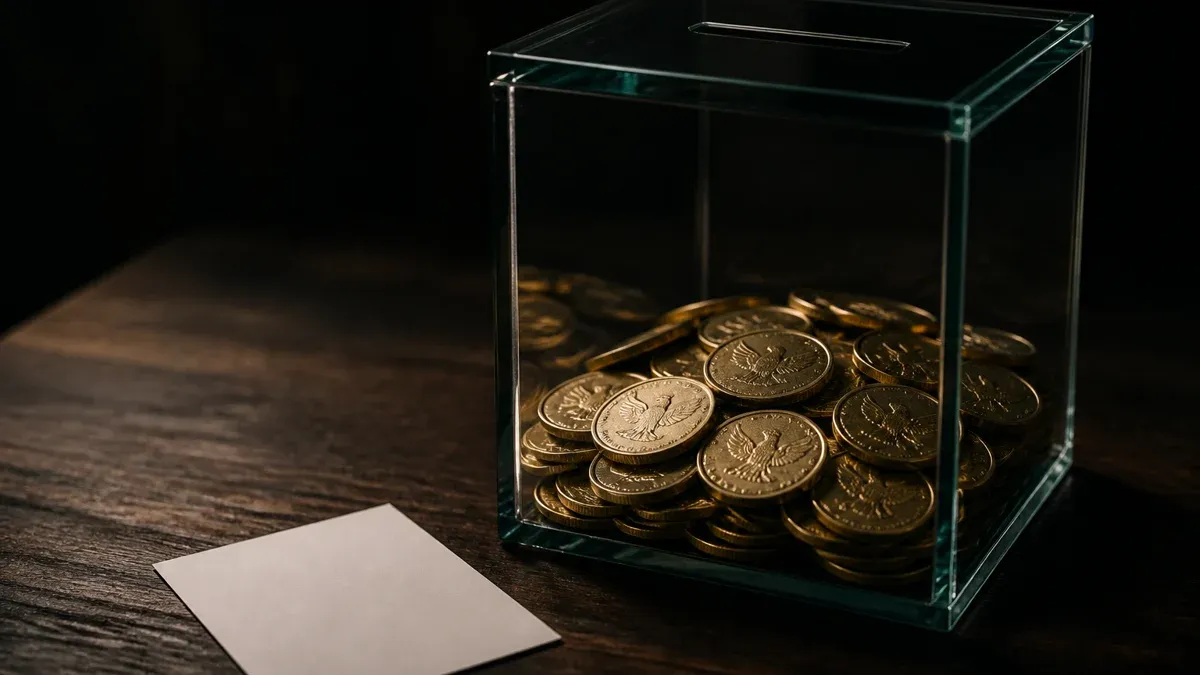
The second topic is a proposal the community is still voting on. According to The Crypto Times, the programme is set to launch on October 1, 2026 if it is adopted. Anyone wanting to take part locks freely available WLFI for at least 180 days in a protocol directly on the blockchain, without handing them to a custodian. On top of that, for every 90 days of the lock-up they have to vote on a proposal themselves at least once. A vote delegated to someone else does not count.
The rewards carry no fixed rate. They come from a pool that World Liberty Financial fills, among other sources, from fees of the World Liberty Markets trading platform and tops up every two weeks. How much an individual receives depends on the size of the pool, how many tokens are locked in total, and whether they met the voting requirement. No participant is meant to reach more than five percent of voting rights through the programme.
Locking World Liberty Financial: plan for the 180 days
For investors, the lock-up is the key point. Anyone taking part cannot touch their tokens for half a year, whatever the price does. Trading a reward whose size nobody knows in advance against six months without the option to sell pays off mainly for investors who intend to hold WLFI long term anyway. Participants should also keep an eye on the voting dates, because without casting their own vote every 90 days they risk their claim to the reward.
WLFI and taxes: what applies to rewards and sales
In Germany, rewards for locked tokens are generally treated like staking rewards, that is, as income from other services under Section 22 No. 3 of the Income Tax Act. They count at their market value on the day they arrive, and they remain tax-free up to an exemption threshold of 256 euros per year. Whether the programme falls into that category in an individual case is best settled with a tax adviser.
For a sale of the tokens themselves, the usual one-year holding period applies. Since the German Federal Ministry of Finance published its guidance on the taxation of crypto assets, it has been settled for staking that a lock-up does not extend the period to ten years. The same is likely to hold for a lock-up with a voting requirement. Each reward starts its own one-year clock on the day it arrives.

Is World Liberty Financial a good buy now?
What argues for an entry is that supply is getting tighter. The largest single holder cannot sell until May 2028, ten percent of the contributed founder tokens have been destroyed, and if the rewards programme is adopted, further tokens disappear from the market for half a year. What argues against it is that WLFI trades only a good fifth above its all-time low and the downtrend since launch remains unbroken.
On top of that comes a political risk that goes beyond the normal crypto market: the price also hangs on how Washington handles the crypto holdings of the presidential family. A revised version of the CLARITY Act provided that senior office holders must divest larger crypto holdings or place them in a blind trust. The bill failed in the Senate on September 15, as we described in our article on the failure of the CLARITY Act. The issue is likely to return, though.
Our assessment: the lock-up takes selling pressure out of the next eighteen months, but it changes nothing about the fact that the market has so far placed little trust in WLFI. The chart analysis with moving averages and trading volume is in our buy assessment of World Liberty Financial from September 16.
Buying World Liberty Financial: what to check before you enter
Three checks are worth doing before a purchase. One, the provider: platforms serving customers in the EU have needed authorisation as a crypto asset service provider under the MiCA regulation since the transition period ended in late 2025. Two, the order size: with a token turning over roughly $30 million a day, you are better off spreading your entry across several purchases. Three, custody: anyone wanting to join the rewards programme needs the tokens in a wallet they control themselves, because the lock-up runs directly on the blockchain.
Our overview of the best crypto exchanges shows which ones combine low fees with EU authorisation. Check whether WLFI is tradable there before you sign up.
World Liberty Financial and Trump: your takeaways
- Expect less selling pressure until 2028, but no price target. The lock-up concerns the largest holder; it says nothing about demand. The buy assessment with chart analysis is in our WLFI check.
- Lock only what you can do without for half a year. The rewards programme requires a 180-day lock-up and regular votes of your own, and the reward is not fixed in advance.
- Document every reward. Each payment counts at its value on the day and starts its own holding period. A crypto tax tool records this automatically.
(As of September 19, 2026, 22:00. This article is not investment advice. Prices and programme terms change; check the terms with the provider before you buy.)



Be the first to comment